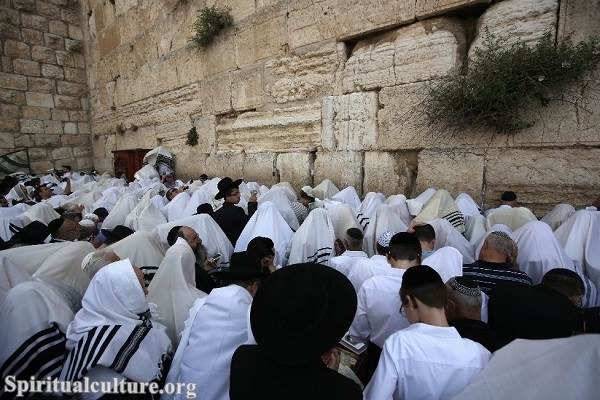
Rosh Hashanah and Yom Kippur are the Jewish High Holy Days. In a synagogue, the first emphasizes the new year, remembrance, and moral reflection; the second focuses on repentance, confession, and atonement. Both involve special prayers, but they do not look or feel like the same service.
What happens at Rosh Hashanah services?
Many congregations gather for extended prayers from a special High Holiday prayer book called a mahzor. The liturgy speaks about God’s sovereignty, remembrance, judgment, and mercy. Torah readings and additional prayers give the day a character different from an ordinary Sabbath.
One of the best-known practices is hearing the shofar, a ram’s horn sounded as a call to attention and spiritual awakening. Customs differ, and traditional communities do not sound it when Rosh Hashanah falls on Shabbat. In other communities, practices can vary. The sound is not a performance; it is part of a religious invitation to examine one’s life.
Outside synagogue, people may share festive meals, offer new-year greetings, and eat apples with honey as a hope for a sweet year. Tashlich, a symbolic ceremony near water, is another custom in many communities, though it is not the central synagogue service.
Services typically include the Amidah and readings from the Torah, with High Holiday passages about divine kingship, remembrance, and the sounding of the shofar. Some communities add extended liturgical poems; others use more Hebrew translation or spoken readings. The length of the service depends heavily on the congregation.
Hearing the shofar is a central observance, but the familiar exception matters: in traditional Jewish law it is not sounded during Rosh Hashanah services when the holiday falls on Shabbat. A visitor should therefore not assume that every service includes the horn.
What happens at Yom Kippur services?
Yom Kippur begins in the evening with services associated with Kol Nidrei, a traditional declaration concerning vows. Through the day, worship includes repeated confession, prayers for forgiveness, and readings that emphasize responsibility for one’s actions. In many communities, adults who are able to do so fast; exemptions and pastoral considerations matter for health and safety.
The liturgy speaks of wrongdoing in the first-person plural, reminding worshippers that repentance has a communal dimension. It is not only about private guilt, but also about repairing relationships and making amends. Asking God’s forgiveness does not replace the need to address harm done to another person.
The final service, Ne’ilah, brings the day to a close with urgent prayers. In many communities a long shofar blast sounds as the service ends around nightfall; the fast is broken afterward.
Kol Nidrei is often misunderstood as a way to escape ordinary promises. Its liturgical formula concerns vows in a defined religious context; it does not erase obligations owed to other people. Jewish teaching insists that wrongs done to another person require seeking that person’s forgiveness. This gives the evening’s solemn words a very different meaning from the common misconception.
Across Yom Kippur, many communities observe five prayer services: Maariv in the evening, then Shacharit, Musaf, Mincha, and the closing Ne’ilah. A remembrance service called Yizkor is included in many congregations. Customs vary, including the exact sequence and whether particular prayers are translated or sung.
Ne’ilah is associated with the closing of the day of repentance. A final shofar blast is sounded near the end of the closing service in many communities; the fast ends at nightfall according to local observance. The blast should not be described as if it happens at a fixed clock time in every synagogue.
Will every synagogue follow the same order?
No. Orthodox, Conservative, Reform, Reconstructionist, and other Jewish congregations may differ in the length of services, language, music, gender participation, and interpretation of customs. Sephardi and Ashkenazi communities also preserve different liturgical melodies and traditions. The recurring themes of repentance and renewal are widely shared, but worship cannot be reduced to one universal script.
What if someone is attending for the first time?
High Holiday services can be crowded and require advance arrangements. Visitors should contact the synagogue first, ask about security and seating, and follow local expectations for dress and participation. Listening respectfully is enough; a visitor does not need to pretend to know every prayer.
Read more about Rosh Hashanah and the synagogue’s role in Jewish community life.
The mahzor is not an ordinary weekly prayer book. It contains the special High Holiday liturgy and may have facing-page translations. No visitor is expected to know every melody. Ask a host what to follow, and allow worshippers space for private prayer; in many congregations people stand, sit, and bow at different points.
Non-Jewish guests should never assume attendance is automatically available. Advance contact, security arrangements, seating policies, and guidance about photography or electronic devices are practical matters, not simply etiquette.