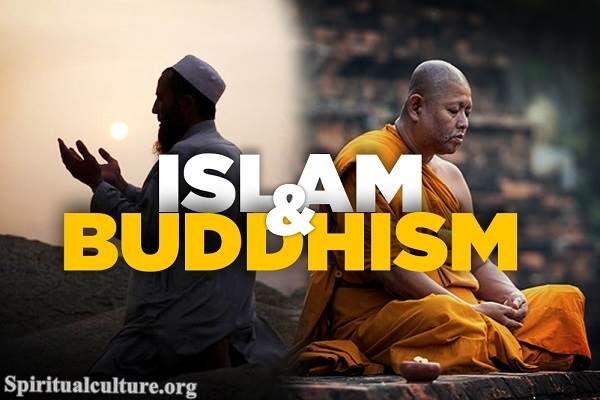
Buddhism and Islam are distinct religious traditions with different understandings of ultimate reality, revelation, human destiny, and religious authority. They can share ethical themes such as generosity, self-discipline, compassion, and concern for moral conduct, but those similarities do not make the religions the same.
God and ultimate reality
Islam is strictly monotheistic. Muslims worship Allah, the one Creator, and reject partners or equals to God. The Qur’an is understood as revelation given to the Prophet Muhammad.
Buddhism does not center on a creator God. Buddhist teachings focus on suffering, impermanence, karma, rebirth, dependent arising, and liberation. Buddhist cosmologies may include gods or heavenly beings, but such beings are not creators or ultimate saviors.
Founders and sacred authority
Muslims understand Muhammad as the final prophet in a line that includes figures such as Abraham, Moses, and Jesus. The Qur’an holds the highest scriptural authority, alongside the prophetic Sunnah in Islamic law and practice.
Buddhists look to Siddhartha Gautama, the historical Buddha, as an awakened teacher rather than a prophet of a creator God. Different Buddhist canons preserve teachings in Pāli, Chinese, Tibetan, Sanskrit, and other languages.
Salvation and liberation
Islam teaches resurrection, judgment, accountability before God, paradise, and hell. Faith, worship, repentance, divine mercy, and righteous action all belong to Islamic religious life.
Buddhism seeks liberation from the cycle of suffering and rebirth. Nirvāṇa is not simply a Buddhist version of heaven; it concerns ending greed, hatred, delusion, and the conditions sustaining saṃsāra.
Ethical similarities
Both traditions value generosity, disciplined conduct, community, and control of harmful desires. Both have forms of fasting, almsgiving, pilgrimage, recitation, and contemplative practice, though their meanings differ.
Similar practices should not be treated as evidence that the underlying theology is the same.
Bottom line
Muslims and Buddhists are not members of the same religion. Respectful comparison acknowledges shared ethical concerns without erasing major theological differences.