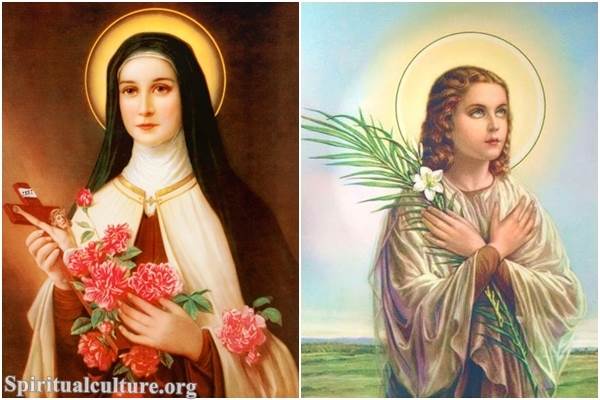
Saint Philomena became the focus of a widespread Catholic devotion in the nineteenth century after remains were discovered in the Catacombs of Priscilla in Rome in 1802. Her cult attracted notable devotees, including the Curé of Ars, but the historical evidence for the detailed biography later associated with Philomena is uncertain.
For that reason, It helps to distinguish three things: the archaeological discovery, the later devotional tradition, and what can be established historically.
The discovery in the Catacombs of Priscilla
In 1802, a tomb was opened in the Catacombs of Priscilla. Tiles associated with the burial carried an inscription that was reconstructed as a form of “Peace be with you, Philomena,” together with symbols that were interpreted devotionally as signs of virginity and martyrdom.
The remains were later transferred to Mugnano del Cardinale near Naples. Devotion grew quickly, especially after reports of favors and healings attributed by believers to Philomena’s intercession.
Where did the familiar life story come from?
The popular narrative describes Philomena as a young Christian princess who refused the marriage proposal of Emperor Diocletian, suffered repeated torture, and was finally martyred. This story became enormously influential in devotional literature.
However, the detailed biography is not derived from contemporary third- or fourth-century historical records. It was associated with reported private revelations received in the nineteenth century, particularly those connected with Sister Maria Luisa di Gesù. Vatican News notes that later historians questioned the historical basis of this narrative.
Accordingly, statements such as “Philomena was a Greek princess” or “Diocletian personally ordered these specific tortures” should be presented as elements of later devotional tradition, not as established historical facts.
Was Philomena formally canonized in 1837?
Another common claim is that Pope Gregory XVI formally canonized Philomena in 1837. That is an oversimplification. Gregory XVI authorized public devotion and liturgical honors connected with Philomena, helping her cult spread, but the nineteenth-century process did not amount to a modern formal canonization establishing a historically documented biography.
The distinction matters because devotion can receive ecclesiastical authorization even when historians have limited evidence about the person’s life.
Why did historical doubts arise?
Archaeologists and historians raised questions about whether the inscribed tiles were originally associated with the remains found behind them and whether symbols on the tomb had been interpreted too confidently as instruments of martyrdom. Vatican News also notes doubts about the small vessel once thought to contain a martyr’s blood.
These issues do not prove that no early Christian woman named Philomena ever existed. They do mean that the elaborate later biography cannot be treated as secure ancient history.
The 1961 calendar decision
In 1961, the Holy See ordered the feast of Saint Philomena to be removed from liturgical calendars. The decision reflected the lack of reliable historical evidence supporting the traditional account.
Removal from the calendar did not erase the history of devotion. Shrines and private devotion connected with Philomena have continued, and she remains meaningful to many Catholics. The responsible way to describe this today is to acknowledge both the devotion and the historical uncertainty.
Philomena and the Curé of Ars
Saint John Vianney, the Curé of Ars, was among the best-known promoters of devotion to Philomena. His influence helped make her cult widely known in France and beyond. The Sanctuary of Ars continues to document this devotional connection while also acknowledging the historical limits of the evidence.
How should Saint Philomena be described?
A balanced description avoids two extremes. It should not present every element of the nineteenth-century narrative as verified ancient history, but it also should not pretend that the devotion had no recognized place in Catholic life.
Historically, the strongest points are the discovery of the tomb in 1802, the rapid growth of devotion, papal authorization of aspects of the cult in the nineteenth century, later archaeological doubts, and the 1961 removal of the feast from liturgical calendars. Claims about her royal birth, encounter with Diocletian, and exact tortures belong to devotional tradition rather than securely documented biography.