The historical Buddha was not buried in a single grave in the modern sense. Buddhist tradition says that after his death, or parinirvana, at Kushinagar in northern India, his body was cremated. The remaining relics were then divided among several communities, which enshrined them in stupas.
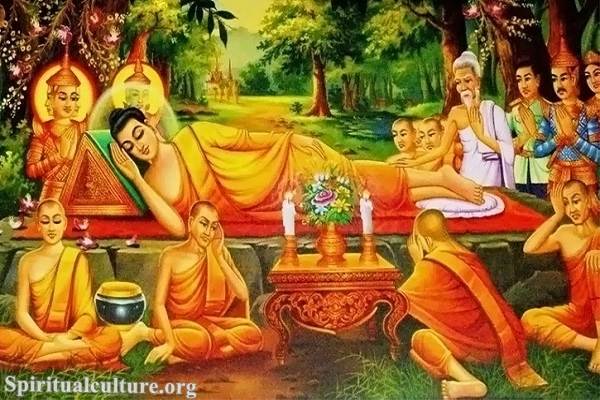
The Buddha’s death at Kushinagar
Early Buddhist tradition places the Buddha’s final days at Kusinārā, usually identified with modern Kushinagar in Uttar Pradesh, India. The narrative describes his final teachings, his death, mourning by followers, and preparations for funeral rites.
Because the sources are religious texts transmitted over generations, historians distinguish between the traditional narrative and what can be independently established. Kushinagar nevertheless became one of the major Buddhist pilgrimage places associated with the Buddha’s life.
Was the Buddha buried?
According to the traditional account, no. His body was cremated rather than interred intact. Cremation was followed by the collection of bodily relics. This is why the question ‘Where was the Buddha buried?’ is better answered by explaining the cremation and relic tradition than by naming a single tomb.
Relics in Buddhist cultures may include physical remains attributed to the Buddha or revered teachers, as well as objects associated with them. Their significance is devotional and commemorative rather than simply funerary.
How the relics were distributed
The traditional account says that several rulers and communities requested a share of the Buddha’s relics. The relics were divided and placed in memorial mounds or stupas. Later Buddhist traditions tell of relics being redistributed more widely, especially during the reign traditionally associated with Emperor Ashoka.
Whether every later relic claim can be historically verified is a separate question. What is clear is that relic veneration and stupa building became major features of Buddhist culture across South, Central, Southeast, and East Asia.
What is a stupa?
A stupa is a Buddhist reliquary monument. Early stupas were mound-like structures, while later forms developed into elaborate monuments with regional architectural styles. Buddhists may walk clockwise around a stupa, make offerings, chant, meditate, or reflect on the Buddha and the path to awakening.
Stupas therefore function as more than graves. They are places of memory, devotion, pilgrimage, and teaching.
Where can pilgrims remember the Buddha today?
Kushinagar is associated with the Buddha’s parinirvana and remains a major pilgrimage destination. Other principal sites traditionally connected with his life include Lumbini, Bodh Gaya, and Sarnath.
To learn more about the historical teacher and the tradition that developed around him, see Buddha and Buddhism.

