Hinduism does not have an official “Top 10 gods” ranking. Different Hindu traditions understand the divine through different theological frameworks, and a deity central to one community may have a different role in another. Some Hindus focus devotion on Vishnu or one of his forms, others on Shiva, Devi, Ganesha, or other sacred forms.
Spiritual Culture therefore presents 10 major Hindu deities and sacred forms as an educational guide, not a hierarchy of spiritual importance.
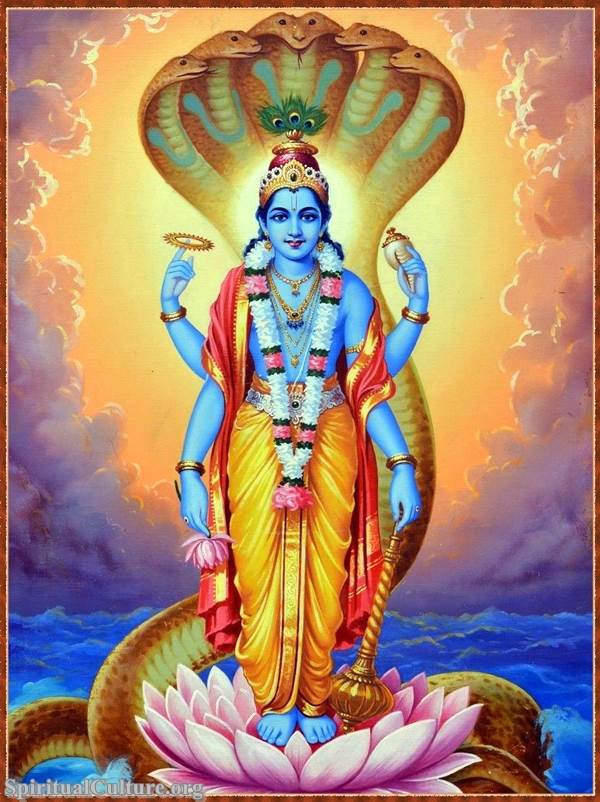
1. Vishnu
Vishnu is central to Vaishnava traditions and is widely understood as the preserver or sustainer of cosmic order. His iconography often includes the discus, conch, mace, and lotus. Vaishnava traditions understand forms such as Rama and Krishna as manifestations or avatars of Vishnu, although theology differs among schools.
2. Shiva
Shiva is the supreme deity in Shaiva traditions and appears in many forms: ascetic, householder, dancer, teacher, and lord associated with transformation. The linga is one of his most important sacred forms, while anthropomorphic images often include the third eye, trident, crescent moon, and matted hair.
3. Devi or Shakti
Devi means “Goddess,” while Shakti can refer to divine power or energy. Shakta traditions understand the Goddess as supreme, appearing in many forms including Durga, Kali, Parvati, Lakshmi, and Saraswati.
4. Ganesha
Ganesha, recognized by his elephant head, is widely honored at the beginning of undertakings and is associated with wisdom, learning, prosperity, and the overcoming of obstacles. His worship crosses many sectarian boundaries.
5. Krishna
Krishna is one of the most beloved figures in Hindu devotion. In many Vaishnava traditions he is understood as an avatar of Vishnu; in others he is worshiped as the supreme form of God. The Bhagavad Gita, Bhagavata Purana, and devotional traditions centered on Krishna have shaped Hindu thought, music, poetry, dance, and pilgrimage.
6. Rama
Rama is the hero of the Ramayana and an important focus of Vaishnava devotion. He is associated with kingship, duty, righteousness, fidelity, and moral order. Rama devotion has deeply influenced religious life across South and Southeast Asia.
7. Lakshmi
Lakshmi is associated with prosperity, abundance, auspiciousness, and well-being and is closely connected with Vishnu in many traditions. Her worship is especially visible during Diwali and in household devotional practice.
8. Saraswati
Saraswati is associated with knowledge, learning, music, speech, and the arts. Students, teachers, musicians, and artists may honor her, and she is especially important in festivals such as Vasant Panchami in some regions.
9. Hanuman
Hanuman is renowned for devotion, courage, strength, and service to Rama. His role in the Ramayana has made him a powerful model of bhakti, disciplined devotion, and selfless service.
10. Brahma
Brahma is traditionally associated with creation and appears in many Hindu cosmological and iconographic systems. Yet he has far fewer major temples and active devotional traditions than Vishnu or Shiva. His inclusion here reflects theological and artistic importance, not a claim that he is among the most widely worshiped deities today.
Why a ranking is the wrong framework
Hindu traditions often allow multiple ways of relating to the divine. A worshiper’s chosen deity, or ishta-devata, can be understood as a deeply personal focus of devotion without denying other sacred forms. Vaishnava, Shaiva, Shakta, and Smarta traditions also organize divine relationships differently.
For that reason, “major deities” is more accurate and respectful than “Top 10 gods.”



Hi,
I like Hanuman : the only one who seems to take care of his health. I will pray him next year to see if I will gain muscle mass and lose fat.
I also like “gandharvas” as I do hiking. They are the guardians of forests, mountains and the air.
Nice article !
Anthony