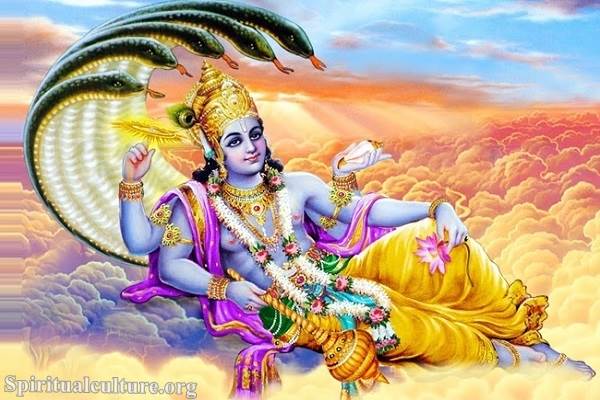
Vishnu is often portrayed with blue or dark-blue skin as a sacred artistic convention, not as a claim about ordinary human pigmentation. Explanations vary across texts, regions, teachers, and modern devotional interpretation; blue may evoke vastness, cosmic presence, depth, or divinity, while Sanskrit descriptions can also use terms meaning dark, black, or cloud-colored.
Viṣṇu is often depicted with blue or dark-blue skin in Hindu art. The color is symbolic rather than a historical claim about ordinary human skin tone. Hindu texts, artistic conventions, and devotional traditions connect dark or blue coloring with vastness, divinity, and cosmic presence.
Color as sacred symbolism
Blue evokes the sky and deep water—vast realities that surround life but cannot be easily bounded. Modern explanations often use this symbolism to describe Viṣṇu’s all-pervading or cosmic nature.
Artistic meaning varies, and not every image uses exactly the same shade.
Dark color in Sanskrit tradition
Sanskrit religious language can use words for dark, black, blue-black, or cloud-like coloring. Translating those terms into a single modern color category can oversimplify the original imagery.
Artists over centuries developed recognizable visual conventions that help viewers identify a deity.
Viṣṇu and his avatars
Kṛṣṇa, a major avatar of Viṣṇu in many traditions, is also frequently represented as dark or blue. Rāma may likewise appear blue in devotional art.
The shared color can visually connect these figures within Vaiṣṇava devotion.
Iconography does more than depict appearance
Hindu sacred art uses color, posture, weapons, ornaments, vehicles, and hand gestures to communicate theology. Viṣṇu’s conch, discus, mace, lotus, crown, and blue body work together as a symbolic language.
Understanding an image therefore requires more than reading color as literal physical description.
Blue, black, and dark color in sacred art
English descriptions can create false precision because Sanskrit terms, regional painting traditions, pigments, and modern reproductions do not always distinguish “blue” and “dark” in the same way. Vishnu may appear deep blue, blue-black, or very dark in different works. The theological point is usually more important than matching a modern color chart.
Artists also work within established iconographic conventions. A recognizable body color helps worshipers identify a deity together with attributes such as the conch, discus, mace, lotus, crown, clothing, and posture.
Devotional images are not ordinary portraits
A murti or sacred image is not simply an attempt to reconstruct what a divine figure would look like as an ordinary human being. Hindu traditions use form, color, gesture, and attributes to communicate divine qualities and relationships. Different schools may explain those features through theology, scripture, devotional poetry, or local artistic tradition.
For that reason, statements such as “Vishnu is blue because of the sky” should be presented as one symbolic explanation rather than the only ancient reason. The most reliable interpretation considers the specific text, temple, artistic school, or devotional community.
Short answer
Vishnu is blue because Hindu art uses color symbolically to express divine and cosmic qualities. The exact interpretation differs across texts, artists, and devotional traditions.