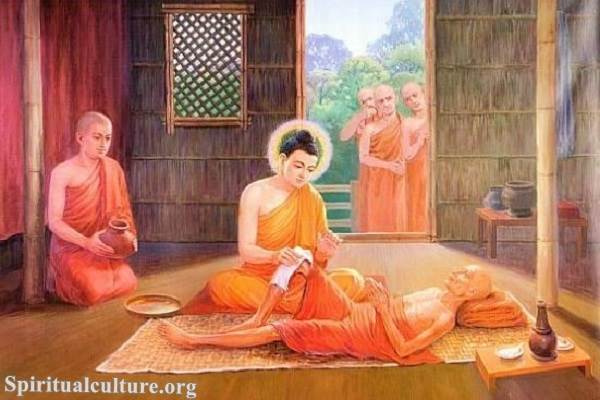
There is no single greeting used by all Buddhists. Buddhist communities are spread across many languages and cultures, so greetings may be religious, cultural, or simply the normal polite greeting of the local society. A bow or palms-together gesture is common in several Buddhist cultures, but even that is not universal.
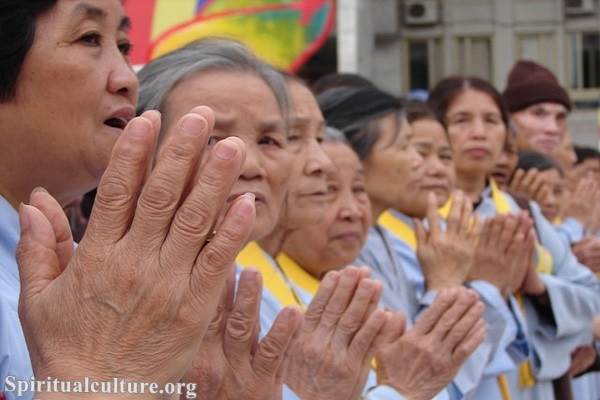
Palms together and a bow
In many South and Southeast Asian settings, people greet respectfully with the palms together near the chest or face and a slight bow. The gesture may be known by local names such as wai in Thailand or añjali in Sanskrit and Pali contexts.
The height of the hands, depth of the bow, and social meaning vary. A visitor does not need to imitate every local detail perfectly; a modest bow and respectful demeanor are usually more important than performing a gesture mechanically.
Is “Namaste” a Buddhist greeting?
Namaste is widely associated with South Asian culture and Hindu contexts. Buddhists in Nepal or India may use it because it is part of the surrounding culture, but it is not a universal Buddhist greeting.
It would therefore be inaccurate to tell people that all Buddhists say “Namaste.” A Thai, Japanese, Tibetan, Sri Lankan, Vietnamese, Chinese, or Western Buddhist may use completely different words and gestures.
Greeting monks and nuns
Monastics may be greeted with a bow, palms together, or a local honorific. Customs can be more formal than ordinary social greetings. In some traditions, laypeople do not shake hands with monastics of another sex; in others, a handshake may be accepted in modern settings.
When visiting a monastery, following the example of local practitioners is often the easiest approach.
Common examples by cultural setting
- Thailand: a wai is common in ordinary and religious life.
- Sri Lanka and other Theravāda communities: palms together and respectful forms of address may be used.
- Japan: bowing is a normal cultural greeting and is also used in Buddhist settings.
- Tibetan communities: greetings follow Tibetan language and etiquette; a simple respectful bow is usually acceptable for visitors.
- Vietnamese and Chinese Buddhist communities: everyday language greetings may be used alongside bows or palms-together gestures in temples.
What should a visitor say?
A simple “hello,” spoken politely, is usually fine unless a community provides a particular greeting. Buddhism does not require visitors to use a sacred formula before speaking to a Buddhist.
Respectful behavior matters more: dress appropriately for a temple, avoid pointing feet toward sacred images where that is considered disrespectful, speak quietly, and follow local guidance.
The key point
Buddhism is not one culture. A “Buddhist greeting” is usually a combination of religious respect and local etiquette. When unsure, a slight bow, a friendly expression, and a normal polite greeting are safe choices.