Thich Nhat Hanh, written in Vietnamese as Thích Nhất Hạnh, was a Vietnamese Buddhist monk, teacher, poet, writer, and peace activist whose work profoundly influenced the modern understanding of mindfulness. Born in central Vietnam in 1926, he lived through colonialism, war, national division, exile, and the global expansion of Buddhism. He died in 2022 at Từ Hiếu Temple in Huế, where he had begun his monastic training nearly eight decades earlier.
His teachings reached far beyond conventional monastery walls. He presented mindful breathing, walking meditation, compassionate communication, and communal practice as ways of responding to both personal suffering and social conflict. His approach was rooted in Vietnamese Thiền Buddhism, Mahayana teachings, Buddhist ethics, and the wider movement for Buddhist renewal in twentieth-century Vietnam.
Thich Nhat Hanh is especially associated with Engaged Buddhism, an approach that joins meditation and ethical cultivation with nonviolent action in society. He did not teach that spiritual practice should replace political, humanitarian, or environmental responsibility. Instead, he argued that awareness, compassion, and disciplined conduct should shape the way people respond to violence, injustice, fear, and collective suffering.
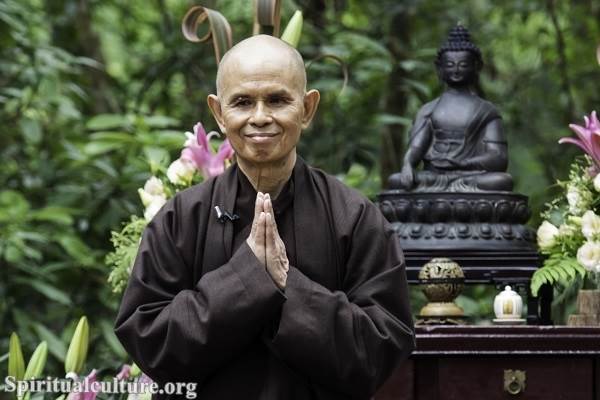
His legacy now continues through the Plum Village monastic tradition, the Order of Interbeing, international practice centers, local mindfulness communities, books, recordings, and generations of monastic and lay teachers. Understanding that legacy requires examining both the accessible practices for which he became famous and the Vietnamese Buddhist, historical, and ethical foundations from which they emerged.
Who Was Thich Nhat Hanh?
Thich Nhat Hanh was born Nguyễn Xuân Bảo on October 11, 1926, in Thừa Thiên, near the historic city of Huế in central Vietnam. He entered Từ Hiếu Temple as a novice monk at the age of sixteen. The temple belonged to the Vietnamese Lâm Tế tradition, related historically to the Chinese Linji school of Chan Buddhism, and to the Liễu Quán lineage that became especially influential in central Vietnam.
In English-language settings, he was frequently described as a “Zen master.” The word Zen is the Japanese pronunciation of a Buddhist meditation tradition known as Chan in Chinese and Thiền in Vietnamese. Although the traditions share historical connections, Thich Nhat Hanh’s religious formation was specifically Vietnamese. Describing him only as a Western-style mindfulness teacher can therefore obscure the monastic discipline, devotional life, sutra study, community rituals, and Vietnamese cultural heritage that shaped his work.
His students commonly called him Thầy, a Vietnamese word meaning “teacher.” Within the Plum Village community, this form of address expressed both affection and the traditional relationship between a Buddhist teacher and his students.
Over the course of his life, Thich Nhat Hanh became known in several overlapping roles:
- A Vietnamese Buddhist monk in the Lâm Tế and Liễu Quán lineages.
- A reformer concerned with Buddhist education and social responsibility.
- A peace advocate during the Vietnam War.
- A founder of communities for monastic and lay practice.
- A writer who translated Buddhist ideas into accessible modern language.
- A teacher of mindfulness as an ethical, communal, and contemplative discipline.
These roles should not be separated too sharply. His peace work grew from his Buddhist understanding of suffering, while his explanations of meditation were shaped by decades of engagement with war, displacement, reconciliation, and community building.
Early Life and Monastic Formation
Thich Nhat Hanh grew up during a period of enormous change in Vietnam. French colonial rule, anti-colonial movements, Japanese occupation during the Second World War, famine, revolutionary conflict, and the First Indochina War all influenced the world in which he entered religious life.
At Từ Hiếu Temple, he received a traditional monastic education that included Buddhist scriptures, ceremonies, meditation, ethical discipline, and communal work. He later studied at Báo Quốc Buddhist Academy in Huế. However, he became dissatisfied with educational models that he believed did not adequately prepare Buddhist practitioners to address modern social and intellectual questions.
His concerns were shared by other participants in the twentieth-century Buddhist revival in Vietnam. Reform-minded monks and laypeople sought to renew Buddhist education, improve publishing, involve young people, and connect religious practice with the needs of society. Thich Nhat Hanh’s later work emerged from this wider Vietnamese movement rather than from an isolated personal invention.
In the 1950s, he wrote essays, edited Buddhist publications, composed poetry, and participated in efforts to create new forms of Buddhist community. In 1957, he and several companions established Phương Bối, an experimental community in the Vietnamese highlands. It gave them space to combine study, writing, meditation, agriculture, and a less rigid model of communal life. Experiences associated with Phương Bối later appeared in his memoir Fragrant Palm Leaves.
His writing during this period addressed the need for a Buddhism that remained faithful to its contemplative roots while responding creatively to contemporary life. That aspiration would eventually become one of the defining features of the Plum Village tradition.
Study in the United States and a Broader Religious Outlook
Thich Nhat Hanh traveled to the United States in the early 1960s. Accounts of this period have sometimes stated that he studied or taught at Princeton University. Princeton University’s own archival review found no record of him as a university student or faculty member. It did, however, confirm that Nguyễn Xuân Bảo—his birth name—was listed as a student at Princeton Theological Seminary between 1961 and 1963. He subsequently lectured and conducted research on Buddhism at Columbia University.
This period brought him into closer contact with Western religious scholarship, Christian theology, American culture, and emerging international peace networks. It also strengthened his ability to explain Buddhist concepts to audiences unfamiliar with traditional Asian Buddhist vocabulary.
His later teaching often used simple images drawn from clouds, rivers, flowers, seeds, families, food, and ordinary household activities. This approachable language did not necessarily indicate a rejection of Buddhist philosophy. Rather, it functioned as a form of skillful means—adapting a teaching to the experience and understanding of a particular audience.
After returning to Vietnam in 1963, he became involved in a period of intense Buddhist educational, publishing, and humanitarian activity.
Buddhist Renewal During a Time of War
The Vietnam War confronted Buddhist communities with urgent ethical questions. Should monks and nuns remain primarily within monasteries, preserving religious discipline and meditation? Or should they leave the monasteries to help civilians affected by bombing, displacement, poverty, and political violence?
For Thich Nhat Hanh, the answer was that Buddhist practitioners needed to do both. Meditation without concern for suffering in society could become detached from compassion. Activism without inner discipline, however, could become consumed by anger, hatred, exhaustion, or ideological rigidity.
In the 1960s, he helped establish or develop several important institutions, including Vạn Hạnh Buddhist University, Lá Bối Press, Buddhist periodicals, and the School of Youth for Social Service. The school trained young volunteers to work in rural areas, establish schools and health facilities, support displaced communities, and rebuild villages damaged by war. Institutional accounts describe it as growing into a movement involving thousands of volunteers.
The volunteers attempted to maintain a nonpartisan humanitarian position. This was extraordinarily difficult in a conflict in which almost every organization could be suspected of supporting one side or another. Some workers were threatened, attacked, or killed. Yet the movement continued to emphasize service, nonviolence, reconciliation, and relief for ordinary people.
This activity became one of the clearest early expressions of what came to be known as Engaged Buddhism.
The Meaning of Engaged Buddhism
Thich Nhat Hanh is widely credited with helping coin and popularize the modern expression Engaged Buddhism during the 1960s. The term described a form of Buddhist life in which meditation, ethical discipline, insight, and compassion are applied directly to social conditions.
Engaged Buddhism should not be understood as the claim that earlier Buddhists had never helped society. Buddhist communities throughout history had established hospitals, schools, charitable networks, public works, and systems of care. Kings, monks, nuns, and laypeople had also debated war, governance, poverty, and moral responsibility.
What was distinctive about the modern movement was its conscious response to industrial warfare, colonialism, nationalism, political ideology, environmental destruction, mass media, globalization, and new forms of social organization. Thich Nhat Hanh gave this response a recognizable vocabulary and linked it systematically to mindfulness practice.
In his understanding, Engaged Buddhism begins before a demonstration, relief project, or political campaign. It begins with the practitioner’s way of seeing. Fear, prejudice, dehumanization, and attachment to rigid views can reproduce the very forms of violence that people hope to overcome.
The purpose of mindfulness is therefore not withdrawal from reality. It is to perceive reality more clearly, recognize suffering, understand its conditions, and respond without adding unnecessary hatred.
This approach can be summarized through several principles:
Contemplation and action belong together
Meditation cultivates stability, awareness, and insight. Social engagement gives compassion a concrete form. Neither should be treated as complete without the other.
Nonviolence requires training
Nonviolence is not merely refusing to strike an opponent. It includes learning to recognize anger, fear, ideological certainty, and dehumanizing language before they become harmful actions.
Compassion does not require passivity
A practitioner may firmly oppose oppression, exploitation, warfare, or environmental destruction. The challenge is to resist harmful systems without denying the humanity of those who participate in them.
Ethical means matter
A just goal does not automatically make every method acceptable. Speech, organizing, consumption, livelihood, and relationships should reflect the values that a movement hopes to establish.
Social suffering has collective causes
Personal distress is influenced by families, institutions, economic systems, media, historical trauma, and cultural habits. Transformation therefore requires both individual practice and changes in collective life.
The Order of Interbeing
In February 1966, Thich Nhat Hanh established the Order of Interbeing, known in Vietnamese as the Tiếp Hiện Order. The first six members were three women and three men associated with the School of Youth for Social Service and other peace activities. They committed themselves to mindfulness, ethical conduct, nonattachment to views, compassionate service, and nonviolent action.
The Order developed the Fourteen Mindfulness Trainings, which adapt Mahayana bodhisattva ethics to modern social life. They address subjects including ideological attachment, intolerance, suffering, truthfulness, anger, communication, livelihood, community, and responsible action.
One of their central principles is nonattachment to views. This does not mean that people should have no convictions or that every opinion is equally valid. It means recognizing that concepts are limited and that attachment to an ideology can prevent people from seeing new evidence, understanding another person, or correcting harmful behavior.
The Order also emphasizes direct experience. Buddhist teachings are not treated only as propositions to accept. Practitioners are encouraged to examine their minds, relationships, habits, and communities through meditation and attentive living.
For many years, war and exile prevented the Order from expanding. It later developed internationally as both a monastic and lay community. In 2026, communities associated with the Order marked sixty years since its establishment.
Peace Advocacy and Martin Luther King Jr.
In 1966, Thich Nhat Hanh traveled outside Vietnam to advocate a negotiated end to the war. He spoke with religious leaders, politicians, peace organizations, students, and journalists, attempting to communicate the suffering of Vietnamese civilians and the importance of reconciliation.
During this period, he met the American civil rights leader Martin Luther King Jr. Their relationship connected the struggle against racial injustice in the United States with international movements for nonviolence and peace.
In January 1967, King formally nominated Thich Nhat Hanh for the Nobel Peace Prize. The Nobel nomination archive confirms King’s nomination, while the surviving letter shows that King regarded the Vietnamese monk as an important advocate of peace and nonviolence.
The nomination was historically significant, but Thich Nhat Hanh did not receive the prize. More important than the award itself was the moral and intellectual exchange between two religious leaders who believed that racism, war, poverty, and dehumanization were interconnected.
Thich Nhat Hanh’s peace mission also had a profound personal consequence. He was unable to return to Vietnam and began an exile that lasted for thirty-nine years. His community states that he was denied reentry because his neutral peace position was unacceptable to authorities on opposing sides of the conflict.
Exile, the Paris Peace Talks, and Life in France
During his exile, Thich Nhat Hanh continued writing, teaching, organizing humanitarian work, and advocating for peace. In 1969, he led the Buddhist Peace Delegation connected with the Paris Peace Talks. He also taught and researched Buddhism in France.
Exile became a major theme in his spiritual life. He could not return to his homeland, yet he taught that a person could learn to experience home through conscious breathing, bodily awareness, community, and the present moment.
This teaching should not be misunderstood as dismissing the pain of displacement. Thich Nhat Hanh worked with Vietnamese refugees and remained deeply connected with Vietnamese language, poetry, history, and Buddhist practice. His emphasis on finding a spiritual home in the present was a way of living with displacement rather than pretending that exile caused no loss.
In 1975, he and his companions established the Sweet Potato Community near Paris. The community offered a setting for meditation, communal living, writing, and the reception of students. As participation grew, a larger location became necessary.
The Founding of Plum Village
In 1982, Thich Nhat Hanh and his students established Plum Village in southwestern France. It began in simple rural buildings surrounded by farmland and vineyards. Barns and agricultural structures were gradually adapted into meditation halls, dining areas, dormitories, and monastic residences.
Plum Village developed into a community of monks, nuns, and lay practitioners from many countries. Retreatants learned meditation not only while sitting in a hall but also while eating, walking, working, resting, listening to a bell, washing dishes, and sharing space with others.
The community later grew into several hamlets and became the largest international practice center in the Plum Village tradition. Its official account describes more than 200 resident monks and nuns living in four hamlets in France.
Additional monasteries and practice centers were established in the United States, Germany, Thailand, Hong Kong, Australia, and other locations. Local lay communities, commonly called sanghas, also formed in many countries.
Plum Village remains an active global community offering retreats and teachings on mindful living and Engaged Buddhism. Its continuing activity demonstrates that the tradition is no longer centered on a single charismatic teacher. It is transmitted through monastic communities, lay teachers, ethical trainings, liturgy, retreats, publications, and shared forms of practice.
The Core Teachings of Thich Nhat Hanh
Thich Nhat Hanh did not present himself as the founder of a new religion. His teachings drew from early Buddhist discourses, Mahayana sutras, Vietnamese Thiền, Pure Land practices, bodhisattva ethics, and centuries of Buddhist commentary.
His distinctive contribution lay largely in the language, practices, and community structures through which he expressed those traditions.
Mindfulness in Everyday Life
Mindfulness is often defined as awareness of what is happening in the present moment. In Thich Nhat Hanh’s teaching, however, it involves more than neutral attention. It includes remembering to return to the body, recognizing thoughts and emotions, understanding the conditions of suffering, and responding with care.
He taught that breathing can connect the mind and body. A person may become aware of an inhalation as an inhalation and an exhalation as an exhalation without forcing the breath. This simple practice can interrupt habitual distraction and bring attention back to immediate experience.
Walking meditation applies the same principle to movement. Rather than treating walking only as a way to reach a destination, practitioners become conscious of each step, bodily sensation, and contact with the earth.
Other ordinary activities can also become practices:
- Drinking tea without rushing.
- Eating while recognizing the people and natural conditions involved in producing food.
- Washing dishes without treating the task as an obstacle to life.
- Listening to a bell as an invitation to pause.
- Resting without feeling that every moment must be productive.
- Recognizing irritation before speaking or acting.
These practices do not promise permanent calm or freedom from difficulty. Their purpose is to help practitioners become more aware of how they relate to experience.
Present-Moment Awareness
One of Thich Nhat Hanh’s most recognizable themes is that life is available in the present moment. This does not mean ignoring history, abandoning plans, or refusing responsibility for the future.
The teaching addresses the tendency to live almost entirely in regret, anxiety, fantasy, or constant anticipation. By returning attention to breathing, bodily experience, and immediate surroundings, a practitioner may become better able to respond to present conditions.
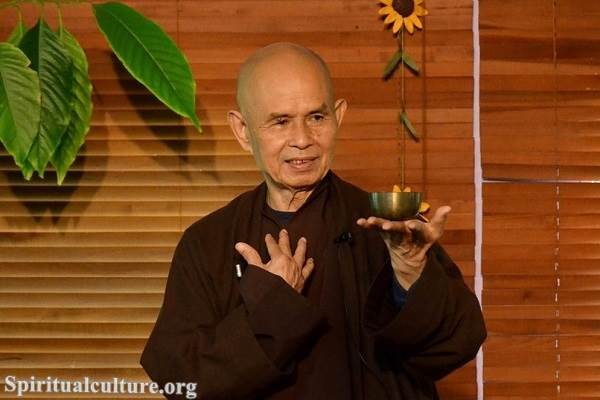
Present-moment awareness is therefore not an excuse for social indifference. In Engaged Buddhism, it is a foundation for action. People who are overwhelmed by fear or anger may act impulsively. People who are attentive may be more capable of recognizing what a situation requires.
Interbeing
Thich Nhat Hanh used the English word interbeing to communicate the Buddhist teachings of dependent origination, emptiness, and the absence of an isolated self.
A sheet of paper, for example, depends on trees, rain, soil, sunlight, human labor, transportation, and numerous other conditions. None of these conditions alone is the paper, yet the paper could not exist without them.
The same principle applies to a human being. A person depends on parents, ancestors, food, language, education, society, ecosystems, and relationships. The self exists conventionally, but not as a completely independent and permanent entity.
Interbeing is not presented as a scientific discovery unique to Thich Nhat Hanh. It is his accessible way of expressing long-established Buddhist insights. Its ethical importance lies in showing that personal well-being cannot be entirely separated from the well-being of others and the natural world.
This understanding shaped his teachings on peace, consumption, economics, climate responsibility, and care for the Earth. His community describes his ecological teaching as an application of Buddhist interdependence to environmental crisis.
Suffering, Compassion, and Transformation
Thich Nhat Hanh frequently used the image of mud and lotus flowers. A lotus grows from muddy conditions, suggesting that painful experiences can become the ground for understanding and compassion.
This does not mean that suffering is automatically beneficial or that people should remain in harmful circumstances. Buddhist practice does not require romanticizing violence, illness, grief, abuse, or injustice.
The teaching is that suffering can be recognized and understood rather than denied. When a practitioner examines anger, for example, the purpose is not simply to suppress it. Anger may contain fear, grief, humiliation, exhaustion, or unmet needs. Understanding those conditions can make a wiser response possible.
Compassion, in this context, is not pity or passive sentiment. It is the intention and capacity to reduce suffering. It may involve listening, setting a boundary, offering material assistance, correcting injustice, apologizing, organizing a community, or refusing to participate in harm.
Deep Listening and Loving Speech
Communication was central to Thich Nhat Hanh’s peace teaching. He argued that many conflicts intensify because people speak from anger and listen mainly to prepare a reply.
Deep listening means giving another person space to describe suffering without immediately arguing, correcting, or defending. The listener does not have to agree with every statement. The immediate aim is to understand the experience and perceptions that have shaped the speaker.
Loving speech means communicating truthfully in a way intended to reduce unnecessary harm. It does not require avoiding difficult subjects. Criticism may still be necessary, but its language should not deliberately humiliate or dehumanize.
These practices appear explicitly in the Five Mindfulness Trainings, which connect responsible speech with reconciliation among individuals, families, religious communities, ethnic groups, and nations.
Deep listening is not a substitute for professional mediation, legal protection, or intervention when someone is in danger. It is a spiritual and ethical discipline that may support communication when circumstances make dialogue appropriate.
The Importance of Sangha
A sangha is a Buddhist community of practice. Thich Nhat Hanh repeatedly emphasized that long-term transformation is difficult to sustain through individual effort alone.
A community creates shared rhythms of meditation, ethical reflection, meals, work, study, and rest. Members can support one another when motivation weakens or suffering becomes overwhelming. Community life also exposes habits that may remain invisible during solitary practice.
His emphasis on sangha helped distinguish Plum Village mindfulness from forms of meditation marketed primarily as private self-improvement. Although individuals benefit from personal practice, the ultimate aim includes healthier relationships and more compassionate communities.
The international network that continued after his death reflects his view that a community, rather than one celebrated individual, should carry the teaching into the future.
The Five Mindfulness Trainings
Thich Nhat Hanh reformulated the traditional Five Buddhist Precepts as the Five Mindfulness Trainings. They are intended primarily for lay practitioners and are presented as ongoing directions of practice rather than commandments imposed by a divine authority.
The five areas are:
Reverence for Life
Practitioners cultivate compassion and seek to reduce killing, violence, intolerance, and the destruction of life.
True Happiness
This training addresses stealing, exploitation, social injustice, attachment to wealth, and the responsible use of material resources.
True Love
Practitioners are encouraged to cultivate responsibility, respect, consent, commitment, and protection from sexual exploitation and abuse.
Loving Speech and Deep Listening
This training concerns truthful communication, reconciliation, compassionate listening, and restraint when anger may lead to harmful speech.
Nourishment and Healing
Practitioners examine food, alcohol, intoxicants, media, entertainment, and other forms of consumption that affect the body, mind, family, society, and environment.
The Plum Village community explains that these trainings are rooted in the traditional Five Precepts but expanded to address modern ethical circumstances. They have also been revised over time, demonstrating that the tradition regards ethical language as something that may require renewed expression while maintaining its Buddhist foundation.
“No Birth and No Death”
Thich Nhat Hanh sometimes taught that a cloud does not truly disappear when it becomes rain. It changes form and continues through other conditions.
This image expresses a Mahayana Buddhist understanding of impermanence and emptiness. It should not be treated as a scientific claim that individual biological life never ends. Thich Nhat Hanh’s body aged, experienced illness, and died.
The religious teaching is that phenomena do not arise independently from nothing and then vanish into absolute nothingness. They emerge through conditions and continue through consequences, relationships, matter, memory, teachings, and other transformations.
For his followers, this perspective offers a Buddhist way to contemplate death and grief. It does not require every reader to interpret death in the same religious or metaphysical way.
Thich Nhat Hanh as an Author
Thich Nhat Hanh wrote poetry, memoirs, Buddhist commentaries, practical meditation manuals, children’s books, and works on peace, ecology, ethics, and relationships. Parallax Press reports that he published more than one hundred books over seven decades of teaching.
Among his best-known works are:
- The Miracle of Mindfulness
- Being Peace
- Peace Is Every Step
- Old Path White Clouds
- The Heart of the Buddha’s Teaching
- The Art of Living
- No Mud, No Lotus
- Interbeing
- The World We Have
- Fragrant Palm Leaves
Some books were written directly by him, while others were edited from Dharma talks, retreats, archival material, or earlier Vietnamese and French publications. Readers should therefore consult publication information when seeking the historical origin of a particular text.
His style is notable for combining simple language with concepts drawn from Buddhist philosophy. A short reflection on breathing or washing dishes may contain implicit references to impermanence, nonself, dependent origination, ethical conduct, concentration, and insight.
Return to Vietnam and Final Years
After thirty-nine years of exile, Thich Nhat Hanh was permitted to visit Vietnam in 2005. He returned again during the following years, teaching, visiting temples, meeting followers, and participating in ceremonies.
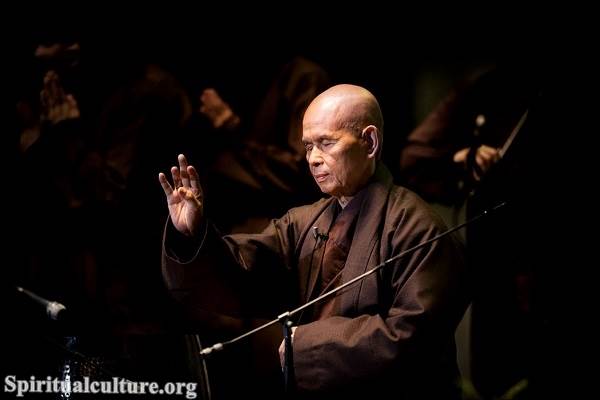
These visits were meaningful to many Vietnamese Buddhists, but they were also politically controversial. Some members of overseas Vietnamese communities feared that the government might use the visits to create an overly favorable image of religious freedom. Others understood his return as an effort toward reconciliation and reconnection with Vietnamese Buddhist roots.
In 2014, Thich Nhat Hanh experienced a severe stroke that left him unable to speak and greatly limited his movement. Although he no longer delivered formal teachings, he continued to participate in community life through his presence, gestures, calligraphy, and periods of walking or sitting with assistance.
In October 2018, he returned permanently to Từ Hiếu Temple in Huế. The return carried strong symbolic meaning: after decades of exile and international teaching, he chose to spend his final years at the monastery where his religious life had begun.
Thich Nhat Hanh died at Từ Hiếu Temple on January 22, 2022, at the age of ninety-five. His funeral ceremonies combined Vietnamese Buddhist monastic traditions with the international participation of the Plum Village community.
The Continuing Legacy of Thich Nhat Hanh
Thich Nhat Hanh’s influence can be seen in several different areas, although his legacy should not be reduced to any single one of them.
The Global Practice of Mindfulness
He helped make Buddhist mindfulness understandable to international audiences without requiring extensive prior knowledge of Buddhist terminology. His breathing and walking practices entered retreat centers, schools, homes, hospitals, prisons, workplaces, and peace organizations.
However, he did not invent mindfulness. It is an ancient element of Buddhist practice found in multiple traditions. His contribution was to transmit and interpret it in forms that became especially influential in the modern world.
The Plum Village Tradition
Plum Village developed recognizable forms of chanting, sitting meditation, walking meditation, communal meals, bell practice, Dharma discussion, ethical training, and mindful work. These practices are now maintained by monastic and lay communities in many countries.
The survival of the tradition after its founder’s death depends on community-led transmission. Senior disciples, younger monastics, lay Dharma teachers, translators, editors, retreat organizers, and local sanghas all participate in preserving and adapting the heritage.
Engaged Buddhism
Thich Nhat Hanh demonstrated that Buddhist practice could address war, refugee suffering, racial injustice, environmental destruction, education, and social division without abandoning meditation or ethical discipline.
Engaged Buddhism has never been a single centralized movement. Other Buddhist leaders and communities in Asia and elsewhere developed their own forms of humanitarian service, peacebuilding, environmental activism, and social reform. Thich Nhat Hanh’s legacy is one influential stream within this diverse field.
Interreligious Dialogue
His friendship with Martin Luther King Jr. and engagement with Christian contemplatives helped create bridges between Buddhist and Christian peace traditions. He often encouraged people from other religions to deepen their own spiritual roots rather than abandon them.
This approach allowed non-Buddhists to practice mindful breathing or compassionate listening without claiming a Buddhist identity. At the same time, it is important not to detach these practices completely from their Buddhist historical and ethical setting.
Spiritual Ecology
His teaching of interbeing provided a religious framework for ecological responsibility. Human beings, in this view, are not separate observers of nature. Their bodies, food, water, breath, economies, and communities depend on the Earth.
The practical consequence is not that meditation alone will solve environmental crises. Rather, awareness should inform consumption, livelihood, public policy, collective action, and the protection of ecosystems.
Common Misunderstandings About His Teachings
Mindfulness is not simply relaxation
Relaxation may occur during practice, but mindfulness also requires facing grief, anger, fear, injustice, and harmful habits. It is not always comfortable.
Living in the present does not mean ignoring the future
Careful planning can take place in the present. The teaching challenges obsessive anxiety, not responsible preparation.
Compassion does not mean accepting abuse
Compassion may include protection, distance, accountability, or firm resistance. Deep listening is not appropriate when it exposes someone to continued danger.
Nonattachment to views does not mean moral indifference
Practitioners can oppose violence and injustice while remaining willing to examine their assumptions and methods.
Interbeing is not the claim that all differences are meaningless
People have distinct histories, responsibilities, privileges, wounds, and cultural identities. Interdependence does not erase these realities; it places them within networks of relationship and consequence.
Thich Nhat Hanh was not merely a secular wellness teacher
His accessible exercises were grounded in Buddhist monasticism, sutra study, ethical precepts, Mahayana philosophy, ritual, and community life.
A Balanced View of His Historical Importance
Popular descriptions sometimes call Thich Nhat Hanh the “father of mindfulness.” The phrase recognizes his enormous international influence, but it can be historically misleading. Mindfulness existed in Buddhism long before the twentieth century and has been cultivated by many Theravada, Mahayana, and Vajrayana communities.
His importance lies not in originating the practice but in becoming one of its most influential modern interpreters. He created an accessible vocabulary, developed communities in which the practice could be embodied, connected meditation with social responsibility, and transmitted Vietnamese Buddhist teachings across cultural boundaries.
His international success also raises important questions. Practices adapted for global audiences may lose cultural context. Meditation can be commercialized as a tool for productivity or stress management while its ethical commitments are neglected. Reverence for a teacher can also overshadow the work of communities, collaborators, women, translators, and lesser-known practitioners who helped build a movement.
A responsible appreciation of Thich Nhat Hanh therefore recognizes both his individual creativity and the collective foundations of his legacy. Sister Chân Không, the first generation of the Order of Interbeing, Vietnamese social workers, monastic disciples, lay practitioners, editors, and local communities all contributed to the tradition’s development and survival.
Conclusion
Thich Nhat Hanh’s life connected Vietnamese Buddhist heritage with some of the most urgent experiences of the modern world: colonialism, war, exile, refugee displacement, ideological division, environmental crisis, and the search for meaningful community.
His central message was not that people can escape suffering through positive thinking. It was that suffering should be approached with awareness, understanding, ethical responsibility, and compassion. Mindfulness begins with a breath or a step, but it does not end there. It extends into speech, relationships, consumption, education, social service, peacebuilding, and care for the Earth.
Engaged Buddhism expresses this union of inner cultivation and outward responsibility. Meditation helps practitioners recognize the roots of fear and hatred. Compassionate action tests whether spiritual insight has become part of daily life.
The continuing importance of Thich Nhat Hanh will depend not only on the popularity of his books or quotations but on the communities that preserve the depth of his teaching. When mindfulness remains connected with ethics, sangha, cultural memory, nonviolence, and service, his legacy is more than a personal philosophy. It becomes a living heritage carried through collective practice from one generation to the next.