Tibetan Buddhism is a major Buddhist tradition shaped by Indian Mahayana and Vajrayana teachings, Tibetan monastic institutions, philosophical study, ritual practice, and centuries of religious life across Tibet and the Himalayan world. It is practiced in Tibet and Himalayan regions and has also spread globally through migration, teaching networks, and monastic communities.
The older Western label “Lamaism” is now generally avoided in scholarship. The term can misleadingly suggest that Tibetan Buddhism is a separate religion centered only on lamas rather than a Buddhist tradition with deep roots in Indian Buddhist philosophy, monastic discipline, Mahayana ethics, and Vajrayana practice.
Historical development
Buddhist teachings entered Tibet over a long period rather than in a single event. Tibetan historical memory gives particular importance to the imperial period and to rulers such as Songtsen Gampo and Trisong Detsen. Indian masters including Shantarakshita and Padmasambhava became central figures in Tibetan accounts of the establishment of Buddhism.
Translation was crucial. Tibetan scholars and Indian teachers produced a large body of translated Buddhist scriptures and commentaries. Monastic institutions, philosophical curricula, ritual lineages, and systems of meditation developed over centuries, while periods of political change affected which schools and monasteries flourished.
Mahayana and Vajrayana
Tibetan Buddhism belongs broadly to the Mahayana Buddhist world and is especially known for preserving extensive Vajrayana traditions. Mahayana teachings emphasize the bodhisattva path: the aspiration to attain awakening for the benefit of sentient beings. Vajrayana adds ritual and contemplative methods transmitted through initiation and lineage.
Practices can include mantra recitation, deity yoga, visualization, mandala ritual, philosophical analysis, compassion meditation, and advanced contemplative systems. Vajrayana practices are traditionally taught within a teacher-student relationship and are not all intended for unsupervised practice.
The four major Tibetan Buddhist schools
Tibetan Buddhism is diverse. Four major schools are commonly identified:
- Nyingma — associated with the earliest transmission of Buddhism to Tibet and with traditions such as Dzogchen.
- Kagyu — known for strong meditation lineages, including Mahamudra, and for several branches headed by different lineage holders.
- Sakya — associated with the Sakya tradition of scholarship, ritual, and the Lamdre teaching system.
- Gelug — founded through the reform movement associated with Je Tsongkhapa and known for extensive monastic scholarship and debate.
Other lineages and movements also form part of Tibetan religious history. Treating Tibetan Buddhism as a single centralized institution can therefore obscure important differences in authority, practice, and lineage.
What is a lama?
A lama is a respected Tibetan Buddhist teacher or spiritual guide. The word does not mean that every Tibetan Buddhist cleric belongs to a separate “lama religion.” Some lamas are monks, some may be recognized reincarnate teachers, and others hold authority because of education, lineage, or spiritual training.
The importance of teachers in Vajrayana helps explain why earlier Western observers coined the term “Lamaism.” Modern scholarship generally considers that label outdated and potentially misleading.
The Dalai Lama
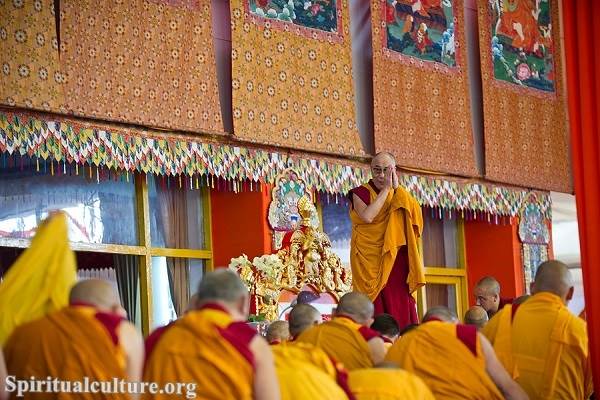
The Dalai Lama institution developed within Tibetan history and became especially associated with the Gelug school and the government of central Tibet. The 14th Dalai Lama, Tenzin Gyatso, is one of the most internationally recognized Tibetan Buddhist figures.

It is inaccurate, however, to treat the Dalai Lama as a Buddhist equivalent of a pope who governs every Tibetan Buddhist school. Tibetan Buddhism has multiple schools, monasteries, lineage holders, and institutional authorities. The Dalai Lama’s religious importance is immense, but authority is not organized through a single worldwide hierarchy.
Study, ethics, and meditation
Tibetan monastic education can involve years of study in logic, epistemology, Madhyamaka philosophy, Prajnaparamita, monastic discipline, and Abhidharma. Debate is an important educational method in many monasteries.
Alongside scholarship, practitioners cultivate ethical conduct, compassion, bodhicitta, concentration, and insight. Lay practice may include refuge prayers, offerings, pilgrimage, prostrations, mantra recitation, devotional practices, and meditation. The balance of these activities differs by community and lineage.
Tibetan Buddhism today
Tibetan Buddhist communities now exist across South Asia, Europe, the Americas, Australia, and elsewhere. Monasteries and educational centers in India and Nepal became especially important after the mid-twentieth-century Tibetan diaspora. At the same time, Tibetan Buddhism continues to be practiced by communities in Tibet and neighboring regions.
Modern global interest has made Tibetan Buddhist teachings more accessible, but it has also encouraged simplified images of Tibet as uniformly mystical or enduring. A more accurate approach recognizes Tibetan Buddhism as a complex living tradition with philosophy, institutions, ritual, historical change, and internal diversity.