The historical Buddha is not normally understood as a creator God in Buddhism. He is revered as an awakened teacher, although Buddhist traditions differ in how they describe Buddhas, celestial Buddhas, bodhisattvas, devas, devotion, and the transcendent qualities of awakening.
Buddhists normally do not understand the historical Buddha as a creator God who made the universe, governs it by divine will, or grants salvation through omnipotent grace. Yet simply saying “Buddha was only a man” can also flatten Buddhist beliefs about awakening. Spiritual Culture separates creator-God language from the religious status Buddhists give to a Buddha.
Buddha means awakened one
Early Buddhist terminology describes a Buddha as one who rediscovers the path to liberation and fully awakens. Gotama Buddha is revered as teacher, guide, and unsurpassed example of awakening.
The Buddha is not the creator of the universe
Early Buddhism does not center on an eternal creator deity. Buddhist cosmology includes many worlds and classes of beings, but these arise within conditioned existence rather than through one creator God.
Buddhist texts do include devas and brahmas
Devas are heavenly beings within samsara. They can possess long lives and extraordinary abilities, but they are not necessarily awakened and remain subject to impermanence and rebirth.
Why worship-like practices can confuse outsiders
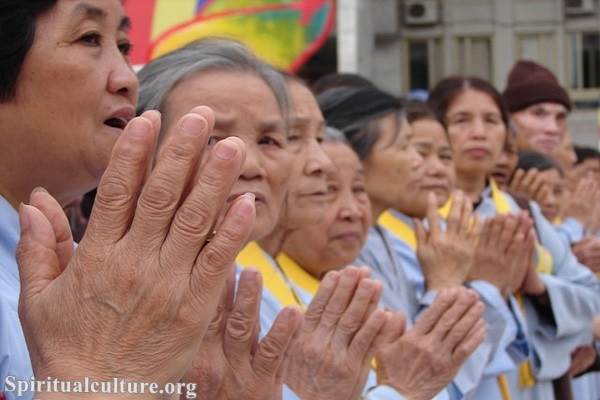
Buddhists may bow before Buddha images, offer flowers or lamps, chant praises, circumambulate stupas, and recollect the Buddha’s qualities. These acts can express gratitude, refuge, merit, aspiration, and reverence without implying belief in a creator deity.
What does taking refuge mean?
Buddhists commonly take refuge in the Buddha, Dhamma, and Sangha. Refuge treats the Buddha as the awakened teacher and the path as reliable guidance toward liberation.
Mahayana presents cosmic Buddhas
Mahayana and Vajrayana traditions speak of many Buddhas and highly exalted bodhisattvas, including figures associated with pure lands and cosmic dimensions. These traditions are richer than the formula “Buddha was just a philosopher.”
Is the Buddha divine?
The answer depends on what “divine” means. If it means creator God, generally no. If it means a transcendent, sacred, awakened being worthy of significant devotion, many Buddhist communities would use religious language far stronger than ordinary human admiration.
Avoid forcing Buddhist categories into Christian or Islamic categories
Terms such as God, prophet, saint, angel, and savior come from different religious systems. Comparison can help, but direct equivalence usually creates confusion.
Differences across traditions
The most accurate answer is that the Buddha is not normally understood as an eternal creator God. Buddhism reveres him as fully awakened, and different traditions express that reverence through philosophical, ritual, and devotional forms.