Buddhism does not contain a universal religious rule that sets a fixed number of wives for every lay Buddhist man. In most modern Buddhist societies, civil law defines legal marriage, and monogamy is the normal legal form. Buddhist ethics focuses more on sexual misconduct, honesty, responsibility, and harm than on prescribing a numerical marriage limit.
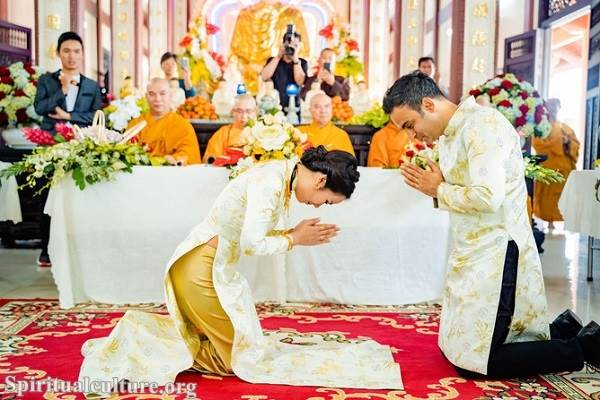
Lay marriage is not a Buddhist sacrament
Early Buddhist texts give ethical advice to householders but do not establish a single worldwide marriage code. Marriage is generally treated as a social and legal institution shaped by local custom.
This helps explain why Buddhist-majority societies have had different marriage patterns across history.
What the third precept requires
For lay Buddhists, the third precept is commonly understood as refraining from sexual misconduct. Traditional explanations warn against adultery, coercion, exploitation, and relationships that violate serious commitments.
A person who has multiple partners without honesty or consent can therefore violate Buddhist ethical principles even where the civil law is not the only issue.
Polygamy and Buddhist cultures
Some Buddhist societies historically tolerated forms of polygyny, while others strongly favored monogamy. Those customs should not automatically be treated as teachings of the Buddha.
Today, the legality of plural marriage depends on national law. A Buddhist living in a country where polygamy is illegal is subject to that legal framework.
Monks are different
Fully ordained Buddhist monks are celibate under the Vinaya and do not marry while maintaining full monastic vows.
A married layman who becomes a monk must address family and legal responsibilities according to his community and circumstances.
Short answer
Buddhism does not give laymen a universal maximum number of wives. Modern Buddhist marriage is usually monogamous, and ethical evaluation centers on fidelity, consent, responsibility, and non-harm.