The Story of the Silent Teaching
The Young Monk’s Longing
Once, in the time when the Blessed One still walked among the people of India, a young monk named Sumita joined the community. He was earnest, diligent, and devoted to study. He recited sutras day and night, memorized the precepts, and asked his teachers countless questions. Yet, in his heart, he felt something missing.
Sumita longed not only to understand the Dharma with his mind, but to hear it with his very soul. He believed there must be a special teaching, a hidden mantra, a sacred sound that could open the gates of wisdom.
So one morning, while the Sangha gathered to hear the Buddha speak, Sumita came forward, bowed deeply, and said:
“Blessed One, I have studied the sutras, listened to your discourses, and practiced as you instructed. Yet my heart thirsts for the true voice of the Dharma. I beg you — let me hear it.”
The Buddha’s Response
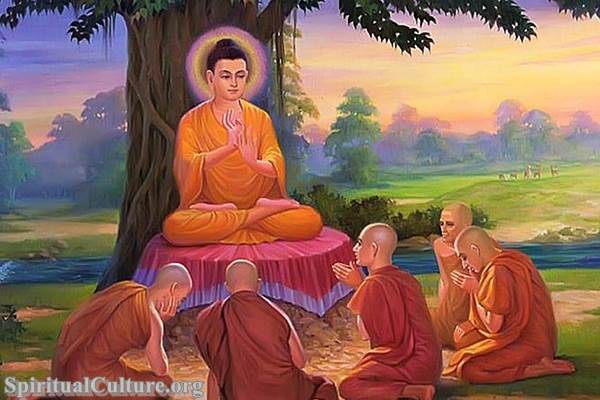
The Buddha looked at him with eyes as calm as a still lake. Instead of speaking, he simply closed his eyes and remained silent.
The Sangha waited. A minute passed. Then another. The birds outside called, the leaves stirred in the breeze, but the Buddha did not utter a word.
Confused, Sumita pressed further: “Lord, I asked to hear the Dharma. Why do you give me silence?”
Still, the Buddha remained silent.
Some of the monks began to murmur, thinking the young man’s request had been foolish. Others wondered if the Blessed One was displeased.
But then, after a long pause, the Buddha slowly opened his eyes and asked gently:
“Sumita, do you hear it?”
The Awakening
At first, the young monk was bewildered. “Hear what, Lord? I hear nothing.”
“Exactly,” the Buddha replied. “In this silence lies the voice of the Dharma. It cannot be captured by words, nor lost in argument. It is always here, waiting, when the mind becomes still.”
In that moment, Sumita stopped reaching for an answer. His racing thoughts fell quiet. He noticed the space between the birdcalls, the stillness beneath the rustling of leaves, the significant peace in the Buddha’s silence. Tears welled in his eyes.
He understood then: the Dharma was not a sound to be heard with the ears, but a truth to be realized within. Silence itself was teaching him — the impermanence of words, the vastness of awareness, the compassion of presence.
From that day on, Sumita no longer sought after hidden mantras or secret teachings. He devoted himself to meditation, learning to rest in the silence that spoke more clearly than a thousand sermons.
And it is said that many years later, when new monks came to him asking for the deepest teaching, he too would close his eyes and sit in silence, until they could hear the voice that is always present.
Wisdom and insight
The story of Sumita and the Buddha’s silence is a reminder that wisdom does not always come through words. In Buddhism, this teaching points to several deep truths:
The Dharma Beyond Words
The Buddha’s silence reveals that ultimate truth cannot be fully expressed in speech. Sutras and chants are guides, but the essence of awakening is direct experience. Silence helps us move beyond intellectual understanding into direct realization.
The Power of Mindfulness
When the Buddha asked, “Do you hear it?”, he was pointing Sumita to the present moment. By listening deeply — not to sound, but to silence — we discover mindfulness, the awareness that underlies everything.
Letting Go of Craving for Special Secrets
Sumita wanted a special sound, a hidden mantra. But the Buddha showed him that there is no secret Dharma apart from what is here and now. Clinging to “special teachings” can be another form of desire. True wisdom is already present in our own awareness.
Silence as Compassion
The Buddha’s silence was not rejection — it was compassion. Sometimes, words only create more confusion. By sitting silently, the Buddha allowed Sumita to realize truth for himself. It was an act of loving guidance.
A practical lesson for daily life
In our modern world, we are surrounded by endless noise — notifications, conversations, advertisements, and even the constant chatter of our own mind. Many of us, like Sumita, long for clarity. We look for books, podcasts, teachers, or techniques to give us the “true answer.”
But this story shows that sometimes the deepest answer is found in silence.
When we pause, breathe, and listen inwardly, we may discover:
- The stillness beneath our stress.
- The compassion that arises when the mind is calm.
- The wisdom that does not depend on anyone else’s words.
Even today, if you sit quietly — even for a few minutes — you may begin to hear “the voice in silence.” It is not a voice made of sound, but of presence. It tells us: You are here. You are alive. This moment is enough.
Ask yourself gently:
- Where in my life am I drowning in noise, when silence could be my teacher?
- Can I learn to listen, not just to words, but to the space between them?
- What would happen if I trusted silence, instead of fearing it?
The story of The Voice That Was Heard in Silence is an invitation. It tells us that the Dharma is not always in what we read or hear, but in what we realize when the mind becomes still.
The next time you sit in meditation, or even in the quiet of a morning before the world awakens, remember Sumita. Remember the Buddha’s silence. And listen — not for sound, but for presence.
As the Buddha once said:
“Better than a thousand hollow words,
Is one word that brings peace.”