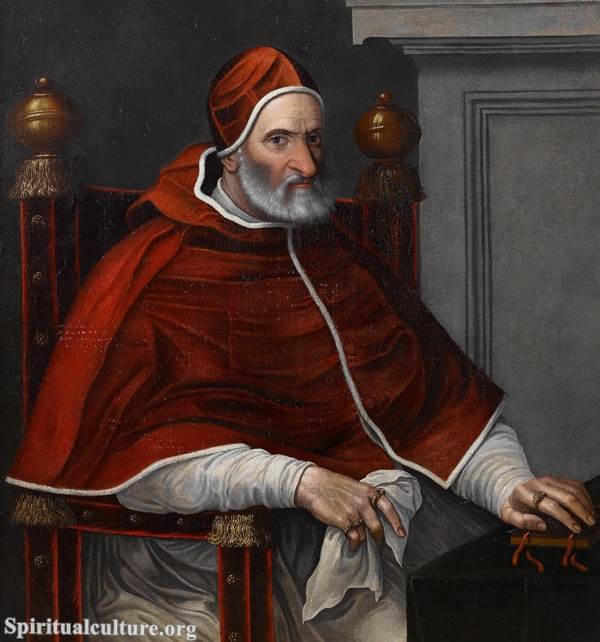
Pope Gregory XIV, born Niccolò Sfondrati, was the 229th pope of the Catholic Church. His pontificate began in December 1590 and ended with his death on October 16, 1591. Although he governed for less than a year, his papacy unfolded during a turbulent phase of the European Wars of Religion and the continuing Catholic reform associated with the Council of Trent.
Who was Niccolò Sfondrati?
Sfondrati was born in Somma Lombardo in 1535 into a prominent Italian family. He pursued an ecclesiastical career, became bishop of Cremona, and was elevated to the College of Cardinals before his election as pope. His background placed him within the generation of church leaders shaped by the Tridentine reform era.
Election and short pontificate
Gregory XIV succeeded Urban VII, whose papacy had lasted only days. The Holy See lists Gregory’s pontificate as beginning in December 1590 and ending on October 16, 1591. Poor health limited the length of his reign, but important political and ecclesiastical questions still reached Rome during those months.
France and the Wars of Religion
One of the central political issues of his pontificate was the struggle for the French crown. Henry of Navarre, the future Henry IV, was then Protestant, while the Catholic League opposed his accession. Gregory XIV supported the Catholic League and adopted a strongly confessional policy toward the French succession. The conflict was part of a wider European struggle involving dynastic politics, confessional allegiance, and foreign powers.
Catholic reform and church government
Gregory XIV belonged to the post-Tridentine Catholic world in which bishops, religious orders, seminaries, discipline, and clearer administration were major concerns. His short reign did not allow the kind of long institutional program associated with some other popes, but his pontificate continued the broader reform environment of the late sixteenth century.
How is Gregory XIV remembered?
He is remembered less for a long program of papal government than for the historical moment in which he served. His actions toward France show how closely religion and state politics were connected in late sixteenth-century Europe. His brief tenure also forms part of an unusually rapid sequence of papal transitions between Sixtus V, Urban VII, Gregory XIV, Innocent IX, and Clement VIII.