In the heart of Buddhist art and philosophy, there stands a radiant presence — one not bound to a historical life story, yet central to cosmic understanding. This is Vairocana Buddha, the all-encompassing Buddha of light and wisdom.
To many, the name Vairocana may sound distant or unfamiliar. We know the historical Buddha, Śākyamuni, who walked and taught in India. But who is Vairocana — this luminous figure who appears at the center of vast mandalas and significant sutras?
Let us step into the radiance of the Dharmakāya and see what Vairocana reveals.
Who Is Vairocana Buddha? A Clear Definition
In Buddhist cosmology, Vairocana Buddha stands not just as one among many Buddhas, but as the primordial source — the embodiment of ultimate reality itself. He is revered across multiple Mahayana and Vajrayana traditions as the Dharmakāya Buddha, or the “truth body” of Buddhahood — a presence that transcends form, time, and individuality.
Whereas Śākyamuni Buddha (the historical Buddha) is the one who walked the Earth and taught in ancient India, Vairocana represents pure, formless enlightenment — the eternal, infinite, and all-encompassing nature of awakened mind. In this sense, Vairocana is not a “person” but the cosmic expression of Buddhahood itself.
The name Vairocana comes from Sanskrit, meaning “radiating one” or “he who illuminates.” It reflects his role as a being of light and wisdom, whose presence shines throughout the ten directions, beyond all boundaries. In East Asian traditions such as Chinese Huayan (Flower Garland School) and Japanese Shingon, Vairocana is sometimes considered the central Buddha of the entire Dharma realm.
He is frequently referred to as the source of all other Buddhas — the origin point from which the other manifestations of Buddhahood (such as Amitābha, Akṣobhya, and Śākyamuni) arise. Rather than teaching with words, Vairocana teaches through his very being — a state of presence that conveys the Dharma directly, beyond dualistic concepts.
One of the defining aspects of Vairocana’s identity is his embodiment of non-duality. In Mahayana thought, all phenomena are seen as empty of fixed self and interdependent. Vairocana is the realization of this truth: the understanding that everything is interwoven, and that all forms are simply expressions of one luminous essence.
In the Trikāya (Three Bodies of the Buddha) doctrine, which developed to express the many dimensions of enlightenment, Vairocana represents:
- Dharmakāya: the truth body — the formless, boundless reality
- While other Buddhas such as Amitābha may represent the Sambhogakāya (enjoyment body), and Śākyamuni the Nirmāṇakāya (emanation body), Vairocana is the ground of all of them — the essence that allows these expressions to arise.
Because of this, Vairocana is sometimes called the Buddha of Emptiness and Luminosity, or the Buddha of the Cosmic Principle. He does not “appear” in the world the way other Buddhas do, because he is already present in all things. This is why in many scriptures and mandalas, Vairocana is placed at the very center — symbolizing the still point from which all arises and to which all returns.
In summary, Vairocana Buddha is:
- The universal Buddha representing the cosmic, formless nature of enlightenment
- The Dharmakāya, or truth body, from which all Buddhas emanate
- A symbol of omnipresent wisdom, light, and the interpenetrating nature of all phenomena
- The inner essence of awakening, alive within every being
Vairocana as the Cosmic Buddha (The Dharmakāya)
The Three Bodies of the Buddha (Trikāya) and Vairocana’s Role
In Mahayana and Vajrayana Buddhism, enlightenment is not viewed as a single, static state. Instead, it expresses itself in three dimensions, known as the Trikāya or “Three Bodies” of the Buddha:
- Nirmāṇakāya – the Emanation Body: This is the form of a Buddha that appears in the world, such as Śākyamuni, to teach and guide living beings.
- Sambhogakāya – the Enjoyment Body: A subtle, radiant form experienced by advanced bodhisattvas in meditation or pure realms.
- Dharmakāya – the Truth Body: The ultimate, unmanifested reality — beyond form, name, or concept.
Vairocana Buddha is the Dharmakāya.
He represents the purest form of enlightenment, the truth that underlies all phenomena. Unlike the other two bodies, the Dharmakāya is not visible. It cannot be seen or grasped with the senses. It is the non-dual awareness that transcends birth and death, gain and loss, self and other.
Vairocana doesn’t come and go. He does not teach with words, yet his presence communicates the Dharma more deeply than any sutra. He is the enduring ground of being — the ever-present space in which all experiences arise and dissolve.
In this role, Vairocana is often compared to the sun — not in the sense of being worshiped, but as the source of illumination. Just as sunlight touches everything without discrimination, the Dharmakāya illuminates all beings equally, regardless of merit or status. All Buddhas are said to arise from this source — and ultimately return to it.
This view radically shifts how we understand awakening. Rather than something to be “attained” far in the future, the Vairocana principle teaches us that awakening is already present — as our true nature, as the clear, luminous awareness behind all thoughts.
Beyond Time and Space
Vairocana is not bound to any one culture, language, or epoch. He is often called the “cosmic Buddha” because his presence spans all directions and all times. In fact, in the Avatamsaka Sutra, he is described not as dwelling in the universe, but as being identical with the entire cosmos.
This is why Vairocana is often portrayed at the center of vast mandalas, surrounded by countless Buddhas, bodhisattvas, and deities. He is both the still point and the radiating energy — stillness and movement, emptiness and form, at once.
Because he represents the non-dual reality, Vairocana is also associated with the teaching that samsara and nirvana are not separate. The deluded mind sees a world of dualities — self and other, holy and profane, birth and death. But Vairocana reveals that these distinctions are like waves on the surface of the ocean — real in appearance, but inseparable from the vast depth beneath.
To meditate on Vairocana is to reflect on this truth:
That even now, even in suffering and confusion, the ground of awakening has never been absent. It is not elsewhere — it is here, always.
Iconography and Symbolism of Vairocana
Posture, Mudra, and Color
In Buddhist iconography, every element — posture, hand gesture, color, throne — carries meaning. Vairocana Buddha, as the Dharmakāya or universal Buddha, is represented in a way that expresses his role as the radiant source of truth and wisdom.
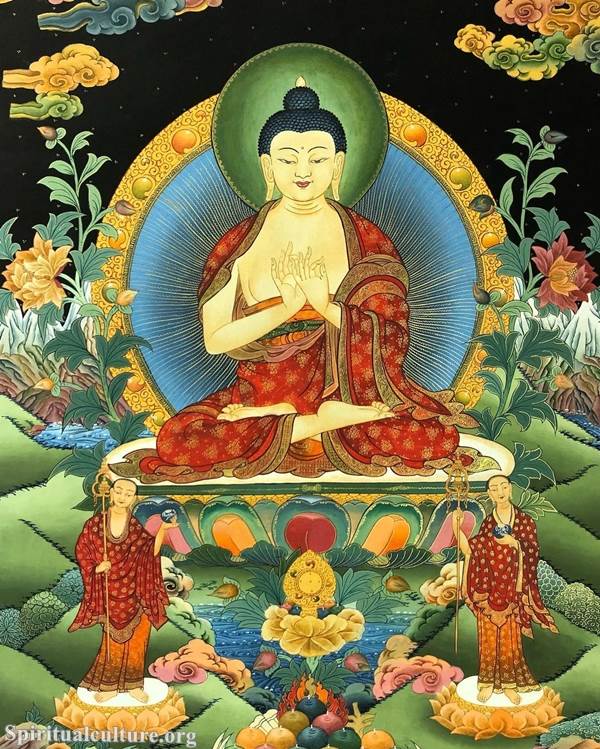
He is usually shown seated in deep meditation on a large lotus throne — a symbol of spiritual purity and transcendence. The lotus rises above the muddy waters of delusion, just as Vairocana’s wisdom rises above conceptual thinking and worldly concerns.
One of the most distinctive features of Vairocana is his hand gesture, or mudra. He most often displays the Dharmachakra Mudrā, which translates as the “gesture of turning the wheel of the Dharma.” In this mudra:
- The thumbs and index fingers of both hands touch to form circles — representing the cycle of the Dharma and the perfection of wisdom.
- The hands are held in front of the chest — symbolizing the teaching of truth from the heart.
This mudra is especially meaningful because it signifies the moment when the Buddha sets the wheel of teaching in motion. When Vairocana performs this gesture, it shows that the truth is always available, and that the teaching is eternal — not just bound to one moment in history.
Vairocana’s body is typically white in color, though sometimes rendered in gold or radiant light. The white hue symbolizes purity, all-encompassing wisdom, and the integration of all colors. It reflects his role as the mirror-like mind that embraces all phenomena without judgment, preference, or rejection.
In some depictions, Vairocana is shown with multiple faces and arms, gazing in all directions and performing many mudras at once. These forms express his omnipresence and boundless awareness — that nothing escapes the gaze of awakening, and no being is left out of his light.
While some Buddhas are shown in dynamic postures, Vairocana is usually calm, centered, and still. His serenity invites contemplation, suggesting that true illumination arises from silence and inward clarity.
Central Figure in the Mandala
One of the most significant visual expressions of Vairocana’s symbolism is found in the Mandala of the Five Dhyani Buddhas — a sacred diagram representing the enlightened qualities of the mind.
In this mandala:
- Vairocana sits at the center, representing the origin and integration of all enlightened activity.
- Surrounding him are four Buddhas, each in a cardinal direction: Akṣobhya (East), Ratnasambhava (South), Amitābha (West), and Amoghasiddhi (North).
- Each of these Buddhas embodies a specific wisdom and transforms a specific mental poison (like anger, pride, or desire).
As the central figure, Vairocana unifies their powers and reflects their shared essence. He is the axis mundi — the spiritual center of the universe, around which all transformation revolves.
This placement is deeply symbolic. In the mandala, every part has its function and beauty, but only the center holds stillness and vision. Vairocana represents that stable center within the chaos of life — the space of awareness from which we can respond rather than react, observe rather than be swept away.
The mandala itself, when used in meditation, becomes a map of the mind. To visualize Vairocana at the center is to center yourself in your own true nature — the mind that sees clearly, acts compassionately, and rests in equanimity.
In this way, Vairocana’s image is not meant for idolization, but realization. It points us back to the center within ourselves, where wisdom, clarity, and peace have always been waiting.
Vairocana in Vajrayana Buddhism
Center of the Five Wisdom Mandala
In Vajrayana Buddhism, especially within Tibetan traditions, Vairocana Buddha is not only a cosmic principle — he becomes a living focus of meditative practice and tantric transformation.
Here, Vairocana takes his place as the central Buddha of the Five Dhyani Buddhas, or Five Wisdom Tathāgatas — a sacred framework that maps how the awakened mind transforms confusion into clarity.
Each of the Five Dhyani Buddhas is associated with:
- A specific wisdom (the enlightened aspect of mind)
- A specific poison or delusion (a klesha to be transformed)
- A direction, color, element, mudra, and symbol
At the center of this mandala sits Vairocana, representing the Mirror-like Wisdom (Ādarśa-jñāna). This wisdom:
- Reflects all things just as they are, without distortion
- Is unclouded by craving, aversion, or identity
- Sees the world as a clear mirror sees reflections — vividly, but without attachment
Role in Tantra and Visualization
In Tantric Buddhism, Vairocana is not only contemplated — he is embodied. Through the practices of sādhana (spiritual discipline), practitioners visualize themselves as Vairocana, entering his form, dwelling in his mandala, and merging their mind with his.
This is not fantasy. It is a significant method of transformation.
By visualizing Vairocana’s body, speech, and mind as inseparable from one’s own, the practitioner breaks through the illusion of separation, dissolving the ego and touching the luminous core of being.
In these practices, Vairocana’s seed syllable (often “OM” or “A”) is visualized at the heart. His mantra — which may differ by lineage — is chanted not as a request for help, but as a resonance with his awakened energy.
He is also a central figure in many tantric rituals of initiation (abhisheka), where a qualified teacher symbolically empowers the student to access the sacred qualities that Vairocana represents. These empowerments are not only ceremonial — they plant seeds of realization and open the door to significant internal change.
In the Mahāvairocana Tantra, a foundational Vajrayana text, Vairocana is portrayed as the universal teacher who reveals the esoteric path to Buddhahood. In this tantra:
- The body of Vairocana is the mandala
- His speech is the mantra
- His mind is the emptiness and clarity of pure awareness
Through this integration, the practitioner’s everyday experience is gradually purified into the awakened experience of a Buddha.
In summary, Vairocana in Vajrayana is not distant or symbolic — he is a living presence within the practitioner. He is the potential of awakening, waiting to be revealed through courage, devotion, and inner stillness.
“The Buddha is not outside. Your own mind is Vairocana.”
– Vajrayana teaching