The question “Why did the Buddha reject Hinduism?” uses modern religious labels for a much older historical setting. Siddhartha Gautama, the historical Buddha, lived in northern India around the fifth century BCE, in a religious world shaped by Vedic and Brahmanical traditions as well as renunciant movements often grouped under the term śramaṇa. It is therefore more accurate to ask which ideas and practices early Buddhism accepted, reinterpreted, or challenged.
Did the Buddha reject Hinduism?
Not in the simple modern sense. “Hinduism” is a broad label for diverse Indian religious traditions that developed over many centuries. The Buddha did not encounter a single, unified religion identical to what people now call Hinduism. Early Buddhist communities instead emerged alongside Brahmanical, Jain, and other ascetic and philosophical traditions in ancient India.
The Buddha’s teaching did, however, disagree with several ideas associated with Brahmanical religious authority. Buddhism did not accept the Vedas as uniquely revealed or binding scriptures, and Buddhist texts challenged claims that spiritual worth or purity depended on birth into a particular social group.
What ideas did early Buddhism challenge?
One major difference concerns the self. Many Indian traditions developed teachings about ātman, an enduring self or spiritual essence. Early Buddhist teaching is associated with anattā (Sanskrit: anātman), the analysis that no permanent, independent self can be found within the changing processes that make up a person.
Buddhism also did not make belief in a creator god the foundation of liberation. Buddhist texts contain many kinds of divine or celestial beings, but awakening depends on understanding suffering, cultivating ethical conduct, developing the mind, and gaining insight rather than receiving salvation from a supreme creator.
Social hierarchy was another area of criticism. The Buddha lived in a society where ideas about lineage and status were important. Early Buddhist texts repeatedly argue that ethical conduct and spiritual attainment are not determined by birth, and the monastic community admitted people from different social backgrounds. It is more precise to describe this as a challenge to claims of spiritual superiority by birth than to reduce the issue to the modern phrase “the Buddha rejected the caste system.”
What did Buddhism share with other Indian traditions?
Buddhism did not develop in isolation. Concepts such as karma, rebirth, renunciation, meditation, liberation, and disciplined ethical practice were part of a wider ancient Indian religious conversation. Buddhist teachers interpreted these ideas in distinctive ways. Karma, for example, became closely connected with intentional action, while liberation was explained through the ending of ignorance and craving rather than through union with an eternal self.
Why suffering is central to the Buddha’s teaching
The Buddha’s teaching begins with the problem of dukkha, often translated as suffering, stress, or unsatisfactoriness. The Four Noble Truths identify craving (taṇhā) as a central condition in the arising of dukkha and teach that liberation is possible through the Noble Eightfold Path. This is more precise than saying that “all desire” is simply bad. Buddhist traditions distinguish craving that binds a person to dissatisfaction from wholesome intentions directed toward ethical conduct, understanding, and liberation.
The Noble Eightfold Path brings together right view, intention, speech, action, livelihood, effort, mindfulness, and concentration. These practices connect ethics, meditation, and wisdom rather than treating liberation as a matter of belief alone.
A better way to describe the relationship
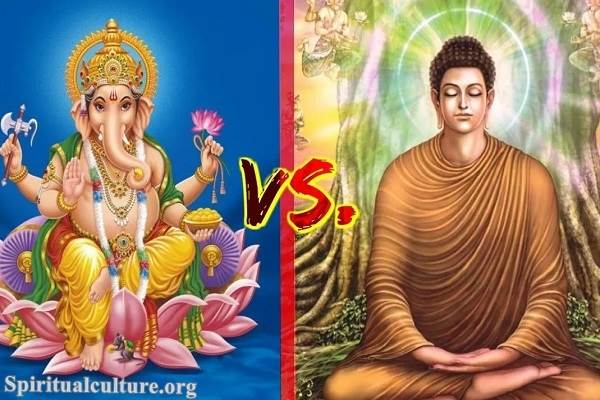
The Buddha is best understood as a teacher within the wider religious and philosophical world of ancient India who developed a distinct path and criticized particular claims about authority, selfhood, ritual status, and liberation. Buddhism later became a separate religious tradition with its own scriptures, institutions, schools, and practices.
For that reason, saying that “the Buddha rejected Hinduism” is too broad. A more historically careful description is that early Buddhism arose in dialogue and debate with Brahmanical and other Indian traditions, sharing some cultural concepts while giving them different meanings and rejecting others.