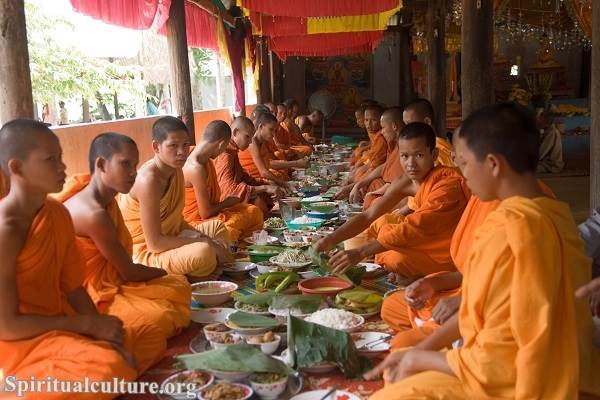
Some Buddhist monks wear orange or saffron-colored robes because early Buddhist monastic clothing was made from simple cloth and dyed with readily available natural materials. Over time, robe colors became markers of monastic identity and regional tradition. Not all Buddhist monks wear orange.
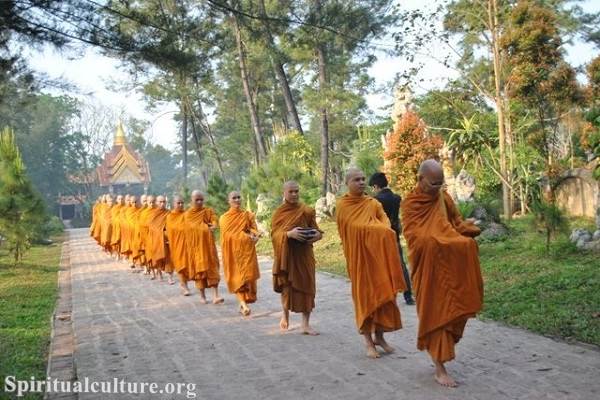
The early ideal of simple robes
Early Buddhist monastic discipline emphasized renunciation and simplicity. Monks were not supposed to dress for fashion, luxury, or social status. Traditional accounts describe robes made from discarded or donated cloth that was cleaned, sewn, and dyed.
Dyes from plants, bark, roots, earth, and other materials could produce muted yellow, ochre, rust, brown, or orange tones. The aim was practical and symbolic rather than the creation of one precise universal color.
Why orange is common in Theravāda countries
Bright orange, saffron, and ochre robes are especially associated with Theravāda monastics in countries such as Thailand, Cambodia, Laos, and Sri Lanka. Even within Theravāda communities, color shades vary by monastery, lineage, available cloth, and local custom.
The robe makes the monastic vocation immediately visible and separates the simplicity of ordained life from ordinary fashion.
Why Tibetan monks often wear maroon
Tibetan Buddhist monastics are commonly associated with deep red or maroon robes, often combined with yellow elements for particular ceremonies or ranks. This reflects a different historical and regional development of monastic dress.
Thus a maroon-robed Tibetan monk and an orange-robed Thai monk may both be following Buddhist monastic traditions even though their clothing looks very different.
East Asian robe colors
Chinese, Korean, Japanese, and Vietnamese Buddhist clergy may wear gray, brown, black, yellow, saffron, or ceremonial outer robes depending on tradition and occasion. Japanese Buddhist clerical clothing can be especially diverse because of the histories of different schools.
This diversity is a reminder that “Buddhist robe” is a category with many regional forms.
What the robe symbolizes
- renunciation of ordinary status and fashion;
- membership in a monastic community;
- discipline and commitment to the Dharma;
- continuity with earlier generations of Buddhist monastics;
- simplicity and dependence on lay support.
Is orange a sacred color for all Buddhists?
No. Orange can have strong religious associations in some Buddhist cultures, but Buddhism does not require every monk or nun in the world to wear the same shade.
The more accurate statement is that ochre and saffron-colored robes became especially prominent in some Buddhist monastic traditions, while other traditions developed different colors and styles.