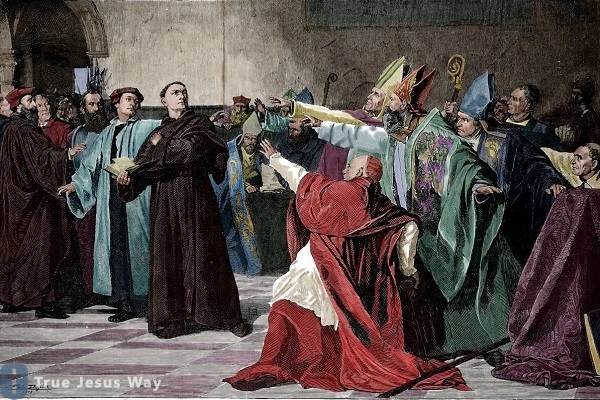
Martin Luther’s Ninety-Five Theses were a Latin academic disputation on indulgences circulated in 1517. They became a symbolic starting point of the Protestant Reformation, but they were not a complete Protestant confession and did not yet contain every doctrine later associated with Lutheranism. Spiritual Culture places the theses inside the late-medieval Catholic practice of penance, indulgences, university debate, printing, and reform.
The full title
The document is commonly called the Ninety-Five Theses, but its historical title is usually translated as the Disputation on the Power and Efficacy of Indulgences.
31 October 1517
A joint Lutheran-Catholic historical study states that Luther sent the theses with a letter to Archbishop Albrecht of Mainz on 31 October 1517 and also wrote to his diocesan bishop.
Were they nailed to the church door?
The same ecumenical study says Luther most likely posted the theses on the Castle Church door in Wittenberg, while historians distinguish that probable academic practice from later dramatic retellings.
What was an indulgence?
In late-medieval Catholic theology, an indulgence concerned temporal punishment connected with sins whose guilt had already been forgiven. It was not officially a permission slip to commit future sin.
Luther’s central concern
Luther believed indulgence preaching and popular practice could damage genuine repentance, Christian spirituality, and care for the poor.
The theses were written for debate
They were framed as propositions for academic disputation, not as a declaration that Luther was founding a new denomination on that day.
Printing changed the scale
Copies circulated rapidly beyond Wittenberg. Print culture helped transform a university controversy into a public European dispute.
The Reformation became much larger
Later controversies involved papal authority, justification, Scripture, sacraments, church structure, politics, education, worship, and relations between princes and church institutions.
Catholic teaching also developed through reform
The Catholic Reformation and Council of Trent addressed discipline, education, sacramental teaching, and church reform in ways that should not be reduced to a simple reaction against one document.
Why 1517 remains symbolic
Reformation traditions use 31 October as a landmark because the indulgence controversy became a flashpoint for a much wider transformation of Western Christianity.
Historical context
The 95 Theses matter because they reveal the first public stage of a controversy that expanded far beyond indulgences. Reading them historically is more accurate than treating them as the instant birth certificate of Protestantism.