Buddhism does not teach that sexual intimacy is inherently forbidden for laypeople. The central lay guideline is the third precept, usually translated as refraining from sexual misconduct. Its application depends on consent, harm, honesty, commitments, power, and the norms of a Buddhist community.
Laypeople and the third precept
Traditional explanations commonly warn against adultery, coercion, exploitation, abuse, and sexual relationships that violate serious commitments or cause foreseeable harm.
Modern Buddhist teachers often place explicit emphasis on consent, equality, honesty, and avoidance of manipulation.
Monastic celibacy
Fully ordained Buddhist monks and nuns follow celibacy as part of the Vinaya. Sexual intercourse is incompatible with full monastic ordination.
This is a monastic rule, not a requirement that all Buddhists avoid sexual relationships.
Marriage and partnership
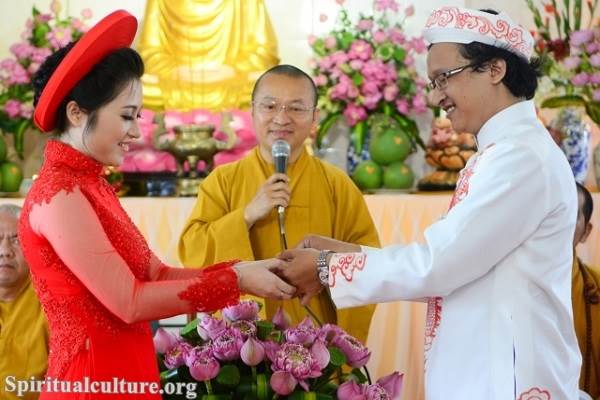
Buddhist laypeople may marry, form families, and have sexual relationships. Buddhism has no universal sacrament of marriage comparable to some Christian traditions; marriage is often treated as a social and ethical relationship shaped by local culture.
Buddhist ceremonies may bless a marriage without making the union a monastic or universally defined doctrinal institution.
Different cultures, different norms
Views on premarital sex, contraception, sexual orientation, and gender vary among Buddhist societies and teachers. Cultural conservatism should not automatically be presented as a universal teaching of the Buddha.
Conversely, modern liberal interpretations should not be assumed to represent every traditional community.
What “sexual misconduct” means in practice
The third precept is concise, and Buddhist communities have interpreted its application through social and ethical context. Traditional explanations commonly focus on adultery, prohibited partners, coercion, exploitation, abuse of trust, and conduct that causes serious harm. Modern teachers often discuss consent and power more explicitly, especially where relationships involve unequal authority, dependency, or vulnerability.
Because these explanations developed in different legal and cultural worlds, no single historical list answers every contemporary question. The continuing ethical task is to apply non-harm, honesty, responsibility, and awareness of consequences rather than to treat sexuality as morally neutral or inherently impure.
Orientation, contraception, and modern debates
Buddhist communities do not speak with one voice on sexual orientation, same-sex relationships, contraception, or premarital sex. Some teachers interpret the precept primarily through harm and consent, while others retain more conservative expectations shaped by traditional family and social norms.
It is therefore misleading to claim either that “Buddhism approves” or “Buddhism forbids” every modern relationship question. A careful answer identifies the tradition, teacher, country, and whether the discussion concerns monastics or laypeople.
Core ethical question
For lay Buddhist ethics, the central question is not whether intimacy exists but whether conduct is honest, consensual, responsible, and free from exploitation and serious harm.