Buddhism has no single worldwide hierarchy comparable to a centralized church. Authority is organized differently in Theravāda, Mahāyāna, Vajrayāna, and national Buddhist institutions. The most basic distinction is usually between monastic communities and lay followers, while leadership depends on ordination, seniority, training, office, and lineage.
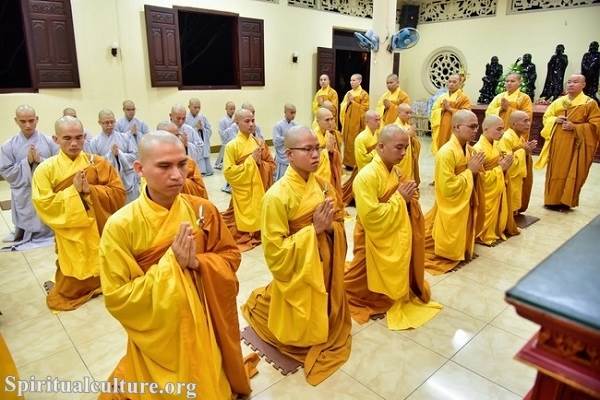
Monks, nuns, and ordination
Fully ordained monks are commonly called bhikkhus in Pāli or bhikṣus in Sanskrit; fully ordained nuns are bhikkhunīs or bhikṣuṇīs. Novices follow a smaller set of training rules before full ordination. In communities preserving a Vinaya lineage, seniority is often counted from ordination rather than social status.
Lay Buddhists may also be respected teachers without being monastics. Modern organizations include meditation teachers, scholars, chaplains, administrators, and community leaders.
Leadership in monasteries
An abbot or abbess normally oversees a monastery or nunnery. Senior monastics may guide discipline, education, ritual life, finances, and the training of novices. Titles vary by language and country, so the same English word can describe offices with different responsibilities.
In some Theravāda countries, national or regional structures include senior monks or a supreme patriarch. Such offices are shaped by local history and law and are not universal Buddhist ranks.
Teachers and lineages
Tibetan Buddhism places strong emphasis on teaching lineages. Titles such as lama, rinpoche, khenpo, and geshe describe different kinds of teachers, scholars, or recognized figures. Some schools recognize tulkus, teachers believed within that tradition to be rebirths of earlier masters.
Zen and other East Asian traditions likewise transmit authority through teacher-student lineages, but institutional titles differ among Japanese, Chinese, Korean, Vietnamese, and Western communities.
Is there a Buddhist pope?
No single person governs all Buddhists. The Dalai Lama is an internationally prominent Tibetan Buddhist leader, but he is not the head of Buddhism as a whole. Theravāda, Zen, Pure Land, Tibetan, and other traditions maintain separate institutions and forms of authority.
A better way to understand Buddhist authority
Rather than imagining one global ladder of rank, ask which Buddhist tradition, country, monastery, or lineage is being discussed.