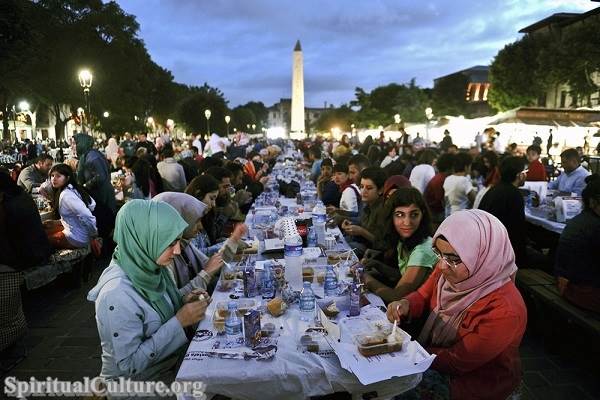
Muslims form the world’s second-largest religious population. The most recent comprehensive country-by-country estimates from Pew Research Center, published in 2025 and describing the religious landscape in 2020, place the global Muslim population at about 2.02 billion people, or 25.6% of the world’s population. Because religious censuses and surveys are not conducted in every country at the same time, global totals should be read as demographic estimates rather than real-time counts.
How many Muslims are there in the world?
Pew Research Center estimates that the Muslim population grew from about 1.68 billion in 2010 to about 2.02 billion in 2020, an increase of roughly 21% over the decade. Islam therefore remained the second-largest major religious tradition after Christianity and grew faster than the global population as a whole during that period.
Population growth does not mean that Muslim communities are evenly distributed. Most Muslims live outside the Middle East and North Africa, and the largest concentration is in the Asia-Pacific region.
Where do most Muslims live?
About 59% of the world’s Muslims lived in the Asia-Pacific region in 2020. Indonesia had the largest Muslim population, with roughly 240 million Muslims, or about 12% of the global Muslim total. Pakistan and India were also among the countries with the largest Muslim populations.
India is especially important in demographic discussions because Islam is not the country’s majority religion. Pew estimated that India had about 213 million Muslims in 2020, representing roughly 15% of the country’s population. This makes India home to one of the world’s largest Muslim communities despite its Hindu majority.
Muslims in the Middle East and North Africa
Islam is the majority religion across much of the Middle East and North Africa, and the region has enormous historical importance in Islamic civilization. Mecca and Medina in present-day Saudi Arabia are Islam’s two holiest cities, while Jerusalem also holds major religious significance in Islamic tradition.
Even so, the Middle East and North Africa should not be treated as synonymous with the Muslim world. A larger number of Muslims live in Asia, and Muslim societies differ widely in language, ethnicity, law, religious practice, and historical experience.
Muslims in sub-Saharan Africa
Sub-Saharan Africa is home to a large and growing share of the global Muslim population. Pew estimated about 369 million Muslims in the region in 2020, and Muslims accounted for about one-third of the region’s total population. Nigeria contains one of the world’s largest Muslim populations, while countries such as Senegal, Mali, Niger, Somalia, and others also have Muslim-majority or very large Muslim communities.
The religious landscape is highly diverse, however. Islam in West Africa, the Horn of Africa, and East Africa has developed through different histories of trade, scholarship, Sufi networks, states, colonial rule, migration, and local cultural traditions.
Muslims in Europe
Muslims made up about 6% of Europe’s population in 2020 according to Pew’s estimates. European Muslim communities include long-established populations in the Balkans and Eastern Europe as well as communities shaped by twentieth- and twenty-first-century migration.
Countries such as France, Germany, the United Kingdom, Italy, Russia, Albania, Bosnia and Herzegovina, and Kosovo illustrate the different historical paths through which Islam has become part of European society. Estimates vary by country because census systems and questions about religious identity differ.
Muslims in North America and Latin America
Pew estimated that 5.9 million Muslims lived in North America in 2020. This regional figure should not be confused with Pew’s earlier estimate of 3.45 million Muslims in the United States in 2017. The 3.45 million figure referred specifically to the United States, not to all of the Americas.
Muslim communities also live throughout Latin America and the Caribbean, although the region has a much smaller Muslim population than Asia, Africa, Europe, or North America. Communities in countries such as Brazil, Argentina, Guyana, Suriname, and Trinidad and Tobago have distinct histories shaped by migration, trade, colonialism, and conversion.
Sunni, Shia, and other Muslim communities
The global Muslim population is not institutionally or theologically uniform. Sunni Muslims form the majority worldwide, while Shia Muslims are especially prominent in countries such as Iran and Iraq and have significant communities elsewhere. Other traditions and movements, including Ibadi communities and a wide range of Sufi orders, also form part of the religious landscape.
These categories describe broad religious identities and do not capture the full diversity of Muslim practice. Local traditions, schools of law, languages, political histories, and patterns of religious observance vary considerably from one society to another.
Why Muslim population estimates change
Religious population figures change as new censuses and surveys become available. They are also affected by births, deaths, migration, and changes in religious identification. Pew’s 2025 global report concluded that Muslims were the fastest-growing major religious group between 2010 and 2020, driven largely by the relatively young age structure and higher fertility of Muslim populations in many countries.
For that reason, older figures should not be mixed with newer regional estimates without noting their reference year and methodology. A figure for the United States in 2017, for example, cannot be used as a count for the entire Americas in 2021.
Sources and data note
This overview uses the comparable 2020 estimates published in Pew Research Center’s 2025 report How the Global Religious Landscape Changed From 2010 to 2020. The report draws on more than 2,700 censuses and surveys across 201 countries and territories. Country and regional figures are estimates and may differ from later national statistics or surveys.