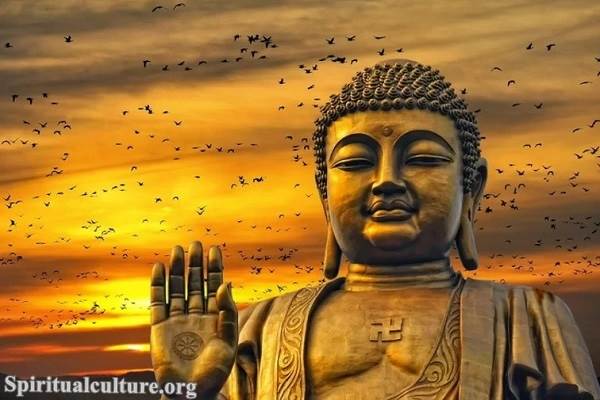
Dharma is one of the central words in Buddhism. In Pali it is usually written Dhamma. The term has several meanings, so its sense depends on context rather than one fixed English translation.
Dharma as the Buddha’s teaching
Most commonly, Dharma means the teaching associated with the Buddha: the explanation of suffering, its causes, its cessation, and the practices leading to liberation. In this sense, the Four Noble Truths and Noble Eightfold Path are core expressions of the Dharma.
Dharma as one of the Three Jewels
Buddhists traditionally take refuge in the Buddha, Dharma, and Sangha. Here Dharma means the teaching and path that are relied upon for understanding and practice. Different Buddhist schools preserve this teaching through different canons, commentaries, rituals, and lineages.
Dharma can also mean phenomena
In Buddhist philosophical and analytical texts, dharma or dhamma can refer to a phenomenon, quality, mental object, teaching category, or factor of experience. The exact translation changes with the passage. This is why statements such as “all dharmas are impermanent” use the word differently from “I take refuge in the Dharma.”
Dharma and the Four Noble Truths
The Buddha’s teaching is organized around a practical problem:
- there is dukkha, or suffering and unsatisfactoriness;
- dukkha has causes, especially craving and ignorance;
- cessation is possible;
- the Eightfold Path is the training leading toward cessation.
Buddhist traditions build extensive philosophies around these ideas, but the teaching remains tied to practice rather than abstract speculation alone.
Dharma across Buddhist traditions
Theravāda Buddhism emphasizes the Pali Canon and later Theravāda commentaries. Mahāyāna traditions also rely on many Mahāyāna sutras and treat the bodhisattva path, emptiness, and compassion as major frameworks. Vajrayāna traditions add tantric texts and practices transmitted through particular lineages.
Is Dharma the same as religion?
Not exactly. “Buddhism” names a broad religious tradition. “Dharma” can mean its teaching, the truth taught, the path of practice, or phenomena analyzed within Buddhist thought. Translating every use as “religion” would hide these differences.
Why the spelling varies
Dhamma is the Pali form and is common in Theravāda contexts. Dharma is the Sanskrit form and is widely used in Mahāyāna, Vajrayāna, and English-language discussion. Both spellings can be correct when their linguistic and historical context is clear.
Dharma as something to be practiced
Buddhist texts repeatedly connect hearing the teaching with reflection and cultivation. Knowing terminology is not the same as following the path. Ethical conduct, meditation, and wisdom are ways the Dharma is enacted rather than merely described.
Dharma and dependent origination
One of the Buddha’s central explanatory frameworks is dependent origination: phenomena arise because of conditions and cease when relevant conditions cease. This principle is applied especially to the arising of suffering and the possibility of ending it.
Does Dharma mean “cosmic law”?
In Indian religious history, dharma has many meanings, including duty, law, teaching, or proper order. Buddhism inherited the word but developed its own uses. Calling Buddhist Dharma simply “cosmic law” can be misleading unless a specific text or tradition uses that interpretation.
Dharma and scripture
The Dharma is not identical to one physical book. Theravāda, East Asian, and Tibetan traditions preserve large scriptural canons with different contents. Buddhists may treat a text as a vehicle for Dharma while also distinguishing the teaching from the manuscript, translation, or edition that carries it.