There is no single food list that all Buddhists are forbidden to eat. Buddhist dietary practice varies by school, country, monastic status, and personal commitment. Many Buddhists eat meat, many are vegetarian, and some Mahāyāna communities strongly encourage or require vegetarian diets in particular settings.
The First Precept and non-harming
The First Precept asks lay Buddhists to refrain from taking life. This creates an ethical concern about killing animals, but Buddhist traditions have interpreted the relationship between the precept and eating meat in different ways.
Some Buddhists avoid meat because they see vegetarianism as the clearest expression of compassion. Others distinguish between personally killing an animal and eating food that was not specifically killed for them.
Theravāda approaches
In traditional Theravāda monastic life, monks and nuns often depend on food offered by laypeople and are not expected to demand favorite foods. Early monastic rules permit certain meat under conditions, while prohibiting meat when the monastic knows, sees, or suspects that the animal was killed specifically for them.
Modern Theravāda lay Buddhists may be vegetarian or meat-eating. Practice differs among families, temples, and countries.
Mahāyāna vegetarian traditions
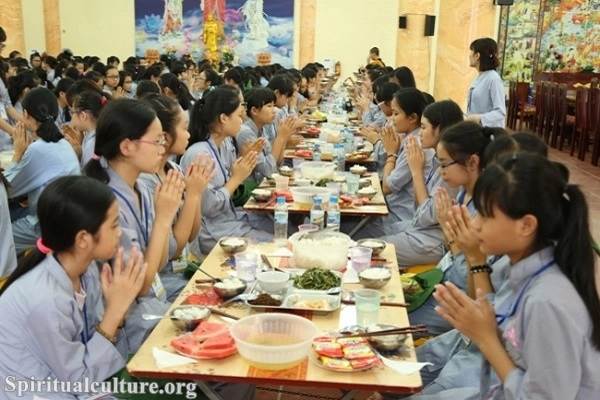
Several East Asian Mahāyāna traditions developed strong vegetarian monastic cultures. Chinese and Vietnamese monasteries commonly serve vegetarian food, and some lay Buddhists eat vegetarian diets on observance days or permanently.
Not every Mahāyāna Buddhist is vegetarian, and Japanese, Korean, Himalayan, and modern communities have their own histories and practices.
Vajrayāna and Himalayan contexts
Tibetan and Himalayan Buddhist communities historically lived in environments where agriculture and year-round vegetable supply could be difficult. Meat therefore remained part of many diets even while compassion toward animals was strongly valued.
Contemporary Tibetan Buddhists show a range of practices, including growing vegetarian movements.
Other monastic food rules
Monastic discipline can include rules beyond meat. In many Theravāda communities, monks do not eat solid food after noon until the next dawn, except for allowable medicines or drinks according to the rule system.
Some East Asian traditions avoid pungent plants such as garlic or onions in particular monastic or ritual settings. These customs should not be generalized to all Buddhists.
Alcohol and intoxicants
The Fifth Precept concerns intoxicants that lead to heedlessness. Alcohol is therefore more directly addressed by Buddhist precepts than coffee, tea, or ordinary foods.
Individual interpretations of medicines and modern substances vary, but deliberate intoxication is widely treated as contrary to Buddhist ethical training.
The clearest answer
Buddhism does not have one worldwide list of forbidden foods. Dietary practice is shaped by non-harming, monastic rules, local tradition, and personal vows.
See also the Five Precepts and the site’s discussion of Buddhist ethics.