Across continents and cultures, there are places where heaven feels closer — where the weight of prayer, pilgrimage, and divine encounter lingers in the air. These are the holiest places in the world. For millennia, seekers of every tradition have journeyed to them in search of healing, meaning, forgiveness, and union with the Divine.
These places are not only ancient. They are alive with mystery, memory, and the longing of generations.
Mecca, Saudi Arabia — The Heart of Islam
The Sacred Center of Unity
Mecca (Makkah) is the holiest city in Islam, the birthplace of the Prophet Muhammad, and home to the Kaaba — the black cubic structure believed to be built by Abraham and his son Ishmael. Muslims around the world pray facing Mecca five times a day, and the Hajj pilgrimage, one of Islam’s Five Pillars, brings millions of faithful here annually.
“Indeed, the first House [of worship] established for mankind was that at Bakkah (Mecca) — blessed and a guidance for the worlds.” (Qur’an 3:96)
Spiritual Meaning
Mecca represents surrender — the full submission of the heart to God (Allah). It is not just a destination, but a deep orientation of the soul. The journey to Mecca, in body or in heart, is one of purification, equality, and remembrance.
Jerusalem, Israel — A City of Three Faiths
A Holy Tapestry of Jewish, Christian, and Islamic Devotion
Few cities have held such enduring religious significance as Jerusalem. For Jews, it is the site of the ancient Temples and the eternal capital. For Christians, it is where Jesus was crucified and resurrected. For Muslims, it is home to Al-Aqsa Mosque, the third-holiest site in Islam and the place of the Prophet’s night journey.
Sacred Sites Within Jerusalem
- Western Wall (Judaism) – Remnant of the Second Temple
- Church of the Holy Sepulchre (Christianity) – Site of crucifixion, burial, resurrection
- Al-Aqsa Mosque & Dome of the Rock (Islam) – Sacred space of ascension
Spiritual Meaning
Jerusalem embodies sacred memory, divine promise, and hope for reconciliation. It is a city where deep wounds and profound holiness coexist — reminding us that the path to God often runs through suffering, faith, and healing.
Varanasi, India — The Soul of Hinduism
Where Life, Death, and Eternity Meet
One of the oldest continuously inhabited cities on Earth, Varanasi is the holiest city in Hinduism. Located on the banks of the sacred Ganges River, it is believed that to die here is to attain moksha — liberation from the cycle of rebirth.
“He who dies in Kashi (Varanasi) is liberated.” – Hindu belief
Rituals and Practices
- Daily Ganga Aarti ceremonies draw thousands
- Pilgrims bathe in the Ganges to purify karma
- Cremation on the riverbanks symbolizes the soul’s journey beyond
Spiritual Meaning
Varanasi is not merely about death — it is about transcendence. It invites reflection on impermanence, the illusion of ego, and the sacredness of every breath.
Bodh Gaya, India — The Tree of Awakening
The Birthplace of Enlightenment
Under the shade of a Bodhi tree in Bodh Gaya, Siddhartha Gautama became the Buddha after intense meditation. For Buddhists, this site represents the very origin of enlightenment.
“Here on this seat, under this tree, I have attained Supreme Enlightenment.” – The Buddha
Key Site
- Mahabodhi Temple – Marks the location of the Bodhi tree
- Pilgrims circle it in silent reverence, often meditating for days
Spiritual Meaning
Bodh Gaya teaches that awakening is possible. It is a quiet testament that peace begins within, through stillness, mindfulness, and wisdom.
Vatican City, Rome — The Heart of Catholic Christianity
The Seat of the Pope and a Pilgrimage of Faith
A sovereign city-state within Rome, Vatican City is the spiritual center of the Roman Catholic Church. It houses St. Peter’s Basilica, built over the tomb of Saint Peter — one of Christ’s apostles and the first pope.
Sacred Sites
- St. Peter’s Basilica – Architectural masterpiece and sacred tomb
- Sistine Chapel – Michelangelo’s art reveals divine beauty
- Papal Masses – Unifying moments of global Catholic faith
“And on this rock I will build my church.” – Matthew 16:18
Spiritual Meaning
Vatican City reflects tradition, continuity, and the sacred authority of the Church. It invites believers to walk in the footsteps of saints and seek unity through the Eucharist.
Lumbini, Nepal — The Buddha’s Birthplace
A Sacred Garden of Beginnings
Lumbini is the place where Queen Maya Devi gave birth to Siddhartha Gautama in 623 BCE. Today, it is a UNESCO World Heritage Site and a major Buddhist pilgrimage location.
Key Features
- Maya Devi Temple – Built at the precise birth location
- Peaceful monastic zones from various Buddhist nations
- Sacred pool and Ashokan pillar commemorating the site
Spiritual Meaning
Lumbini reminds us of sacred potential. Every soul, like the Buddha, is born with the seed of awakening.
Mount Sinai, Egypt — The Mountain of Revelation
Where God Spoke to Moses
In the Abrahamic traditions, Mount Sinai is where Moses received the Ten Commandments from God. It is a symbol of covenant, divine law, and spiritual ascent.
“The Lord descended to the top of Mount Sinai and called Moses to the top of the mountain.” – Exodus 19:20
Pilgrimage
- Still climbed by pilgrims today for sunrise reflection
- Monastery of St. Catherine at the base, one of Christianity’s oldest
Spiritual Meaning
Mount Sinai calls us upward — into obedience, encounter, and transformation.
The Golden Temple, Amritsar — Sikhism’s Shining Heart
A Place of Equality, Beauty, and Service
Also known as Harmandir Sahib, the Golden Temple is the holiest site in Sikhism. Built on a foundation of humility and universal brotherhood, it welcomes people of all faiths.
Core Values
- Langar (community kitchen) – Free meals for all
- 24/7 scripture reading – Eternal presence of the divine word
- Surrounded by Amrit Sarovar (pool of nectar) – Symbol of spiritual purity
Spiritual Meaning
The Golden Temple is a radiant symbol of service (seva), remembrance (simran), and the oneness of humanity.
Uluru, Australia — The Sacred Heart of Aboriginal Dreaming
A Spiritual Rock in the Desert
Uluru (formerly known as Ayers Rock) is a massive sandstone monolith revered by Australia’s Indigenous Anangu people. It is not only a natural wonder — it is a sacred site filled with ancestral stories known as the Dreamtime.
Sacred Meaning
- Caves and carvings contain spiritual lessons
- Not climbed out of deep respect for tradition
- Site of ceremonies, creation myths, and songlines
Spiritual Meaning
Uluru is a living story — a reminder that the earth itself is sacred, and that wisdom is passed through land, ritual, and silence.
Shinto Shrines, Japan — Pathways to the Kami
Entering the Realm of the Sacred
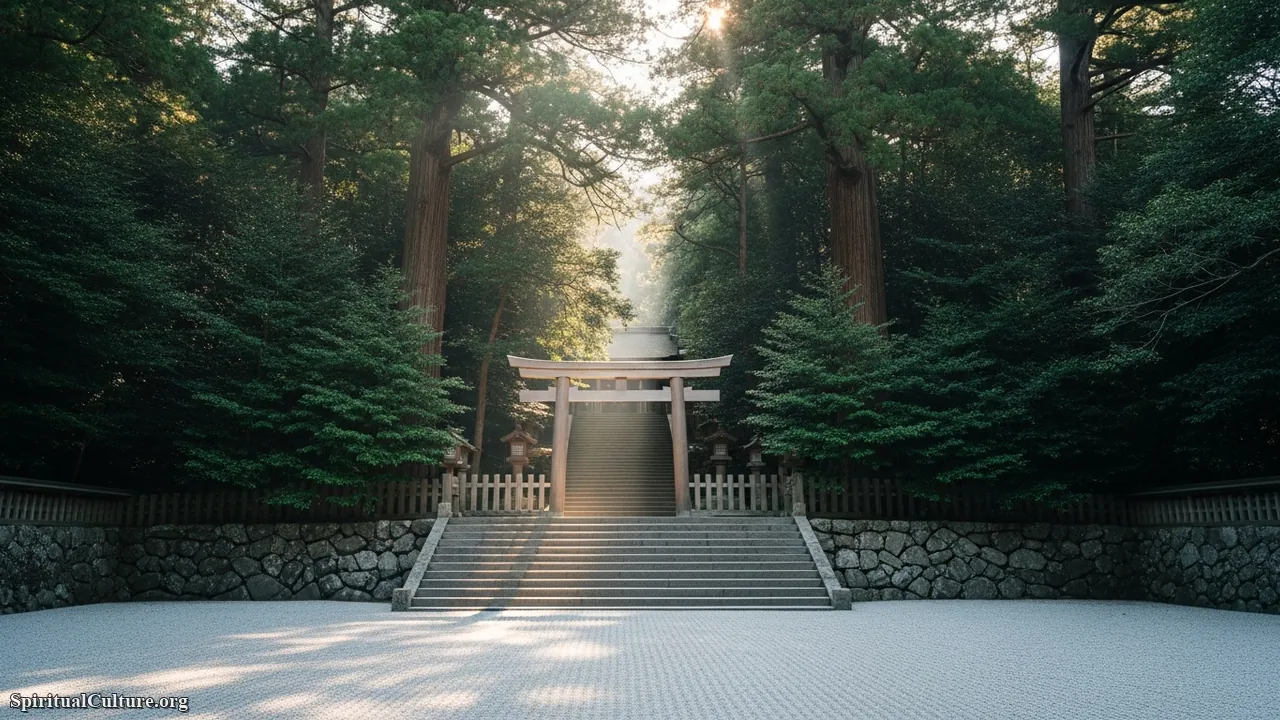
In Shinto, Japan’s indigenous spirituality, shrines are portals to the divine known as kami — sacred spirits of nature, ancestors, and place.
Famous Shrines
- Ise Grand Shrine – Dedicated to sun goddess Amaterasu
- Fushimi Inari Shrine – Famous for thousands of vermilion torii gates
- Meiji Shrine – Honors Emperor Meiji and his consort
Ritual Elements
- Torii gates mark transition from profane to sacred
- Purification rituals (temizu) and offerings (saisen)
Spiritual Meaning
Shinto shrines embody the sacred in everyday life — teaching reverence for beauty, nature, and the unseen harmony that sustains existence.
Mount Kailash, Tibet — The Axis of the World
A Sacred Peak for Four Faiths
Mount Kailash is unique in that it is sacred to Hindus, Buddhists, Jains, and followers of the Bon tradition. It is never climbed, only circled — out of awe and respect.
Pilgrimage Practice
- Kora – A ritual circumambulation (32 miles) believed to purify lifetimes of karma
- Believed to be the abode of Shiva in Hinduism
- Buddhists associate it with Demchok, representing supreme bliss
Spiritual Meaning
Kailash is a cosmic mountain — the spiritual center of the universe. It reminds us that the highest truths are not conquered but approached with humility.
Conclusion
These holiest places are more than destinations. They are mirrors of the soul’s longing — for God, for peace, for purpose. They remind us that the sacred is both universal and deeply personal. Whether you walk the sands of Mecca, the steps of Jerusalem, or the banks of the Ganges, the true pilgrimage begins within.
In every tradition, we see the same yearning: to draw near to the Source of life, to be healed, to be whole. You do not need to travel the world to find the holy — but seeing how the world honors the sacred can awaken a deeper reverence in your everyday life.
“Wherever you stand, be the soul of that place.” — Rumi
Let these places not only inform you — let them transform you.