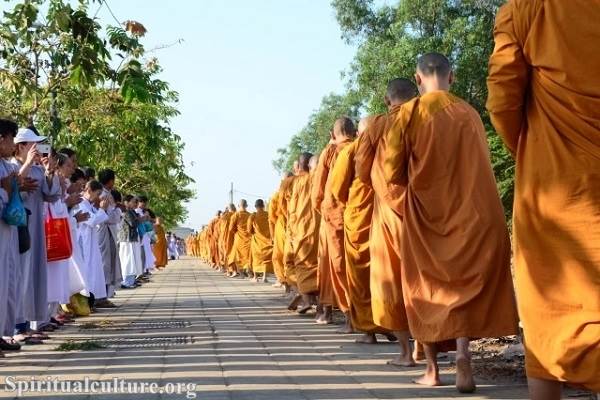
Sangha is a Sanskrit and Pali word meaning an assembly or community. In Buddhism it has several related meanings, so the context matters.
The monastic Sangha
In its most traditional institutional sense, the Sangha is the community of ordained Buddhist monks and nuns. The Buddha’s monastic community developed rules of discipline, known as Vinaya, for communal life, ordination, ethical conduct, teaching, and the use of material support.
Monastic communities differ across Theravada, Mahayana, and Vajrayana traditions. Ordination lineages, robes, daily schedules, study systems, and local customs are not identical, but the basic idea of a community dedicated to Buddhist training is widely shared.
The noble Sangha
Buddhist texts also use Sangha for the community of noble disciples who have directly realized stages of the path. In this sense, Sangha is not simply a social group or membership organization. It refers to practitioners regarded as having attained genuine insight.
Sangha as one of the Three Jewels
Buddhists traditionally take refuge in the Buddha, the Dharma, and the Sangha. These are called the Three Jewels or Three Refuges. The Buddha is the awakened teacher, the Dharma is the teaching and path, and the Sangha is the community that preserves, practices, and embodies the teaching.
Laypeople and the Sangha
Historically, lay Buddhists and monastics have depended on one another. Lay followers provide food, clothing, shelter, medicine, and other forms of support. Monastics teach, preserve texts and rituals, conduct ceremonies, and maintain communities of practice. The relationship varies by region and tradition.
Modern use of the word
Many contemporary Buddhist groups use “sangha” more broadly for the whole local practice community, including lay meditators. This usage is common in modern global Buddhism, although it is broader than some classical meanings of the term.
For that reason, a statement such as “the Sangha” may refer to ordained monastics, noble disciples, or a wider Buddhist community. The intended meaning should be identified from context.
Ordination and communal discipline
Formal monastic Sanghas are shaped by ordination lineages and Vinaya rules. Decisions may be made through communal procedures, seniority, teachers, abbots, or wider ecclesiastical structures depending on the tradition. There is no single worldwide Buddhist authority governing every Sangha.
Why the term is easy to misunderstand
Sangha is sometimes translated simply as “church,” but the comparison is imperfect. A Buddhist Sangha can mean an ordained community, an ideal community of realized disciples, or a local practice group. Using the word carefully helps distinguish monastic institutions from broader Buddhist communities.

