Christian holidays are more than dates on a calendar. They are moments when time itself becomes a teacher, inviting believers to remember who God is, what Christ has done, and how the Holy Spirit continues to renew the world. In a hurried age, they offer sacred pauses: days to rejoice, to grieve, to wait, to give thanks, and to begin again.
This article views the Christian year as a spiritual life through the central mystery of faith. From the quiet expectation of Advent to the blazing joy of Easter, from the sorrow of Good Friday to the hope of Pentecost, each holy day speaks to a part of the human heart. We all know longing, loss, celebration, doubt, gratitude, and the desire for a new beginning.
Christian holidays also reveal something beautiful about the global Church. Christians in different nations, languages, and traditions may celebrate with distinct foods, music, prayers, processions, and customs. Yet beneath this diversity is a shared story: God comes near, Christ gives himself in love, death does not have the final word, and the Spirit gathers people into a living community of hope.
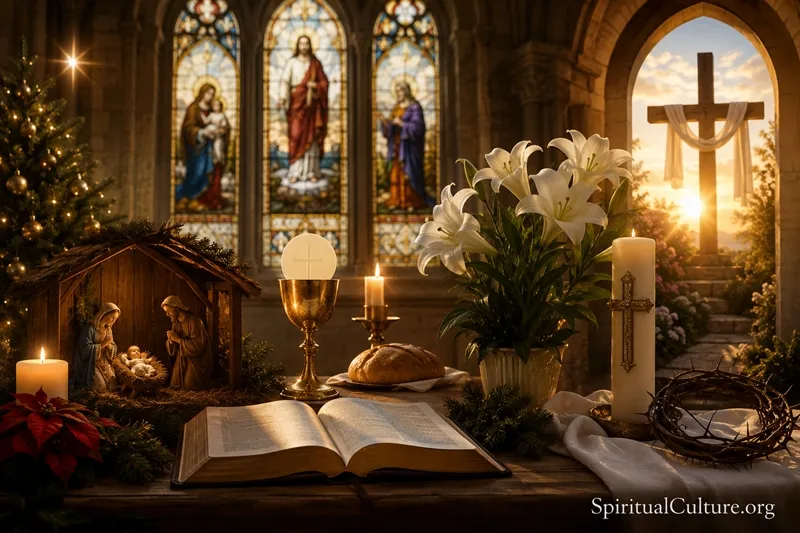
What Are Christian Holidays?
The word “holiday” originally comes from the idea of a “holy day.” In Christian life, a holy day is not simply a break from work or a cultural celebration. It is a day set apart for worship, remembrance, prayer, and renewed attention to God.
Christian holidays often center on major events in the life of Jesus Christ: his birth, baptism, ministry, death, resurrection, ascension, and the sending of the Holy Spirit. Other feast days remember the saints, the Virgin Mary, the apostles, or important moments in the history of the Church.
A Calendar That Tells a Story
The Christian calendar is sometimes called the liturgical year. “Liturgical” refers to the public worship of the Church. Instead of allowing the year to be shaped only by work schedules, political events, sales seasons, or personal milestones, the liturgical year offers another rhythm.
It tells the story of salvation again and again.
The year begins not with human achievement, but with waiting. It moves toward the birth of Christ, then through his public ministry, his suffering, his resurrection, and the birth of the Church at Pentecost. It returns, once more, to hope and expectation.
This rhythm reminds believers that faith is not only an idea to accept. It is a life to enter.
Shared Faith, Different Traditions
Not every Christian church observes every holy day in the same way. Roman Catholics, Eastern Orthodox Christians, Oriental Orthodox Christians, Anglicans, Lutherans, Methodists, Presbyterians, Baptists, Pentecostals, and many other communities may emphasize different parts of the calendar.
Some churches follow a full liturgical cycle with specific colors, readings, fasts, and feast days. Others focus primarily on Christmas, Good Friday, Easter, and Pentecost. Some Orthodox churches celebrate certain feasts on dates that differ from Western churches because of calendar traditions.
These differences do not erase the shared center. Across the Christian world, the heart of the faith remains Jesus Christ: born for the world, crucified in love, risen in glory, and present with his people through the Spirit.
The Christian Year: A Journey Through the Life of Christ
Time Can Become Sacred
Many people experience time as pressure. Deadlines, responsibilities, aging, regret, and uncertainty can make life feel like a race we are always losing. Christian holidays offer another vision.
They teach that time can become sacred when it is received with gratitude and opened to God.
The Bible describes God as faithful across generations. Psalm 90:1 says, “Lord, you have been our dwelling place for all generations.” This verse shows that human life changes quickly, but God remains a place of refuge.
A holy day does not remove life’s struggles. It changes how we carry them. It asks us to pause long enough to remember that our lives belong to a larger story than our immediate fears.
Advent: The Season of Holy Waiting
Advent is the season that prepares Christians for Christmas. It usually begins four Sundays before Christmas and is marked by themes such as hope, peace, joy, love, repentance, and expectation.
In many churches, Advent is a quieter season. Candles are lit one by one. Prayers become more attentive. The Church remembers the ancient longing for a Savior and waits again for Christ to come into the world.
Waiting Is Not Wasted Time
Modern culture often treats waiting as an inconvenience. We wait in traffic, wait for answers, wait for healing, wait for opportunities, wait for relationships to mend, and wait for grief to become more bearable.
Advent gives waiting a spiritual meaning.
It teaches that waiting can become a form of trust. A seed waits beneath the soil. A child waits to be born. Dawn waits behind the night. In the same way, faith sometimes grows quietly before any visible answer arrives.
The prophet Isaiah gave voice to this longing: “The people who walked in darkness have seen a great light” (Isaiah 9:2). Christians hear these words as a promise that darkness is real, but it is not ultimate.
Advent and the Human Heart
Advent speaks to those who are tired of pretending everything is fine. It makes room for unfinished prayers and unhealed places. It says that longing is not a failure of faith; it can be the beginning of faith.
A person may wait for reconciliation with family. Another may wait for work, health, peace, direction, or freedom from anxiety. Advent does not promise that every desire will be fulfilled exactly as we expect. It promises that God is not indifferent to human longing.
The season prepares the heart to recognize grace when it arrives quietly.
Christmas: God Comes Near
Christmas celebrates the birth of Jesus Christ. It is one of the most widely recognized Christian holidays in the world, but its spiritual meaning reaches far beyond decorations, meals, music, or gifts.
At Christmas, Christians celebrate the mystery of the Incarnation: God becoming human in Jesus Christ.
The Gospel of John says, “The Word became flesh and lived among us” (John 1:14). This simple sentence contains one of Christianity’s deepest claims. God did not remain distant from human pain, weakness, and confusion. In Christ, God entered the human story.
The Humility of Bethlehem
Jesus was not born in a palace surrounded by worldly power. The Christmas story points instead to Bethlehem, a small town, a young mother, a faithful guardian, shepherds in the fields, and a child laid in a manger.
The angel announced to the shepherds, “For there is born to you today, in David’s city, a Savior, who is Christ the Lord” (Luke 2:11).
The first witnesses were not kings or scholars, but ordinary people working through the night. This detail matters. It suggests that God’s love is not reserved for the impressive, the successful, or the socially powerful.
Christmas tells the weary heart: God knows the ordinary places of life.
Christmas and the Gift of Presence
The deepest gift of Christmas is not abundance. It is presence.
Many people feel pressure during the holiday season. They may worry about money, family expectations, loneliness, grief, or the feeling that they are supposed to be happier than they actually are. For some, Christmas brings memories of people who are no longer alive or relationships that have changed.
The Christian message of Christmas does not deny these emotions. It speaks into them.
Emmanuel means “God with us.” Christians believe that God is present not only in joyful celebrations, but also in hospital rooms, quiet homes, crowded cities, broken families, and hearts carrying sorrow.
Christmas is an invitation to receive that presence.
Christmas Around the World
Christmas is celebrated in countless cultural forms. Some communities gather for midnight worship. Others share special meals, sing carols, perform nativity plays, give gifts, visit family, or serve people in need.
In parts of Europe, Christmas markets and church bells shape the season. In Latin America, processions and communal celebrations often express devotion and joy. In the Philippines, long preparations, lanterns, and early morning novena services are central traditions. In many African Christian communities, music, dancing, colorful clothing, and shared worship make the feast a public expression of faith.
These customs differ, but they point toward one shared truth: Christ is received not only in private belief, but also in community, hospitality, and joyful remembrance.
Epiphany: The Light Revealed to the Nations
Epiphany is commonly celebrated on January 6 in many Christian traditions. It remembers the visit of the Magi, or wise men, who came from the East to honor the child Jesus.
The Gospel of Matthew tells how they followed a star and found Jesus with Mary his mother. They offered gifts of gold, frankincense, and myrrh (Matthew 2:1–12).
Epiphany means “manifestation” or “revelation.” It celebrates the revelation of Christ not only to one people, but to the nations.
The Wise Men Still Speak
Christ for Every People
Epiphany also challenges narrow ideas of belonging. The Magi were outsiders to the Jewish world of Bethlehem, yet they were welcomed into the story of Christ.
This matters in a world divided by race, nation, language, class, and ideology. The light of Christ is not the private possession of one culture. Christianity has taken root in every continent because the Gospel speaks to the universal human desire for reconciliation, dignity, and hope.
Epiphany asks believers to look beyond familiar boundaries and recognize the image of God in people they might otherwise overlook.
Lent: The Journey of Repentance and Renewal
Lent is a season of roughly forty days before Easter. It begins on Ash Wednesday in many Western traditions and is marked by prayer, fasting, repentance, generosity, and spiritual preparation.
The number forty recalls many biblical stories: the forty days of rain in the story of Noah, the forty years Israel spent in the wilderness, Moses’ forty days on Mount Sinai, and Jesus’ forty days of fasting in the wilderness.
The Gospel says, “Jesus, full of the Holy Spirit, returned from the Jordan, and was led by the Spirit in the wilderness” (Luke 4:1).
Ash Wednesday: Remembering Our Humanity
On Ash Wednesday, many Christians receive ashes on the forehead as a sign of humility and repentance. The words often spoken are: “Remember that you are dust, and to dust you shall return.”
These words may sound severe, but they can also be freeing.
They remind people that they are not gods. We cannot control everything. We are mortal, dependent, fragile, and in need of mercy. In a culture that often demands endless productivity, self-creation, and success, Ash Wednesday tells the truth gently: you are human.
And because you are human, you are allowed to need grace.
Fasting as Freedom
Fasting during Lent is not meant to be spiritual punishment. At its best, it is a practice of freedom.
A person may fast from certain foods, social media, unnecessary spending, harsh speech, resentment, or habits that distract from love. The purpose is not to prove moral strength. The purpose is to make space.
When we give something up, we may discover what has been controlling us. When we become quieter, we may hear the needs of our own heart. When we simplify, we may become more aware of people who live without enough.
Jesus warned against religious displays done merely to impress others. He said, “When you fast, anoint your head, and wash your face; so that you are not seen by men to be fasting” (Matthew 6:17–18).
The meaning is clear: spiritual practices are not performances. They are invitations to become more truthful, more compassionate, and more open to God.
Lent and the Courage to Face Ourselves
Lent is a season for honest reflection. It asks difficult but healing questions.
What am I carrying that I need to release? Where have I allowed fear to guide my choices? What relationships need forgiveness? What patterns keep me from becoming the person I am called to be?
Repentance does not mean drowning in shame. In Christian faith, repentance means turning around. It is the decision to stop walking away from life and begin walking toward love.
Lent assures us that change is possible because mercy is real.
Holy Week: Love Enters the Depths of Suffering
Holy Week is the most solemn and spiritually intense period in the Christian calendar. It begins with Palm Sunday and leads through the final days of Jesus’ earthly life before Easter.
These days do not allow Christians to skip quickly from celebration to resurrection. They invite believers to stay close to the suffering, sacrifice, betrayal, and love at the heart of the Gospel.
Palm Sunday: Praise and Fragility
Palm Sunday remembers Jesus entering Jerusalem while crowds greeted him with branches and cries of “Hosanna.” The word “Hosanna” carries the sense of “Save us now.”
The scene is full of joy, but it also carries tension. The same city that welcomes Jesus will soon witness rejection, violence, and crucifixion.
Palm Sunday reveals how quickly human emotions can change. We may praise what benefits us, yet turn away when truth challenges us. It asks whether we want Christ only as a symbol of success, or whether we are willing to follow him into humility, sacrifice, and love.
Maundy Thursday: The Commandment of Love
Maundy Thursday remembers the Last Supper, when Jesus shared bread and wine with his disciples and washed their feet.
In the Gospel of John, Jesus says, “A new commandment I give to you, that you love one another. Just as I have loved you” (John 13:34).
This is the heart of the day. Jesus does not define greatness through domination. He kneels down and serves.
Foot-washing ceremonies in many churches make this teaching visible. The act can feel uncomfortable because it challenges pride. It reminds people that love is not only emotion or belief. Love becomes real through service, humility, patience, and attention to the dignity of others.
Good Friday: The Cross and the Meaning of Love
Good Friday remembers the crucifixion of Jesus. It is a day of mourning, prayer, silence, and deep contemplation.
The cross is one of the most recognized symbols in the world, but it should never become ordinary. It represents the suffering of Christ, the cruelty of injustice, and the depth of divine love.
Jesus’ final words from the cross include, “Father, into your hands I commit my spirit” (Luke 23:46).
Good Friday does not glorify pain for its own sake. Christianity does not teach that suffering is good simply because it hurts. Instead, Good Friday proclaims that God enters human suffering rather than abandoning people to it.
For those who have known grief, betrayal, illness, injustice, or loss, the cross says: you are not unseen. God has entered the place where human strength ends.
Holy Saturday: The Silence Between Death and New Life
Holy Saturday is the day of waiting between Good Friday and Easter. It is often quieter than the days around it, but it carries a powerful spiritual meaning.
There are seasons in life when we stand between what has ended and what has not yet begun. A job is lost, a relationship is broken, a loved one has died, or a dream has collapsed. We may not yet see resurrection. We only know silence.
Holy Saturday teaches patience in the dark.
It reminds believers that even when God seems silent, the story may not be over.
Easter: The Celebration of Resurrection
Easter is the central feast of Christianity. It celebrates the resurrection of Jesus Christ from the dead and proclaims that death, sin, despair, and evil do not have the final word.
The Gospel of John tells of Mary Magdalene coming to the tomb early in the morning and finding it empty (John 20:1–18). Her grief becomes astonishment, and her tears become a message of hope.
Jesus says, “I am the resurrection and the life. He who believes in me will still live, even if he dies” (John 11:25).
Why Easter Matters
Easter is not only a happy ending after a sad story. It is Christianity’s bold declaration that God creates life where human beings see only finality.
The resurrection does not erase the wounds of the cross. The risen Christ still bears the marks of suffering. This matters because genuine hope does not pretend that pain never happened. It transforms pain without denying it.
For Christians, Easter means that love is stronger than hatred, mercy is stronger than revenge, and life is stronger than death.
This hope has inspired countless people to keep serving, forgiving, rebuilding, and believing even when circumstances appear hopeless.
Easter Dates and Christian Unity
Easter is a movable feast, meaning it does not fall on the same calendar date every year. Its date is connected to the ancient relationship between the Jewish Passover season, the spring moon, and the early Church’s efforts to celebrate the resurrection together.
Western and Eastern Christian traditions sometimes celebrate Easter on different Sundays because they use different calendar calculations. Yet the spiritual meaning remains the same.
Wherever it is celebrated, Easter announces: Christ is risen.
This shared proclamation is stronger than the differences of date.
The Fifty Days of Easter
In many traditions, Easter is not only one Sunday. It is a season of fifty days leading to Pentecost.
This extended celebration teaches that resurrection is too large to be contained in a single morning. New life needs time to sink into the heart. Joy needs to become a way of living.
Easter asks believers not only to celebrate what happened to Jesus, but also to consider where resurrection is needed in their own lives. Perhaps an old bitterness must die. Perhaps courage must rise. Perhaps hope must be born again after disappointment.
Ascension, Pentecost, and the Gift of the Spirit
After Easter, the Christian calendar continues with Ascension Day and Pentecost. These holy days remind believers that the risen Christ is not only a figure of the past. His life continues through the mission, worship, and love of the Church.
Ascension: Christ Is Not Absent
Ascension Day remembers Christ’s return to the Father after his resurrection. The Book of Acts describes Jesus being lifted up before the disciples’ eyes (Acts 1:9–11).
At first, the Ascension may seem like a story about departure. Yet its deeper meaning is not abandonment. Christ does not leave the world behind; he remains present in a new way.
The Ascension reminds Christians that faith is not about holding onto Jesus as a private possession. It is about becoming his witnesses in the world.
Before his ascension, Jesus says, “You will receive power when the Holy Spirit has come upon you. You will be witnesses to me” (Acts 1:8).
These words call believers to live their faith through compassion, justice, truthfulness, courage, and service.
Pentecost: The Church Learns to Speak Love
Pentecost celebrates the coming of the Holy Spirit upon the disciples. The Book of Acts describes a sound like a rushing wind and tongues of fire resting on those gathered in prayer.
“All of them were filled with the Holy Spirit, and began to speak with other languages” (Acts 2:4).
Pentecost is often called the birthday of the Church because it marks the moment when frightened disciples became courageous witnesses.
The gift of languages is especially meaningful. The Spirit does not erase human diversity. Instead, the Spirit creates understanding across it. People from different regions hear the message in their own languages.
In a divided world, Pentecost offers a vision of unity that does not demand sameness.
Trinity Sunday: The Mystery of Divine Love
Trinity Sunday follows Pentecost in many churches. It celebrates the Christian belief in one God known as Father, Son, and Holy Spirit.
The Trinity is not a puzzle meant to make faith complicated. It is a way of speaking about God as eternal relationship, love, and communion.
Christians believe that God is not lonely power. God is love in its deepest reality.
The First Letter of John says, “God is love” (1 John 4:8). This does not mean that every human desire is automatically love. It means that the source of true love is found in God’s own being.
Trinity Sunday invites believers to see relationships not as obstacles to personal freedom, but as places where love, humility, and shared life can grow.
Saints and Holy Days of Witness
Beyond the major feasts of Christ, many Christian traditions remember saints and holy people throughout the year. These may include apostles, martyrs, teachers, missionaries, monastics, reformers, pastors, mothers, fathers, and ordinary believers whose lives became signs of faithfulness.
The saints are not remembered because they were flawless. They are remembered because grace changed them.
All Saints’ Day
All Saints’ Day, observed on November 1 in many Western traditions, honors all the saints known and unknown. It celebrates the great community of believers who have gone before.
The Letter to the Hebrews speaks of being surrounded by “so great a cloud of witnesses” (Hebrews 12:1).
This image is deeply comforting. Faith is not a lonely journey. Christians belong to a vast family across time, cultures, and generations.
All Saints’ Day reminds people that holiness is not reserved for famous spiritual heroes. Holiness can grow in ordinary acts of faithfulness: caring for a child, visiting the sick, telling the truth, forgiving an enemy, praying in hardship, or serving without recognition.
All Souls’ Day and Remembering the Departed
Many Christians also observe All Souls’ Day, a time to remember those who have died. Families may visit graves, light candles, offer prayers, or speak the names of loved ones.
Grief can make people feel isolated, especially when the world seems to move on too quickly. Days of remembrance give grief a place. They acknowledge that love does not disappear simply because someone is no longer physically present.
Christian hope does not ask people to forget the dead. It invites them to remember with trust.
Sunday: The Weekly Celebration of Resurrection
Among all Christian holy days, Sunday holds a special place. From the earliest centuries of Christianity, believers gathered on the first day of the week because Jesus rose from the dead on Sunday.
Sunday is sometimes called the Lord’s Day.
For many Christians, Sunday worship is the foundation of spiritual life. It is a weekly return to the story of Christ: gathering, hearing Scripture, praying, sharing communion or the Eucharist, singing, confessing, giving thanks, and being sent out to serve.
A Weekly Sabbath of the Heart
Sunday can also become a form of resistance against a culture of constant exhaustion.
To rest is not laziness. To worship is not escape. To step away from endless production is to remember that human worth is not measured only by output.
A holy day teaches that life is more than work. It is relationship, gratitude, worship, beauty, service, and rest.
Even people who cannot attend church every Sunday can still honor the spirit of the day by making room for prayer, family, silence, nature, generosity, or reflection.
Christian Holidays in a Modern World
Christian holidays are often surrounded by commercial pressure. Christmas can become focused on buying. Easter can become reduced to decorations and sweets. Holy days can become cultural habits without spiritual depth.
Yet the answer is not to reject celebration. The answer is to recover its meaning.
The Christian tradition does not despise beauty, food, music, gatherings, gifts, or joy. These can all become expressions of gratitude. The question is whether they point us toward love or distract us from it.
Celebration Without Forgetting the Center
A meaningful celebration asks simple questions.
Does this day help us remember Christ? Does it deepen gratitude? Does it make room for people who are lonely? Does it encourage generosity? Does it help children understand that faith is more than rules?
A family may light an Advent candle and pray together. Friends may share a meal on Christmas and include someone who would otherwise be alone. A person may choose quiet reflection on Good Friday. A church may serve meals to people in need at Easter.
These acts do not need to be elaborate. Sacredness often grows through small, faithful practices.
Christian Holidays as a Call to Compassion
Every holy day carries an ethical invitation.
Christmas calls people to welcome the vulnerable. Lent calls people to live more simply and generously. Good Friday calls people to stand with those who suffer. Easter calls people to resist despair. Pentecost calls people to cross boundaries of fear and misunderstanding. All Saints’ Day calls people to live with courage and faithfulness.
A holiday becomes spiritually empty when it is only about personal comfort. It becomes alive when it opens the heart toward God and neighbor.
How to Celebrate Christian Holidays More Deeply
The purpose of Christian holidays is not perfection. No one needs to create an ideal celebration. The aim is simply to be more awake to grace.
Begin With One Meaningful Practice
Choose one practice that fits the season.
During Advent, spend a few minutes each evening in silence. At Christmas, read the nativity story aloud. During Lent, give up one habit that keeps you from being present. On Good Friday, sit quietly and pray for people who are suffering. At Easter, write down one area of life where you hope for renewal.
Small practices can shape the heart over time.
Make Space for Scripture
The Bible gives Christian holidays their deepest language. Reading the Gospel stories slowly can transform a familiar feast into a personal encounter.
Do not rush to understand every line. Sometimes one sentence is enough.
At Christmas, sit with the words, “The Word became flesh.” At Easter, reflect on the question Jesus asked Mary Magdalene: “Why are you weeping?” At Pentecost, consider what courage the Holy Spirit may be inviting you to receive.
Scripture becomes living when it is allowed to speak into real life.
Let Celebration Become Service
One of the most powerful ways to honor a holy day is to serve someone.
Offer a meal. Visit a lonely person. Reconcile with a family member. Give to a charity. Listen to someone who is grieving. Forgive where forgiveness is possible. Make room at the table.
Christian faith becomes visible not only in church buildings, but in acts of mercy.
Christian holidays invite us to see time differently. They remind us that life is not only a sequence of tasks, achievements, disappointments, and passing years. It is also a sacred journey shaped by waiting, incarnation, sacrifice, resurrection, and hope.
Whether you celebrate within a church tradition or are simply exploring the meaning of these holy days, the Christian calendar offers a significant invitation: pause, remember, and look again. The story of Christ speaks to the deepest questions of human life because it does not ignore darkness, grief, failure, or death. It meets them with love.
The seasons will continue to change. Feasts will come and go. Yet the message at the heart of Christian holidays remains quietly enduring: God is near, love is stronger than fear, and new life is still possible.

