Maitreya is the future Buddha in Buddhist tradition. He is expected to appear in the world after the teachings of the present Buddha, Gautama, have declined and been forgotten.
Maitreya in early Buddhist tradition
Texts in several Buddhist traditions describe Maitreya as a bodhisattva who will become a buddha in a future age. He is commonly associated with Tusita heaven, where he is believed to await his final birth before awakening.
What the future-Buddha teaching means
The Maitreya tradition is part of Buddhist sacred history and future expectation, not a date-based prediction that can be verified by a modern calendar. Different texts describe the future conditions of his appearance in different ways.
Maitreya across Buddhist cultures
Maitreya is known in Theravada, Mahayana, and Vajrayana traditions. His name and iconography vary across languages and regions. Images may show him as a bodhisattva seated in a waiting posture or as a future buddha.
Maitreya and Budai
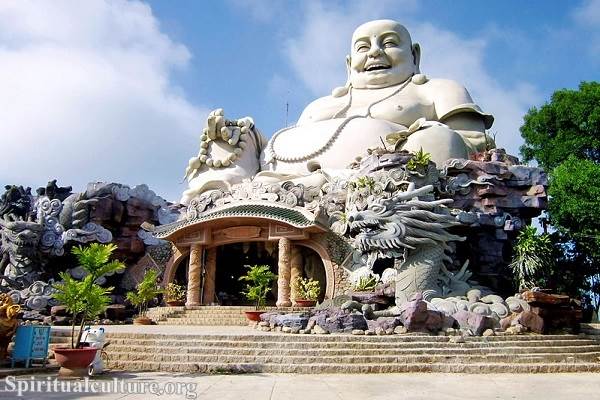
In Chinese popular religion and Buddhism, the smiling monk Budai became identified as a manifestation of Maitreya. Budai was a Chinese monk remembered in later tradition, whereas Maitreya is the future Buddha of Buddhist scripture. The two should not be treated as the same historical figure.
Devotion and interpretation
Some Buddhists recite Maitreya’s name, make offerings, study related scriptures, or aspire to encounter his teaching in the future. Other Buddhists give the figure less emphasis. Maitreya therefore has an important but uneven role across Buddhist communities.
Maitreya in art and religious history
Images of Maitreya have appeared across South, Central, and East Asia for centuries. Some show a princely bodhisattva; others show a buddha. Archaeological and artistic traditions demonstrate the wide historical reach of Maitreya devotion even though the future appearance described in scripture is a matter of religious belief.
No single modern claimant
Various movements and individuals have claimed connections with Maitreya at different times. Such claims should not be confused with a consensus position of Buddhism as a whole. Mainstream Buddhist traditions generally treat Maitreya within inherited scripture, ritual, art, and future-buddha expectation.