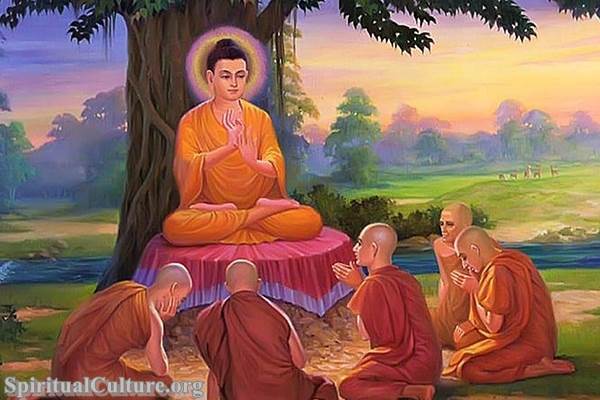
The Heart Sutra is one of the best-known scriptures of Mahayana Buddhism. It belongs to the Prajnaparamita, or Perfection of Wisdom, tradition and presents a highly condensed teaching on emptiness. Versions of the sutra are recited in East Asian, Tibetan, and other Mahayana communities.
Who speaks in the Heart Sutra?
In a widely transmitted version, the bodhisattva Avalokiteshvara explains the perfection of wisdom to Shariputra while the Buddha is present. The teaching examines the five aggregates—form, feeling, perception, formations, and consciousness—and states that they are empty of intrinsic nature.
“Form is emptiness; emptiness is form”
This famous formulation does not mean that nothing exists. In Mahayana philosophy, emptiness points to the absence of an independent, permanent essence. Phenomena arise through causes, conditions, relations, and conceptual designation. Form therefore functions conventionally while being empty of self-existing nature.
Why does the sutra negate so many Buddhist categories?
The text proceeds through lists such as the aggregates, sense fields, dependent-origination factors, and Four Noble Truths, saying that from the standpoint of perfected wisdom they are empty. The point is not to discard Buddhist teaching but to prevent attachment to teachings and categories as if they possessed fixed existence.
Prajnaparamita and the bodhisattva path
Prajnaparamita means “perfection of wisdom.” Mahayana traditions connect this wisdom with the bodhisattva path, where insight into emptiness and compassion develop together. The Heart Sutra presents freedom from grasping as central to overcoming fear and reaching awakening.
The mantra
Many versions conclude with a short mantra beginning gate gate paragate parasamgate bodhi svaha. Translations and explanations vary, and in practice the mantra is often recited rather than treated as an ordinary sentence.
Why the Heart Sutra matters
The sutra’s brevity makes it easy to chant but not necessarily easy to interpret. Different Buddhist schools explain emptiness through their own philosophical traditions. Reading the Heart Sutra alongside broader Prajnaparamita teaching helps prevent the common mistake of equating emptiness with nihilism.
Different versions and transmission
The Heart Sutra survives in several recensions and canonical languages. Short and long versions circulate, and the text became especially important in Chinese, Japanese, Korean, Vietnamese, and Tibetan Buddhism. Its exact textual history has been studied extensively, so claims about one simple original form should be made cautiously.
Emptiness and dependent arising
Many Mahayana interpreters explain emptiness together with dependent arising: because things exist through conditions and relations, they lack a self-contained essence. This is why emptiness does not erase cause and effect, ethics, or ordinary distinctions. Rather, it challenges the tendency to treat changing phenomena as independent and fixed.