From cave walls to cathedral ceilings, religion has always held the brush that shaped humanity’s earliest masterpieces. This article journeys through the sacred relationship between religion and visual art — a relationship that transcends time, culture, and medium. By tracing this divine inspiration across ancient, classical, medieval, and modern eras, we uncover how faith has not only guided artistic form, but also defined the soul of civilizations.
As Spiritual Culture, we believe that art is one of the oldest languages of the soul — a form of sacred storytelling that reveals how humanity has seen, worshipped, feared, and loved the Divine across millennia.
The need to express the inexpressible, to visualize the invisible, lies at the heart of religious art. Whether it’s the trembling awe in front of a Gothic cathedral, the serene gaze of a Buddha sculpture, or the mysterious depth of an abstract icon, visual art has served as a mirror of spiritual yearning.
This article explores how religious beliefs and institutions have profoundly shaped the evolution of visual art — and how, in turn, art has expanded and enriched humanity’s understanding of the sacred.
The Dawn of Sacred Art: Prehistoric and Tribal Visions
The First Temples Were Caves
Before temples, before texts, there were symbols carved into stone and painted on cave walls. These were not only decorative expressions — they were rituals in pigment.
Ritual and Survival: Spirituality in the Paleolithic Era
In the Lascaux caves of France (circa 15,000 BCE), animals are depicted in fluid, reverent motion. While their exact meaning is debated, many scholars believe these images were linked to hunting rituals, shamanism, or fertility rites — all expressions of humanity’s early spiritual awareness.
Such prehistoric art reflects a sacred worldview where animals, nature, and spirits were part of a living, interconnected reality. These artworks weren’t just aesthetic; they were spiritual technologies.
“Art is not a mirror held up to reality but a hammer with which to shape it.”
— Bertolt Brecht
Even then, art was shaping belief.
Ancient Civilizations: Gods, Kings, and Cosmic Order
Egypt: Art as Eternal Devotion
In ancient Egypt, art was inseparable from religion. Tomb paintings, temple carvings, and monumental statues were acts of devotion and preparation for the afterlife.
Sacred Proportions and Divine Order
Egyptian art followed strict canons of proportion to reflect Ma’at — the divine order of the universe. Gods like Osiris, Isis, and Horus were consistently represented in hieratic scale (gods larger than humans), showing their eternal superiority.
Every brushstroke served theology.
Mesopotamia: Visualizing Divine Power
In Sumerian and Babylonian cultures, ziggurats and votive statues reflected the belief in gods who ruled from the heavens. Eyes were exaggerated in statues, possibly to symbolize eternal watchfulness or divine presence.
Religious art in Mesopotamia was both devotional and political — depicting rulers as intermediaries between gods and humanity.
Classical Religions: Beauty and Myth in Balance
Greece: The Divine in Human Form
The ancient Greeks brought a revolution to religious art: idealized realism. Gods looked like perfected humans — strong, serene, and proportionate. Temples such as the Parthenon were artistic offerings to Athena, filled with mythological friezes and sculpted narratives.
Sacred Harmony: Religion Meets Aesthetics
Religious art here wasn’t just about worship — it was about reflecting cosmos, or harmony between the divine and the human. Apollo, the god of light and reason, epitomized this fusion.
Art became a form of divine philosophy.
Rome: Imperial Power and Sacred Syncretism
The Romans adopted and adapted Greek religious iconography but added grandeur. Temples and triumphal arches depicted not just gods, but emperors as divine.
In early Christian Rome, art began to shift — symbols like the fish, the shepherd, or the anchor replaced overt portraits of Christ to avoid persecution. These coded visuals marked the birth of Christian sacred symbolism.
Medieval Christianity: Icons, Illumination, and the Sublime
Byzantine Icons: Portals to the Divine
In Eastern Christianity, icons were not merely paintings. They were sacred windows to heaven. Artists fasted and prayed before painting them, believing the process itself was holy.
Gold as Light: Material and Meaning
The use of gold leaf in icons symbolized divine light — a realm beyond time and matter. The flatness of figures was intentional, meant to detach them from worldly realism and elevate them toward the eternal.
“An icon is not a work of art; it is a work of worship.”
— Orthodox Teaching
Romanesque and Gothic: Art That Lifts the Soul
In Western Europe, cathedrals became sacred canvases. From the Chartres stained glass to the Sistine Chapel, the visual arts exploded in complexity and beauty.
The Gothic Style: Heaven in Stone and Glass
Gothic cathedrals were designed to inspire awe. Tall arches, radiant rose windows, and flying buttresses reflected a theology of transcendence. Light filtered through colored glass was seen as divine presence made visible.
Art was theology in stone.
Islamic Art: Geometry, Calligraphy, and the Infinite
No Images, Only Illumination
Islamic tradition generally discourages figurative art in sacred spaces. Instead, Islamic art expresses the divine through geometry, arabesques, and calligraphy.
Calligraphy: The Visual Quran
Writing became the highest visual form. Verses from the Qur’an, written in intricate scripts, decorated mosques, prayer rugs, and manuscripts. The art was in the Word — literally.
Geometric patterns symbolized the infinite and unknowable nature of Allah, reflecting unity in diversity.
Architecture as Sacred Art
From the Dome of the Rock to the Alhambra, Islamic religious architecture expresses harmony, repetition, and sacred space. It is art that embodies the idea of divine order.
Eastern Traditions: Spiritual Form in Hinduism, Buddhism, and Taoism
Hinduism: Embodied Divinity
Hindu religious art is lush with form, color, and symbolism. Deities like Shiva, Vishnu, and Lakshmi are portrayed in intricate poses (mudras), with multiple arms or heads — not as literal depictions, but as visual metaphors for divine attributes.
The Temple as a Cosmic Body
In India, the temple itself is a form of sacred sculpture — a mandala in stone. Carvings narrate the Ramayana and Mahabharata, while dance and sculpture blend into a single sacred aesthetic.
“What is here is found elsewhere, but what is not here is nowhere.”
— Mahabharata
Buddhism: Serenity in Form
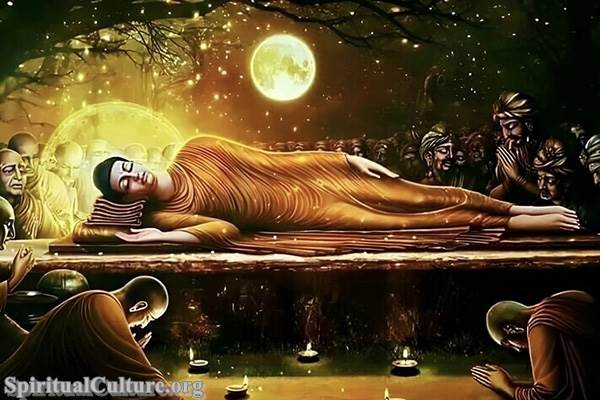
Buddhist art, from the Gandhara Buddha to Tibetan thangkas, emphasizes compassion, serenity, and inner awakening. The Buddha’s posture, hand gestures, and facial expression are visual teachings.
Stupas, mandalas, and prayer wheels are all forms of art designed not just to be seen — but to transform the soul.
Taoism: Flow and Nature
Taoist-inspired art emphasizes harmony with nature. Ink paintings of mountains, rivers, and mist are not landscapes, but expressions of Tao — the Way.
Here, art becomes a spiritual discipline of wu wei (effortless action), inviting the viewer to flow with the natural rhythms of existence.
The Renaissance: Rebirth of the Sacred Through Humanism
A Divine Balance: Faith and Form
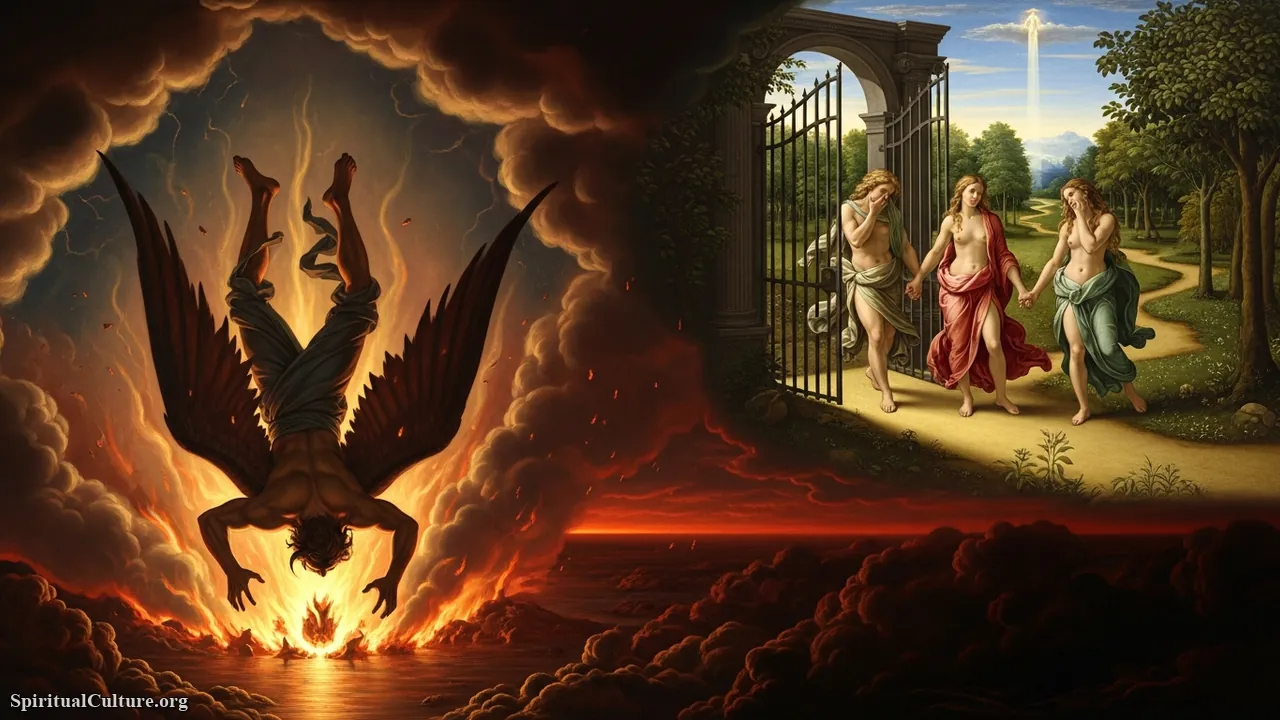
The Renaissance wasn’t a break from religion — it was a rebirth of sacred art, infused with human depth. Michelangelo’s David and da Vinci’s Last Supper reflect the fusion of biblical themes and anatomical perfection.
Perspective and Presence
Linear perspective, invented during this period, created a new depth — both visually and spiritually. Sacred scenes now invited the viewer into the moment, bridging heaven and earth.
Art became both worship and wonder.
Reformation and Iconoclasm: When Images Became Contested
Protestant Reformers: Suspicion of Images
Martin Luther and other Protestant reformers criticized the use of religious imagery, fearing it could become idolatry. Many churches were stripped of icons, and a wave of iconoclasm swept across Europe.
The Birth of Religious Simplicity in Art
While Catholic art continued to flourish (especially in the Baroque period), Protestant aesthetics favored minimalism, scripture, and personal devotion over visual grandeur.
This shift redefined the relationship between art and belief for centuries.
Modern and Contemporary Religious Art: Searching for the Sacred
Beyond Institutions: Spirituality in the Abstract
In the 20th and 21st centuries, religious themes found new forms — sometimes subtle, sometimes revolutionary. Artists like Marc Chagall and Mark Rothko explored Jewish mysticism and Christian transcendence through dreamlike or abstract imagery.
Art as Personal Theology
Modern religious art often moves beyond dogma into spiritual exploration. Whether through installations, digital media, or street art, the search for meaning continues.
Even in secular spaces, the sacred finds expression.
Conclusion
Throughout history, religion has been the heartbeat of visual art, shaping not just what artists created, but why. Sacred art invites us to see not only with our eyes, but with the eyes of the soul — to recognize the Divine not only in temples, but in ourselves.
Whether through stone or paint, mosaic or mandala, stained glass or script, religious art continues to ask eternal questions:
- What is beyond this world?
- How do we touch the sacred?
- What does it mean to be human in the light of the Divine?
As Spiritual Culture, we invite you to reflect:
How has art shaped your image of God — or your vision of meaning?
Where do you see beauty not just as decoration, but as revelation?
Let this not be just an article — but a mirror to your own sacred vision.