There’s a word you might have heard in church or seen in the Bible — Apostle. Maybe you’ve wondered what it really means. Maybe it feels like an ancient, distant concept — reserved for stained-glass windows, dusty pages, or lofty religious titles.
But here’s the truth: “Apostle” isn’t just a word for the past. It tells the story of real men who walked with Jesus, witnessed His miracles, failed miserably, and were sent to change the world. Their legacy shapes the Church, the New Testament, and even your opportunity to hear the Gospel today.
Because understanding the apostles means understanding the very foundation of Christianity.
At the heart of it all is one man: Jesus Christ. And the apostles were His messengers.
What Does “Apostle” Mean?
The word “Apostle” may sound formal or distant, but its origin is simple — and powerful.
In the original Greek of the New Testament, apostolos means “one who is sent out.” It was not initially a spiritual term. In ancient Greek culture, an apostolos could refer to an envoy, a delegate, or a messenger sent on behalf of a ruler or authority to carry out an official mission. The emphasis was on being commissioned — not just going, but being sent with purpose and authority by someone greater.
When Jesus used the term, He gave it a uniquely sacred and eternal meaning. His apostles weren’t just messengers; they were hand-picked representatives, entrusted with the Gospel and empowered to act on His behalf.
From Word to Office
In the New Testament, “apostle” became more than a job description. It became a distinct spiritual office. Jesus didn’t send everyone the same way. He had many followers — men and women, crowds and disciples — but He chose twelve men to be apostles (Luke 6:13). These men were set apart with a unique calling and authority.
They were:
- Eyewitnesses of Jesus’ life, death, and resurrection.
- Founders of the early Church.
- Channels of divine revelation through the Holy Spirit.
- Living witnesses to the truth of the resurrection, often sealed by their blood.
More Than Missionaries
Today, we often associate “apostles” with missionaries or church planters — people who are sent to proclaim Christ in new places. That’s partially true, especially in a broader sense. But in the New Testament, the word apostle held a deeper, foundational weight.
To be an apostle meant:
- Being commissioned by the risen Christ Himself (Galatians 1:1).
- Speaking and acting with the authority of Christ.
- Laying the doctrinal and spiritual foundation of the Christian faith.
Paul even wrote that the Church is “built on the foundation of the apostles and prophets, with Christ Jesus himself as the chief cornerstone” (Ephesians 2:20). That means their role was not just important — it was essential.
Jesus: The First Apostle?
Interestingly, the Bible also refers to Jesus Himself as an apostle. In Hebrews 3:1, He is called “the apostle and high priest of our confession.” What does this mean?
Jesus was sent by the Father into the world to accomplish redemption. He is the ultimate Apostle — the one who perfectly fulfills the mission of God. Every other apostle, then, is a reflection of Christ’s own divine mission.
So when Jesus appointed apostles, He wasn’t inventing a new word. He was passing on His mission — sending others to carry the message of the Kingdom to the ends of the earth.
The Original Twelve Apostles of Jesus
When Jesus began His public ministry, He didn’t build a political team, gather scholars, or recruit the religious elite. Instead, He walked by the sea, passed through villages, and looked people in the eye — calling fishermen, tax collectors, and ordinary men to follow Him.
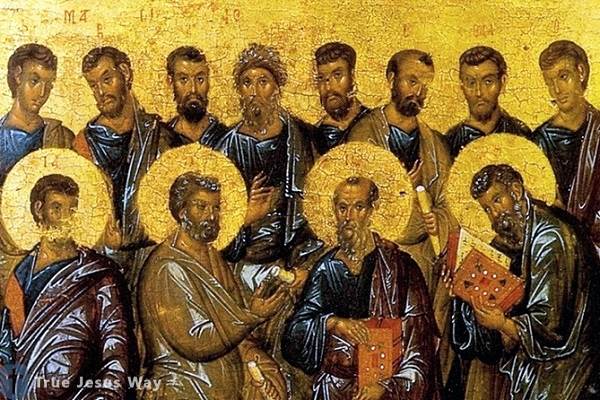
From the many disciples who followed Him, Jesus chose twelve specific men to become His closest companions and most trusted messengers. These were the Twelve Apostles, and their lives would change the course of history.
Who Were the Twelve?
The four Gospels (Matthew 10:2–4, Mark 3:16–19, Luke 6:13–16) list the Twelve Apostles as follows:
- Simon Peter – A fisherman from Galilee, often seen as the leader among the twelve. Impulsive, passionate, and deeply devoted, Peter is the most frequently mentioned apostle.
- James (son of Zebedee) – One of the “sons of thunder,” part of Jesus’ inner circle.
- John (brother of James) – Also part of the inner circle, the beloved disciple, and later author of the Gospel of John, three letters, and Revelation.
- Andrew – Peter’s brother, the first to follow Jesus, known for bringing others to Him.
- Philip – Thoughtful and questioning, often seen in dialogues with Jesus (John 14:8–9).
- Bartholomew (also called Nathanael) – A sincere man who declared Jesus as the Son of God (John 1:49).
- Matthew (Levi) – A former tax collector, author of the Gospel that bears his name.
- Thomas – Often remembered as “Doubting Thomas,” but also courageous and faithful.
- James (son of Alphaeus) – Sometimes called “James the Less” to distinguish him from the other James.
- Thaddeus (also known as Judas son of James, or Lebbaeus) – Little is known about him, but tradition holds that he was a faithful preacher.
- Simon the Zealot – Possibly a former political revolutionary before following Jesus.
- Judas Iscariot – The one who betrayed Jesus for thirty pieces of silver, later replaced.
After Judas Iscariot’s betrayal and death, the apostles selected Matthias to take his place (Acts 1:15–26), following the criteria that the replacement had to be someone who had been with Jesus from the beginning and was a witness to His resurrection.
Why These Twelve?
The number twelve was no accident. In Jewish tradition, twelve symbolized completeness and covenant — the twelve tribes of Israel represented God’s chosen people. By selecting twelve apostles, Jesus was making a bold statement: He was forming a new people of God. This was the beginning of a new covenant community — not built on ethnicity or law, but on faith in Him.
Jesus wasn’t just starting a movement. He was building a Kingdom — and these twelve men would help lay the foundation.
Their Transformation
These men were not perfect. They misunderstood Jesus, argued about who was greatest, and fled in fear when He was arrested. Peter denied Him. Thomas doubted Him.
But after Jesus rose from the dead and the Holy Spirit was poured out at Pentecost, everything changed.
These once fearful and flawed men became bold witnesses, preaching the Gospel in Jerusalem, Judea, Samaria, and to the ends of the earth (Acts 1:8). They healed the sick, cast out demons, established churches, and endured persecution — all for the sake of Christ.
Tradition holds that nearly all of them died as martyrs, unwilling to deny the truth of what they had seen: Jesus Christ risen from the dead.
Their courage and faithfulness are not only part of Christian history — they are part of our spiritual inheritance.
Paul the Apostle: A Unique Case
Among all the apostles in the New Testament, Paul stands out as a truly unique and extraordinary figure. He was not one of the original Twelve. He never walked the dusty roads of Galilee with Jesus. He didn’t witness the crucifixion or the resurrection firsthand — at least not in the way the others did.
And yet, no one shaped the theology, mission, and expansion of early Christianity more than Paul the Apostle.
From Enemy to Apostle
Paul was born as Saul of Tarsus, a Jew of the tribe of Benjamin, and a Roman citizen by birth (Philippians 3:5; Acts 22:28). He was highly educated under the respected Pharisee Gamaliel and was zealous for the law of Moses. But this zeal led him down a dark path — one of persecution.
In the early days of the Church, Saul was one of its fiercest enemies. He supervised the stoning of Stephen, the first Christian martyr (Acts 7:58), and made it his mission to arrest, imprison, and destroy the followers of Jesus. His name struck fear into the hearts of believers.
But everything changed on the road to Damascus.
As Saul traveled to persecute more Christians, a bright light from heaven surrounded him. He fell to the ground and heard a voice:
“Saul, Saul, why do you persecute me?”
“Who are you, Lord?” Saul asked.
“I am Jesus, whom you are persecuting.” (Acts 9:4–5)
Blinded and humbled, Saul was led into the city. Three days later, a disciple named Ananias, directed by the Lord, laid hands on him, and Saul received back his sight and was filled with the Holy Spirit. From that moment on, Saul became Paul — a servant of Christ Jesus, called to be an apostle (Romans 1:1).
Apostle to the Gentiles
Unlike the original Twelve, who primarily preached to Jews, Paul was called to the Gentiles — the non-Jewish nations of the world. Jesus had said of Paul, “He is my chosen instrument to proclaim my name to the Gentiles and their kings and to the people of Israel” (Acts 9:15).
This calling shaped Paul’s entire ministry. He became a tireless missionary, planting churches across Asia Minor, Greece, and Rome. He endured beatings, shipwrecks, hunger, rejection, and prison — all to bring the Gospel to people who had never heard the name of Jesus.
Wherever he went, he preached Christ crucified and risen, salvation by grace through faith, and the unity of Jews and Gentiles in one new people of God.
Paul’s Legacy
Paul was eventually arrested and brought to Rome. According to early church tradition, he was beheaded during the reign of Emperor Nero, around A.D. 64–67. But long before his death, Paul had already surrendered his life:
“I consider my life worth nothing to me; my only aim is to finish the race and complete the task the Lord Jesus has given me — the task of testifying to the good news of God’s grace.” (Acts 20:24)
He did exactly that.
Paul’s life is a testimony to the transforming power of Jesus. From violent enemy to passionate apostle. From law-bound Pharisee to grace-filled preacher. From persecutor to martyr.
His story shows us that no one is too far gone, that God’s grace is real, and that Christ can call anyone, anywhere, at any time — and use them mightily.
The Qualifications and Role of an Apostle
Not everyone who followed Jesus or preached the Gospel was called an apostle. In fact, the office of apostle in the early Church was both highly specific and deeply sacred. It came with immense responsibility, unique authority, and clear qualifications.
So what exactly did it mean to be an apostle — not just in name, but in truth?
Biblical Qualifications for Apostleship
According to the New Testament, apostles were not chosen randomly or self-appointed. Their selection followed clear criteria, especially during the foundational period of the Church.
Here are the essential qualifications:
- Personally Chosen by Jesus Christ
Apostles did not volunteer for the role — they were called and appointed directly by Jesus.- Jesus said to His disciples: “You did not choose me, but I chose you and appointed you…” (John 15:16)
- Paul also emphasized this divine calling: “Paul, an apostle — sent not from men nor by a man, but by Jesus Christ and God the Father…” (Galatians 1:1)
- Eyewitness of the Resurrected Christ
One of the clearest requirements for being counted among the apostles was to have personally seen the risen Jesus.- When the apostles sought to replace Judas, Peter said: “It is necessary… that one of these men who have been with us… must become a witness with us of His resurrection.” (Acts 1:21–22)
- Paul claimed his authority on this basis: “Am I not an apostle? Have I not seen Jesus our Lord?” (1 Corinthians 9:1)
- Empowered by the Holy Spirit for Miracles and Signs
Apostles were uniquely anointed to perform miraculous signs to validate their message.- “The signs of a true apostle were performed among you with utmost patience, with signs and wonders and mighty works.” (2 Corinthians 12:12)
- Foundational to the Church’s Construction
The apostles weren’t simply messengers — they were foundation-layers.- “Built on the foundation of the apostles and prophets, with Christ Jesus himself as the chief cornerstone.” (Ephesians 2:20)
Their words, witness, and writings formed the theological bedrock of Christian faith.
The Unique Role of Apostles
Once called and qualified, the apostles were entrusted with roles no one else could fill in the same way. These included:
- Proclaiming the Gospel with Authority
Apostles preached not as opinionated individuals, but as ambassadors of Christ, speaking His truth with divine authority (2 Corinthians 5:20). - Establishing Churches
Apostles were sent to regions where the Gospel had not yet been preached. They didn’t just share the message — they planted communities of believers and appointed local leaders (Titus 1:5; Acts 14:23). - Teaching and Preserving Sound Doctrine
As witnesses of Christ, apostles ensured the Church remained grounded in true teaching. They corrected errors, refuted heresies, and defended the faith (e.g., Galatians, Colossians, Jude). - Writing the New Testament
The majority of the New Testament books were written by apostles or under their supervision (e.g., Mark writing under Peter’s guidance). These writings carried inspired authority. - Suffering for Christ’s Name
Perhaps most humbling of all, apostles were called to suffer. Jesus told Ananias about Paul: “I will show him how much he must suffer for My name” (Acts 9:16).
Their lives were marked by hardship — beatings, imprisonment, shipwrecks, hunger, and martyrdom. They bore Christ’s name with courage and endurance.
Apostles vs. Other Church Leaders
While many spiritual gifts and leadership roles were present in the early Church — such as prophets, teachers, pastors, and evangelists — the apostle’s role was foundational and non-repeatable in the same exact sense.
- Prophets spoke forth the word of God.
- Evangelists spread the Gospel.
- Pastors and teachers cared for and instructed the flock.
- Apostles did all these — but with foundational authority, as those commissioned by the risen Christ to establish the global Church.
This doesn’t mean today’s Church lacks guidance — but that its guidance now flows from the apostolic teaching preserved in Scripture.