The alliance between Julius Caesar and Cleopatra VII of Egypt is often regarded as one of the most fascinating, complex, and impactful stories in ancient history. Their relationship was not only a personal affair but a politically motivated alliance that shaped the destinies of both Rome and Egypt during a critical junction in ancient history.
Historical Context
Political Landscape of the Roman Republic
The foundation for Julius Caesar and Cleopatra’s alliance was laid amidst a turbulent political climate in the Roman Republic during the first century BCE. The Republic, which had experienced substantial expansion following the Second Punic War, became increasingly characterized by internal strife, class conflict, and political ambition. The civil wars and struggles for power that plagued the Republic created a fertile ground for leaders like Julius Caesar, Pompey the Great, and Marcus Licinius Crassus to emerge as significant figures shaping Rome’s destiny.
Rome’s political system was defined by a delicate balance of power among its various institutions, including the Senate, the Assemblies, and the Consuls. However, this system increasingly fell prey to the ambitions of individual leaders. The strife between patricians (the aristocratic elite) and plebeians (common citizens) further exacerbated existing tensions. Key events, such as the rise of populist leaders advocating for reform and the various political alliances formed between ambitious generals, set the stage for civil war.
Julius Caesar, a member of the populist faction, famously crossed the Rubicon River in 49 BCE, a defiant act that ignited a civil war against his rival Pompey, who represented the conservative senatorial faction. The outcome of this civil war would determine not just the fate of Caesar but also the subsequent political landscape that would allow figures from outside Rome, such as Cleopatra, to play decisive roles.
Overview of the Ptolemaic Kingdom
Simultaneously, the Ptolemaic Kingdom of Egypt was in a state of decline following the death of Alexander the Great and the subsequent fragmentation of his empire. Ptolemy I Soter, one of Alexander’s generals, established the Ptolemaic dynasty, which maintained Greek culture in Egypt while intertwining it with Egyptian traditions. However, by the time Cleopatra ascended the throne in 51 BCE, the kingdom faced significant internal challenges, particularly from the younger brother of Cleopatra, Ptolemy XIII, as well as external pressures from the growing power of Rome.
Cleopatra VII, born of Greek descent, was a formidable ruler known for her intelligence, multilingual capabilities, and political acumen. She aimed to restore Egypt’s former glory and secure its position amid rival powers. Cleopatra’s reign was marked by her effort to establish Egypt as a significant player in the Mediterranean, one that could hold its ground against Rome’s encroachment and internal family rivalries that jeopardized her sovereignty.
Ptolemaic Egypt, grappling with both economic difficulties and the fear of Roman domination, was in dire need of strong leadership. Cleopatra’s vision for her nation included forming alliances with powerful individuals, and Julius Caesar was an irresistible candidate given his military strength and influence over the Republic.
Civil War Between Julius Caesar and Pompey
The civil war between Julius Caesar and Pompey was a major turning point not only for Rome but for the relationships between Roman leaders and foreign kingdoms as well. The Senate’s growing apprehension towards Caesar, due to his rising power and popularity among the people, led to direct confrontations. Pompey, once an ally of Caesar, aligned himself with the ruling elite of the Senate, ultimately positioning himself against Caesar.
The conflict reached its zenith in 49 BCE when Caesar’s decision to cross the Rubicon River—a clear point of no return—initiated a civil war that would alter the fate of the Roman Republic. Pompey fled to Egypt, seeking refuge and hoping to find an ally in Ptolemy XIII. However, Cleopatra and her advisors saw an opportunity amidst this chaos.
The outcome of this civil war created an environment ripe for Cleopatra to engage with Caesar. The subsequent defeat of Pompey in 48 BCE led to his assassination in Egypt, with the political landscape laid bare for Caesar and Cleopatra’s impending alliance. Caesar’s influence in Egypt began as a means to secure his interests against potential threats, while Cleopatra saw him as her key to regaining control of her kingdom.
Meeting in Alexandria
Arrival of Julius Caesar in Egypt
After the murder of Pompey, Julius Caesar arrived in Alexandria in 48 BCE, finding himself in a complex situation. Egypt was in turmoil, and the political intrigue surrounding the young Ptolemy XIII and his sister Cleopatra was palpable. Caesar, ever the strategist, understood the significance of getting involved in this familial conflict, recognizing that aligning with Cleopatra could grant him access to vast resources and a formidable ally.
Upon his arrival, Caesar quickly assessed the political landscape and was drawn into the ongoing power struggle between Cleopatra and her brother, who sought to secure his own position by appealing to Rome against Cleopatra’s claims.
Cleopatra’s Strategy to Meet Caesar
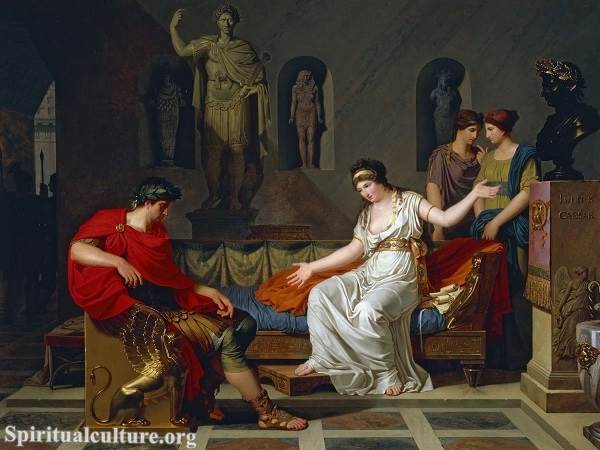
Recognizing the precariousness of her position and the aspirations of her brother Ptolemy XIII, Cleopatra devised a strategic plan to meet Caesar. Understanding that her future hinged on obtaining Caesar’s favor, she arranged for a dramatic entrance. Some accounts suggest that she had herself smuggled into the royal palace hidden inside a rug or a bedroll, positioning herself as a figure of intrigue who captivated Caesar with her boldness and intellect.
Her approach was not only about romantic allure but was steeped in astute political maneuvering. Cleopatra understood that to gain Caesar’s trust and support, she needed to demonstrate not only her beauty and charm but also her capability as a leader. The meeting between the two effectively marked the beginning of a significant political alliance that would alter the landscape of both Rome and Egypt.
The Power Struggle with Ptolemy XIII
The power struggle between Cleopatra and Ptolemy XIII came to a head after Caesar’s arrival. Due to his guidance and military support, Cleopatra was able to challenge her brother’s authority directly. Ptolemy XIII’s advisors, apprehensive of Caesar’s influence and the growing support for Cleopatra, rallied forces against their sister to secure their control over Egypt.
This lead to a significant confrontation, with skirmishes erupting in Alexandria. Caesar used his military prowess to assist Cleopatra, and together, they engaged in a fierce, armed conflict that culminated in the decisive Battle of the Nile. Caesar’s decisive military actions not only ensured Cleopatra’s position but also established him as the preeminent Roman in Egypt.
The defeat of Ptolemy XIII marked a crucial turning point. With her brother’s forces defeated and his authority dismantled, Cleopatra emerged as the sole ruler of Egypt. This victory allowed her to consolidate her power and helped solidify Caesar’s influence in the region, setting the stage for a long and complex relationship.
The Political Alliance
Reasons for the Alliance
The alliance between Caesar and Cleopatra was driven by multiple motivations, each rooted in their political ambitions. For Cleopatra, Julius Caesar represented both a formidable ally and a potential protector against external threats. With Rome’s power rapidly growing, aligning with one of its foremost leaders not only secured her position against her brother but also provided a safeguard for Egypt’s independence.
For Caesar, establishing a political association with Cleopatra was equally strategic. Egypt, rich in resources and vital to grain supply for Rome, was essential for his ambitions. Securing an alliance would enhance his power and legitimize his authority as he sought to consolidate his gains in the East. The cooperation between the two was a calculated move that underscored the mutual benefits derived from their relationship, intertwining personal and political interests.
Military Support and the Battle of the Nile
With Caesar’s military backing, Cleopatra was able to gain the upper hand over her brother. The Battle of the Nile, fought in 47 BCE, was the definitive confrontation that established Cleopatra’s rule. Caesar’s forces, bolstered by Cleopatra’s supporters, decisively defeated the troops loyal to Ptolemy XIII. This victory asserted Cleopatra’s place on the throne and symbolized the culmination of their alliance, integrating military might with personal ambition.
The aftermath of the battle saw Cleopatra reaffirming her authority, while Caesar utilized Egypt’s resources to reinforce his standing within Rome. The collaboration between them reflected a symbiotic relationship where each party’s strengths complemented the other’s needs.
Cleopatra as Sole Ruler of Egypt
Following the victory over Ptolemy XIII, Cleopatra emerged as the sole ruler of Egypt. Her ascent to power was characterized by a newfound authority that was both respected and feared. Cleopatra worked to enhance her image as a powerful and capable leader, keen on restoring Egypt’s former glory. She embraced the title of Pharaoh, aligning herself with the divine heritage of Egypt and leveraging her royal lineage to solidify her rule.
In consolidating her power, Cleopatra made significant political and economic reforms aimed at stabilizing Egypt’s economy. She sought to increase trade, foster loyalty among her subjects, and fortify Egypt’s position against potential encroachments from other aspiring powers, most notably Rome, which had shown increasing interest in her nation.
Her alliance with Caesar was critical in achieving these goals. By maintaining a close relationship with him, Cleopatra effectively ensured that Egypt’s interests were protected while navigating the complex politics of Rome. Their relationship was no longer limited to personal dynamics but transformed into a potent political union that had lasting implications for both kingdoms.
Cleopatra’s Visit to Rome
Reasons for Traveling to Rome
In 46 BCE, Cleopatra took the bold step of traveling to Rome, a move laden with political significance. Her journey represented a crucial attempt to further cement her political alliance with Caesar while elevating her own status within Rome. Cleopatra understood that her presence in the heart of the Roman political sphere would not only solidify her claims but also serve as a reminder of Egypt’s power.
By showcasing herself in Rome, Cleopatra aimed to garner support for her reign and legitimize her position as a leader, reassuring Rome that Egypt would remain a powerful ally. The visit allowed her to negotiate terms, secure her interests, and refocus Roman attention on the importance of their alliance.
Reactions of Roman Society
Cleopatra’s arrival in Rome stirred mixed reactions among the Roman populace. Many were enchanted by her beauty, sophistication, and intelligence. She represented a different cultural essence, infusing Roman society with a novel perspective on governance and international politics. Her ability to engage with influential elites made her a captivating figure.
However, her presence also incited concern among some Roman aristocrats who perceived a foreign queen’s influence over Caesar as a threat to their power. The notion of a queen from a foreign land sharing a bed with the most powerful man in the Roman Republic was unsettling for many, challenging traditional Roman virtues and the hegemony of the patrician class.
Cleopatra’s visit highlighted the broader tensions between traditional Roman values and the emerging complexities of a multicultural and interconnected world. The dynamics of power, gender, and loyalty were all magnified through her presence, revealing the precarious nature of political allegiances.
Cultural Exchange and Egyptian Influence
Cleopatra’s stay in Rome facilitated a rich cultural exchange between Egypt and the Roman Republic. As an educated woman fluent in multiple languages, Cleopatra introduced elements of Egyptian culture, art, and philosophy to Roman society. This exchange highlighted the intellectual curiosity and fascination Romans had towards exotic lands and cultures.
Her presence in Rome reinforced the importance of international alliances and created an atmosphere where Egyptian customs began to influence Roman elites. Cleopatra’s ability to blend aspects of both cultures set the stage for an enduring legacy of cultural interchange, evident in art, literature, and philosophical discourse that would follow.
Moreover, as Caesar and Cleopatra formed a partnership, they symbolized a merging of two powerful worlds—fostering a narrative of unity that intertwined the destinies of Egypt and Rome long after their relationship came to an end.