Julius Caesar was a Roman general, politician, priest, and author whose career transformed the Mediterranean world. Through political alliances, military victories, public popularity, and civil war, he rose from an ambitious Roman aristocrat to the dominant figure in the Roman Republic. His assassination on March 15, 44 BCE, did not restore the older republican order. Instead, it opened another period of conflict that eventually led to the establishment of imperial rule under his adopted heir, Augustus.
Caesar is often casually described as a Roman emperor, but he never held that title in the later imperial sense. He governed as dictator within the constitutional vocabulary of the Republic, although the extraordinary duration and concentration of his powers made his position unlike that of an ordinary republican magistrate. By the beginning of 44 BCE, he had been named dictator perpetuo, generally understood as dictator in perpetuity or for life.
His significance extends beyond battles and political institutions. Caesar operated in a society where religion, ancestry, military command, public ceremony, and government were deeply connected. As pontifex maximus, the senior figure in one of Rome’s most important priestly colleges, he occupied a major religious office as well as a political position. His family promoted an ancestral association with the goddess Venus, and after his death he was officially honored as the deified Julius. These developments helped prepare the symbolic culture of Roman imperial rule.
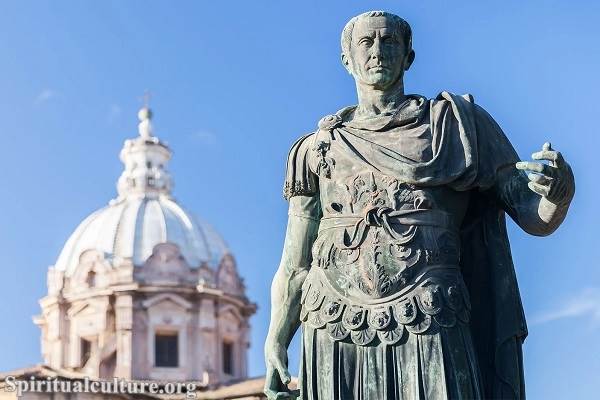
Caesar’s life must nevertheless be considered critically. His campaigns brought Roman control to large parts of western Europe, but they also caused immense destruction, enslavement, displacement, and loss of life. His political reforms addressed real problems within the Republic, yet his accumulation of power weakened already fragile constitutional restraints. His legacy is therefore neither simply heroic nor entirely destructive. It is the legacy of a gifted and ruthless leader who reshaped Rome while accelerating the end of its republican system.
Julius Caesar in the Crisis of the Roman Republic
Caesar lived during the final century of the Roman Republic, a period marked by territorial expansion, social inequality, political competition, and repeated violence. Rome had grown from an Italian city-state into the center of a large Mediterranean dominion. Its territories extended across Italy, Spain, North Africa, Greece, Asia Minor, and other regions.
The institutions of the Republic had been created for a much smaller state. Consuls, praetors, popular assemblies, tribunes, priestly colleges, and the Senate continued to govern Rome, but the administration of distant provinces and large armies placed increasing pressure on these institutions. Wealth from conquest enriched some Roman families, while debt, land concentration, and military service created hardship for many others. The gap between those who benefited from expansion and those who did not contributed to political instability.
Roman politics was not divided into modern political parties. Influential leaders formed shifting alliances based on family, friendship, wealth, patronage, ideology, and immediate advantage. Some senators emphasized the traditional authority of the Senate and resistance to powerful individuals. Others sought support through popular assemblies, tribunes, land legislation, grain distributions, or promises to soldiers.
Before Caesar’s ascendancy, Rome had already experienced political murder, military rebellion, and civil war. The brothers Tiberius and Gaius Gracchus had been killed during conflicts over reform. The generals Gaius Marius and Lucius Cornelius Sulla had used military force in Roman political struggles. Sulla had marched on Rome, defeated his enemies, ruled as dictator, and carried out proscriptions against political opponents.
Caesar did not single-handedly destroy a peaceful and stable republic. He rose within a system that had already suffered decades of institutional breakdown. Nevertheless, his actions—especially his decision to lead an army into Italy in 49 BCE—greatly intensified the crisis and made the restoration of traditional republican competition increasingly difficult.
Early Life and Family Background
Gaius Julius Caesar was probably born on July 12 or 13 in 100 BCE, although some details of his birth date remain debated. He belonged to the Julii Caesares, a patrician family with an ancient name but without the extraordinary wealth or recent political dominance enjoyed by some other Roman noble houses.
Roman aristocratic identity depended heavily on ancestry. Elite families preserved stories about distinguished forebears, displayed ancestral images, conducted elaborate funerals, and connected current political ambitions with inherited honor. The Julian family claimed descent from Iulus, or Ascanius, the son of the Trojan hero Aeneas. Because Roman tradition regarded Aeneas as a son of the goddess Venus, the Julii could present themselves as possessing a sacred and heroic lineage.
Such genealogies should be understood as Roman ancestral tradition rather than verifiable biological history. Their importance lay in the cultural authority they carried. Caesar later emphasized his family’s association with Venus in public imagery, temple patronage, military symbolism, and coinage.
Caesar’s father, also named Gaius Julius Caesar, held political office, while his mother, Aurelia, was remembered in ancient literature as a respected Roman matron. His aunt Julia had married Gaius Marius, the famous general and political rival of Sulla. This family connection placed the young Caesar near one side of Rome’s violent political divisions.
Caesar married Cornelia, the daughter of Lucius Cornelius Cinna, another leading opponent of Sulla. After Sulla gained control of Rome, Caesar was reportedly ordered to divorce Cornelia. He refused. Ancient accounts state that he lost property and priestly standing and was forced to hide until relatives and supporters obtained a pardon for him.
This episode became part of the traditional image of Caesar as bold, proud, and unwilling to surrender under pressure. However, much of the narrative comes from biographies written generations later. It is best treated as an ancient biographical tradition supported by the general political circumstances of Sulla’s dictatorship rather than as a fully documented modern account.
Military Service and the Pirate Story
Caesar left Rome and served in the eastern Mediterranean. During the siege of Mytilene, he reportedly received the civic crown, a prestigious military decoration associated with saving the life of a Roman citizen. These early experiences introduced him to military command, provincial politics, and the networks through which ambitious Romans built their careers.
One of the most famous stories from Caesar’s youth concerns his capture by pirates while traveling across the Aegean Sea. According to Plutarch and other ancient writers, Caesar behaved as though he were the pirates’ superior rather than their prisoner. He supposedly joked that he would have them crucified after his release. When the ransom was paid, the story continues, he raised a force, captured the pirates, and carried out the punishment.
The episode illustrates how ancient biography combined reported events with character-building drama. Plutarch used the story to portray Caesar’s confidence, authority, and dangerous determination. Although Caesar’s capture by pirates is widely accepted, the conversations and theatrical details cannot be independently verified. They belong to the literary presentation of Caesar as much as to the recoverable record of his life.
Caesar also studied rhetoric, an essential skill for Roman public life. Political advancement required more than military ability. Roman aristocrats were expected to speak in courts, address assemblies, negotiate alliances, prosecute rivals, defend clients, and communicate their achievements through carefully shaped public narratives.
The Beginning of Caesar’s Political Career
Caesar advanced through the cursus honorum, the conventional sequence of Roman public offices. He served as quaestor, aedile, praetor, and provincial governor before seeking the consulship, the highest regularly elected office of the Republic.
As an aedile in 65 BCE, Caesar sponsored costly public games and spectacles. Such displays entertained the population, honored the gods, and increased a politician’s visibility. Public spectacle in Rome was closely connected to elite competition. Games, processions, banquets, funerals, and theatrical performances allowed political leaders to advertise wealth, generosity, ancestry, military achievement, and devotion to the community.
Caesar spent heavily and accumulated substantial debts. Financial risk was common among ambitious Roman politicians, but Caesar operated on a particularly large scale. His debts made wealthy allies important to his career, including Marcus Licinius Crassus, one of Rome’s richest men.
In 63 BCE, Caesar was elected pontifex maximus. The title is sometimes translated as “chief priest,” but the office should not be equated with the leadership of a modern centralized religion. Roman public religion was administered through several priestly colleges, magistracies, ritual traditions, and local cults. The pontifex maximus led the College of Pontiffs and had important responsibilities involving sacred law, the calendar, priestly matters, and public religious procedure.
Caesar’s election demonstrated his political influence and gave him a position of lasting prestige. It also illustrates how Roman religion and government overlapped. Priests could be politicians, military commanders, and senators. Public ritual was not normally separated from civic authority in the modern sense.
During the Catilinarian conspiracy of 63 BCE, Caesar argued against executing Roman citizens without trial. His position was opposed by Cato the Younger, who advocated death for the conspirators. Caesar’s speech did not save them, but the debate strengthened his reputation as an influential public figure.
He became praetor in 62 BCE and later governed Hispania Ulterior, a Roman province in the Iberian Peninsula. His military successes there allowed him to claim the honor of a triumph, but he also wished to stand for consul. Because the rules surrounding candidacy and triumphal entry created a conflict, Caesar ultimately gave up the immediate triumph and pursued the consulship.
The First Triumvirate
In approximately 60 BCE, Caesar formed an informal political alliance with Pompey the Great and Marcus Licinius Crassus. Modern historians usually call this arrangement the First Triumvirate, although it was not an official three-man government.
Each participant possessed something the others needed. Pompey had achieved major military victories and wanted political approval for arrangements made in the eastern provinces, as well as land for his veterans. Crassus possessed immense wealth and influence but competed bitterly with Pompey. Caesar had political skill, aristocratic status, popular support, and the ambition to reconcile their interests.
The alliance was strengthened through marriage. Caesar’s daughter Julia married Pompey, creating a family connection between the two men. Caesar himself married Calpurnia, the daughter of Lucius Calpurnius Piso.
Caesar was elected consul for 59 BCE. During his consulship, he promoted land legislation and other measures beneficial to Pompey, Crassus, veterans, and sections of the Roman public. His colleague, Marcus Calpurnius Bibulus, opposed him, and their conflict demonstrated how intimidation, public pressure, obstruction, and procedural manipulation had become regular features of Roman political life.
The First Triumvirate allowed three powerful men to overcome senatorial resistance, but it depended on personal cooperation. It contained no durable constitutional mechanism for resolving disagreements. Its eventual breakdown would have far-reaching consequences.
The Conquest of Gaul
After his consulship, Caesar received a provincial command that gave him control over Roman armies in Cisalpine Gaul, Illyricum, and eventually Transalpine Gaul. From 58 to 50 BCE, he conducted a series of campaigns now known collectively as the Gallic Wars.
These campaigns transformed Caesar’s political position. They gave him wealth, military prestige, experienced legions, and soldiers whose advancement was closely connected to his leadership. They also extended Roman power across much of the territory corresponding broadly to modern France and Belgium, with operations reaching parts of Switzerland, Germany, and Britain.
Caesar presented the wars as responses to threats, migrations, rebellions, and appeals from allies. Modern scholarship, however, also recognizes his personal and political motives. Military victory offered one of the clearest paths to glory in Roman aristocratic culture. Conquest could produce wealth, public honors, loyal clients, enslaved captives, and electoral influence.
Major episodes included his defeat of the migrating Helvetii, his campaigns against the Germanic king Ariovistus, wars against Belgic peoples, a bridge built across the Rhine, and two expeditions to Britain. The British expeditions did not result in permanent Roman occupation, but they created enormous publicity because Britain lay beyond the familiar boundaries of Roman power.
The most serious challenge came in 52 BCE, when Vercingetorix led a broad Gallic revolt. After difficult fighting, Caesar surrounded Vercingetorix’s forces at Alesia. Roman soldiers constructed extensive lines of fortification to contain the besieged army while defending against a large relief force from outside. Vercingetorix eventually surrendered. Ancient literature later turned this surrender into one of the defining scenes of Caesar’s military career.
The conquest should not be reduced to a narrative of strategic brilliance. Communities were devastated, captives were enslaved, and local political structures were forcibly reorganized. Caesar reported very large numbers of enemies killed or captured, but ancient numerical claims are frequently uncertain and may reflect exaggeration. His campaigns were central to Roman expansion, yet they were also acts of imperial violence.
Caesar as an Author and Political Communicator
Caesar recorded his campaigns in works usually known as the Commentaries on the Gallic War and the Commentaries on the Civil War. Their clear Latin style made them influential literary works and, much later, standard texts in classical education.
The Gallic War presents Caesar in the third person, creating an appearance of distance and objectivity. The prose is controlled, direct, and often restrained. Yet the work is not a neutral military record. It explains Caesar’s decisions, defines enemies and allies, emphasizes danger, and presents his actions as rational responses to unfolding circumstances.
The commentaries are indispensable historical sources because they contain detailed accounts from a central participant. At the same time, they must be read as acts of political communication. Caesar had reasons to defend his command, display his achievements, maintain support in Rome, and shape how contemporaries understood the wars.
His writing contributed to his rise because Roman power depended partly on reputation. Military events occurred far from the capital, and reports, letters, speeches, monuments, coins, triumphs, and written narratives helped translate battlefield success into political authority.
The Collapse of the Triumvirate
The alliance among Caesar, Pompey, and Crassus gradually weakened. Julia died in 54 BCE, removing an important personal bond between Caesar and Pompey. Crassus was killed in 53 BCE during a disastrous campaign against the Parthian Empire at Carrhae.
Without Julia and Crassus, Caesar and Pompey moved increasingly toward rivalry. Political violence in Rome intensified, and Pompey became more closely aligned with senators who feared Caesar’s power.
Caesar’s command protected him from prosecution and allowed him to retain control of his armies. His opponents wanted him to surrender that command before standing for another consulship. Caesar feared that returning as a private citizen would expose him to political and legal attacks. Negotiations focused on whether Caesar and Pompey should both relinquish their commands, whether Caesar could stand for office while absent, and how the balance of power could be preserved.
The dispute involved constitutional principles, but it also involved personal survival, military loyalty, and competition between powerful individuals. Neither side trusted the other to surrender its advantages safely.
Crossing the Rubicon
In January 49 BCE, Caesar led troops across the Rubicon, a small river marking the boundary between his provincial command and Italy. A governor was not permitted to bring his provincial army into Italy in this manner. The crossing therefore represented an open challenge to the authority of the Senate and the magistrates aligned against him.
The phrase “crossing the Rubicon” later became a metaphor for taking an irreversible step. Ancient writers supplied dramatic words supposedly spoken by Caesar, commonly rendered as “the die is cast.” The exact wording and circumstances remain matters of literary tradition, but the political significance of the act is clear.
Caesar’s defenders argued that his enemies had violated the rights of tribunes and used the Senate to destroy him. His critics regarded the armed entry into Italy as rebellion driven by personal ambition. Both legal language and political propaganda became weapons in the civil war.
Pompey and many senators withdrew from Rome and eventually crossed to Greece. Caesar moved rapidly through Italy, secured Rome, and then campaigned against Pompeian forces in Spain. He later crossed the Adriatic to confront Pompey directly.
At the Battle of Pharsalus in 48 BCE, Caesar defeated Pompey despite facing a larger opposing army. Pompey fled to Egypt, where he was killed by officials of the Ptolemaic court. According to ancient narratives, Caesar was displeased when presented with Pompey’s severed head. Whether every emotional detail is reliable or not, Pompey’s death eliminated Caesar’s greatest rival while drawing him more deeply into Egyptian affairs.
Caesar, Cleopatra, and Egypt
Egypt was ruled by the Ptolemaic dynasty, a Macedonian Greek royal house established after the conquests of Alexander the Great. At the time of Caesar’s arrival, Cleopatra VII was struggling for power against her brother and co-ruler Ptolemy XIII.
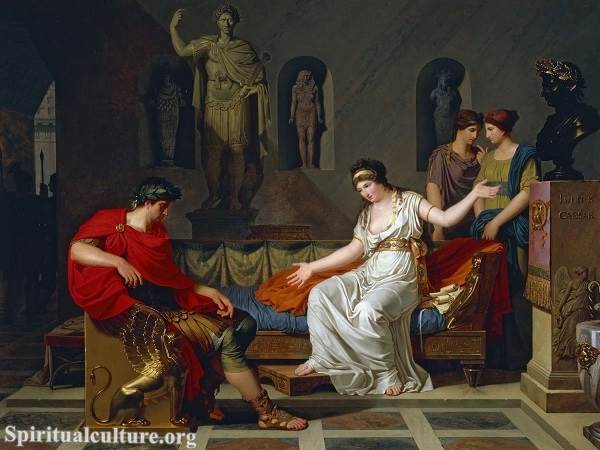
Caesar intervened in the dynastic dispute. Cleopatra became his political ally and intimate partner, and Caesar supported her restoration to royal power. Conflict with opposing Egyptian forces led to the Alexandrian War, during which Caesar faced serious danger before receiving reinforcements.
Cleopatra later gave birth to Ptolemy XV, commonly called Caesarion, meaning “little Caesar.” Cleopatra presented him as Caesar’s son. Caesar did not make Caesarion his Roman heir, and the question of biological paternity cannot be conclusively settled from the surviving evidence.
Popular culture often portrays the relationship as a enduring romance, but it also had a powerful political context. Cleopatra needed Roman support to secure her throne. Caesar benefited from a stable allied government in wealthy and strategically important Egypt. Their relationship connected Roman civil conflict with Ptolemaic dynastic politics.
After Egypt, Caesar campaigned against Pharnaces II of Pontus. His rapid victory at Zela became associated with the famous phrase veni, vidi, vici—“I came, I saw, I conquered.” He then defeated remaining opponents in North Africa at Thapsus in 46 BCE and in Spain at Munda in 45 BCE.
Caesar’s Dictatorship
The Roman dictatorship was originally a temporary emergency magistracy. A dictator was appointed to respond to a crisis and traditionally served for a limited period. Caesar’s dictatorships departed increasingly from this older pattern.
He held the office on several occasions and for progressively longer terms. In 46 BCE, he received a ten-year dictatorship. In early 44 BCE, he was named dictator perpetuo. This unprecedented accumulation of authority alarmed Romans who associated permanent one-man rule with kingship.
Caesar also repeatedly held the consulship, controlled military appointments, influenced elections, and dominated public decision-making. The Senate remained in existence, but its independence was reduced. Caesar enlarged its membership, admitting many supporters and men from Italian and provincial backgrounds. Broadening participation could be interpreted as adaptation to Rome’s expanded territories, but critics saw the new senators as dependent on Caesar’s favor.
His rule combined mercy with coercion. Caesar pardoned many former opponents and allowed some to return to political life. This policy, known as clementia Caesaris, helped distinguish him from Sulla’s proscriptions. Yet clemency itself could emphasize inequality: Caesar appeared as the superior figure who possessed the power to forgive defeated aristocrats.
Some former enemies accepted his pardon while remaining deeply uncomfortable with his dominance. Among them were men who later joined the conspiracy against him.
Caesar’s Reforms
Caesar introduced reforms intended to address problems of government, settlement, timekeeping, debt, citizenship, and urban administration. Their precise purposes and effects continue to be debated, but they demonstrate that his dictatorship involved more than personal display.
He established colonies outside Italy, providing land for veterans and creating opportunities for Roman citizens. Colonization also strengthened Roman influence in provincial regions. Some measures extended citizenship or political status to selected communities and individuals beyond Rome’s older ruling circles.
Caesar attempted to regulate debt without simply canceling all obligations. He revised aspects of taxation and provincial administration and sought to reduce abuses associated with tax collection. He enlarged the Senate and increased the number of magistrates, partly because a wider territorial state required more administrators.
He sponsored ambitious building projects and planned others. Such projects altered Rome’s physical landscape while advertising the authority of their patron. His Forum of Caesar, associated with the temple of Venus Genetrix, connected urban development, family ancestry, divine symbolism, and political power.
Some planned initiatives were unfinished at his death. Ancient sources credit him with considering a major public library containing Greek and Latin works under the direction of the scholar Marcus Terentius Varro. He was also associated with plans for legal codification and large-scale engineering projects.
The Julian Calendar
Caesar’s most enduring administrative reform was the reorganization of the Roman calendar. The older calendar required intercalation—the insertion of additional time—to remain aligned with the solar year. Political manipulation and irregular administration had allowed the calendar to drift significantly from the seasons.
As pontifex maximus and ruler of Rome, Caesar possessed both the religious standing and political power needed to impose a major reform. With the assistance of astronomical expertise associated in ancient tradition with Alexandria, he introduced a solar calendar of approximately 365¼ days, using an additional day at regular intervals.
The year 46 BCE was lengthened dramatically to correct accumulated errors. The new system took effect in 45 BCE. Early administrators initially applied the leap-year rule incorrectly, and adjustments under Augustus were required before the system operated as intended.
The Julian calendar remained influential for many centuries. The Gregorian calendar later modified its leap-year calculation, but much of the modern calendar’s structure descends from Caesar’s reform. The month Quintilis was renamed Julius—July—in his honor.
The reform was not only technical. In Roman society, the calendar organized religious festivals, legal activity, assemblies, markets, and public memory. Reordering time was therefore also an expression of political and sacred authority. Cambridge scholarship has emphasized that Caesar’s calendar reform should be understood not only as practical correction but also as a proclamation of his extraordinary place within the Roman state.
Religion, Sacred Ancestry, and Political Authority
Caesar’s career shows why religion and politics should not be treated as separate spheres in the Roman Republic. Roman magistrates consulted divine signs, presided over ceremonies, dedicated temples, sponsored sacred games, and fulfilled priestly duties. Military commanders made vows to gods and celebrated triumphs within a religious framework.
As pontifex maximus, Caesar held a prominent lifelong religious office. He supervised matters connected with public cult and sacred procedure, although he did not function as a theological leader in the modern sense. Roman religion emphasized correct ritual relationships among gods, community, family, and state rather than adherence to a single creed.
Caesar’s association with Venus became increasingly visible. The goddess could be honored as Venus Genetrix, Venus the Ancestress, emphasizing the Julian claim of descent through Aeneas and Iulus. Caesar dedicated a temple to Venus Genetrix in his new forum after his victory in the civil war.
This sacred genealogy supported his public identity without necessarily proving that every Roman literally accepted the family’s divine descent. Ancestral narratives operated as cultural and political claims. They placed the Julii within Rome’s mythic history and gave Caesar’s achievements a sacred dimension.
Honors granted to Caesar during his final years increasingly resembled forms later associated with emperors. Statues, ceremonial privileges, special dress, titles, and his portrait on coinage elevated him above other aristocrats. The depiction of a living Roman leader on state coinage was especially striking because it challenged republican traditions that generally reserved such imagery for deities, ancestors, and symbolic figures. The British Museum and the Metropolitan Museum both identify Caesar’s living portrait coinage as an important break in Roman practice.
These developments contributed to fears that Caesar intended to become king. Romans possessed a rooted cultural hostility toward the title rex, associated with the traditional expulsion of Rome’s last monarch. Caesar denied seeking kingship, but symbolic acts surrounding him left room for suspicion.
Why Was Julius Caesar Assassinated?
By 44 BCE, a group of senators believed Caesar’s power threatened the Republic and their own political independence. The conspirators included Gaius Cassius Longinus, Marcus Junius Brutus, Decimus Junius Brutus Albinus, and many others. Ancient accounts suggest that more than sixty men were involved.
Their motives were not identical. Some may have acted from republican principle. Others had personal grievances, political disappointments, fear of exclusion, or resentment toward Caesar’s honors. The conspiracy united individuals who believed that removing Caesar was necessary, but it did not provide them with a shared and practical program for governing afterward.
Brutus carried particular symbolic importance because Roman tradition associated his family name with Lucius Junius Brutus, the legendary founder of the Republic who had helped overthrow Rome’s final king. Messages reportedly appeared calling upon Brutus to defend liberty. Ancient narratives used this ancestral connection to frame the assassination as a struggle between republican freedom and tyranny.
The immediate cause of urgency was Caesar’s accumulation of permanent authority. His appointment as dictator perpetuo, increasing ceremonial elevation, control over offices, and expected departure for a campaign against Parthia raised fears that opportunities to stop him would soon disappear.
The Ides of March
The conspirators selected a Senate meeting on March 15, 44 BCE—the Ides of March. Because the ordinary Senate house was unavailable, the meeting took place in a hall within Pompey’s theater complex.
The location was filled with historical irony. The Theater of Pompey had been dedicated in 55 BCE by Caesar’s former ally and later rival. It was Rome’s first permanent theater and also a monumental expression of Pompey’s military achievements. Caesar was killed near a statue associated with the man he had defeated in civil war.
Ancient writers filled the days before the assassination with dreams, prophecies, omens, and warnings. Caesar’s wife Calpurnia was said to have dreamed of danger, and a soothsayer supposedly warned Caesar about the Ides of March. These accounts should be understood as sacred and literary narratives within ancient historiography. Roman authors often used omens to express moral meaning, divine concern, or the tragic inevitability of a major death.
According to the surviving accounts, the conspirators surrounded Caesar under the pretense of presenting a petition. They then attacked him with daggers. Suetonius reported that Caesar suffered twenty-three wounds, although he also stated that only one was considered fatal. The exact reconstruction depends on sources written after the event.
The famous words “Et tu, Brute?” come principally from later dramatic tradition and were immortalized by William Shakespeare. They should not be treated as Caesar’s historically verified final statement. Ancient sources offer different possibilities, including a disputed report that he spoke Greek to Brutus, while some accounts say he spoke no words at all.
The Failure to Restore the Republic
The assassins called themselves liberators and expected Caesar’s death to restore political freedom. Instead, they had removed the central figure in Roman government without securing control of the army, the population, the treasury, or the institutions needed to establish a stable settlement.
Mark Antony, Caesar’s fellow consul, remained a powerful political actor. Caesar’s will identified his young great-nephew Gaius Octavius—later Octavian and then Augustus—as his principal adopted heir. Octavian accepted the name Gaius Julius Caesar and used his connection to the dead dictator to claim legitimacy and attract support.
Caesar’s funeral became a decisive political event. Public emotion, the reading of his will, and the presentation of his wounds intensified hostility toward the conspirators. Brutus and Cassius eventually left Italy and raised armies in the eastern provinces.
In 43 BCE, Octavian, Antony, and Lepidus formed the Second Triumvirate, an official and legally empowered three-man regime. Unlike the informal alliance of Caesar, Pompey, and Crassus, the Second Triumvirate possessed formal authority and carried out proscriptions in which enemies were killed and their property confiscated.
The forces of Antony and Octavian defeated Brutus and Cassius at Philippi in 42 BCE. Conflict later developed between Octavian and Antony. Antony’s alliance with Cleopatra became a major target of Octavian’s propaganda. After Octavian’s victory at Actium in 31 BCE and the deaths of Antony and Cleopatra in 30 BCE, he became the undisputed ruler of the Roman world.
In 27 BCE, the Senate granted Octavian the title Augustus. This event is conventionally treated as the beginning of the Roman Empire. The path from Republic to Empire therefore passed through Caesar’s dictatorship and assassination, but the permanent imperial settlement was created by Augustus.
The Deification of Julius Caesar
After Caesar’s death, his supporters developed a public cult around his memory. During games held in 44 BCE, a comet appeared and was interpreted by many Romans as a sign that Caesar’s soul had ascended to the heavens. The comet became known as the Julian Star or Caesar’s Comet.
This interpretation belongs to Roman religious belief and political culture, not to scientific proof of deification. The astronomical object was real, but its meaning was understood through the sacred worldview and political circumstances of the period.
Caesar was officially recognized as Divus Julius, the deified Julius. A temple was dedicated to him in the Roman Forum, and his priesthood and cult became elements of the new political order. Suetonius records the belief that the comet represented Caesar’s reception among the gods.
Deification strengthened Octavian’s position. As Caesar’s adopted son, Octavian could call himself divi filius, “son of a god.” This was both a religious title and a claim to political legitimacy.
The cult of Caesar helped establish patterns later used in Roman imperial religion. Practices varied by period and region, and living emperors were not worshipped everywhere in the same way. Nevertheless, the relationship among ruler, divine favor, sacred honors, and public loyalty became a major feature of imperial culture.
Was Julius Caesar a Tyrant or a Reformer?
The question has no simple answer because Caesar’s government contained both reforming and authoritarian elements.
He addressed administrative problems created by Rome’s territorial expansion. His calendar reform was effective and enduring. Colonization provided land for veterans and citizens. Provincial reforms attempted to limit some abuses. Enlarging the Senate and extending opportunities beyond the narrowest Roman aristocracy could be interpreted as adaptation to a Mediterranean-wide state.
At the same time, Caesar placed these changes under his personal authority. Political offices continued to exist, but meaningful competition became difficult when one man controlled armies, appointments, legislation, and the duration of his own dictatorship.
His clemency spared many opponents, yet it made their lives dependent on his decision. His popularity among soldiers and sections of the urban population was genuine, but popular support did not erase the coercive foundations of his rule.
The conspirators were also not simply democratic defenders in the modern sense. The Roman Republic was an aristocratic system with limited citizenship, slavery, sharp inequalities, and elite control. Many senators defended not universal political equality but their own traditional right to share power.
Caesar’s career is therefore best understood as the product of a failing republican order and as a force that pushed that order further toward one-man government. He offered solutions to real crises, but the political structure through which he imposed them centered increasingly on himself.
Caesar’s Legacy in Language and Political Culture
The name Caesar became a title of rulership. Roman emperors adopted it as part of imperial nomenclature, and later forms appeared in languages beyond Rome. The German Kaiser and the Slavic tsar or czar ultimately derive from Caesar’s name.
“Caesarism” later became a political term for personal rule based on military authority, popular appeal, centralized administration, and the weakening of representative institutions. The term has been applied in many different contexts, sometimes too loosely. Historical comparisons should recognize that the Roman Republic differed greatly from modern nation-states and constitutional democracies.
The expression “crossing the Rubicon” remains a metaphor for an irreversible decision. “The die is cast,” “I came, I saw, I conquered,” and “Beware the Ides of March” have all entered global cultural memory, even though their popular forms often owe as much to later writers as to surviving ancient evidence.
The month of July preserves Caesar’s name, while the basic structure of the Julian calendar continues to shape modern timekeeping. Few political leaders have left such visible traces in everyday language and chronology.
Caesar in Literature, Art, and Public Memory
Ancient authors created contrasting portraits of Caesar. Some admired his intelligence, endurance, generosity, and military skill. Others condemned his ambition and responsibility for civil war. Writers under the emperors also interpreted Caesar through the political conditions of their own periods.
Plutarch’s biography emphasized character, moral choices, omens, and comparisons with other great leaders. Suetonius gathered official actions, personal habits, rumors, honors, and memorable anecdotes. Appian and Cassius Dio placed Caesar within broader histories of Roman civil conflict. None of these sources should be read as a modern documentary record, but together they preserve valuable evidence about how Romans remembered him.
William Shakespeare’s Julius Caesar became one of the most influential interpretations of the assassination. The play focuses less on Caesar’s complete life than on Brutus, political violence, persuasion, loyalty, fate, and the unintended consequences of murder. Lines created or reshaped for the theater are frequently mistaken for direct historical testimony.
Visual representations have also changed over time. Roman portraits often emphasized age, seriousness, and individualized features. Renaissance and neoclassical artists presented Caesar as a model of command, while modern films and television productions have alternately depicted him as a military genius, charismatic populist, dictator, lover of Cleopatra, or architect of empire.
These representations reveal as much about later societies as about Caesar himself. Each period has used him to explore leadership, ambition, republican decline, military power, betrayal, and the relationship between individual ability and political institutions.
Common Misunderstandings About Julius Caesar
Julius Caesar was not the first Roman emperor
Caesar became Rome’s dictator and concentrated extraordinary authority in his hands, but Augustus established the more durable political system conventionally called the Roman Empire. Caesar was a crucial predecessor to imperial rule rather than an emperor in the formal historical sequence beginning with Augustus.
Caesar was not killed in the main Senate house
He was assassinated during a Senate meeting in the Curia of Pompey, part of the Theater of Pompey complex. The regular Senate house was not being used for the meeting.
“Et tu, Brute?” is not a verified quotation
The phrase is most closely associated with Shakespeare. Ancient sources disagree about whether Caesar spoke during the attack and what he may have said.
The First Triumvirate was not an official institution
It was a private political alliance among Caesar, Pompey, and Crassus. The later Second Triumvirate of Octavian, Antony, and Lepidus received formal legal powers.
Roman deification was a religious and political institution
Caesar’s recognition as Divus Julius reflected Roman sacred traditions, public ritual, political memory, and interpretations of divine favor. It should neither be dismissed as meaningless propaganda nor presented as scientifically demonstrated supernatural fact.