The biggest Catholic churches in the world are not simply oversized buildings. They are places where architecture, liturgy, pilgrimage, civic identity, artistic patronage, and cultural memory meet. Some were constructed over several centuries by generations of craftspeople. Others were built within a few years to accommodate rapidly growing pilgrimage movements or large modern congregations.
St. Peter’s Basilica in Vatican City is generally recognized as the world’s largest Catholic church when interior flooring and liturgical space are considered. Yet other churches also hold credible records. The Basilica of Our Lady of Peace in Côte d’Ivoire is frequently described as the largest by exterior area. Seville Cathedral is recognized as the largest Gothic cathedral, while the Basilica of the National Shrine of Our Lady of Aparecida is the world’s largest Marian shrine.
These different claims are not necessarily contradictory. The word “biggest” may refer to internal floor area, total footprint, volume, capacity, length, tower height, dome size, or the extent of an associated sanctuary complex. This article therefore does not present a rigid league table based on a single measurement. Instead, it compares major Catholic churches according to their architecture, size, religious function, historical background, and importance as living sacred places.
What Does “Biggest Catholic Church” Mean?
Comparing enormous churches is more complicated than comparing ordinary buildings. Published measurements do not always describe the same part of a structure. One source may calculate the interior floor available to worshippers, while another includes walls, chapels, sacristies, crypts, museums, courtyards, offices, or surrounding colonnades.
The number of people a church can accommodate is equally difficult to standardize. Some figures refer to permanent seats. Others include standing worshippers, temporary seating, exterior plazas, or crowds attending major celebrations. A circular modern sanctuary may seat more people than a medieval cathedral with a similar floor area because it contains fewer pillars, chapels, choir screens, and enclosed monuments.
The terms used for Catholic churches also describe different functions:
- A cathedral is the church containing the official seat, or cathedra, of a diocesan bishop.
- A basilica is a church granted a special title because of its historical, devotional, or liturgical importance.
- A shrine is associated with pilgrimage, a sacred image, a saint, a relic, or an event remembered by the faithful.
- A parish church primarily serves a local Catholic community.
A church can hold several of these identities at once. Aparecida, for example, is a cathedral, a minor basilica, a national shrine, and a major pilgrimage destination. St. Peter’s Basilica, despite its global prominence, is not the cathedral of Rome. That role belongs to the Archbasilica of St. John Lateran. The official St. Peter’s Basilica website itself emphasizes this distinction.
Comparative overview
| Church | Location | Notable measure or record |
|---|---|---|
| St. Peter’s Basilica | Vatican City | About 22,000 m² of flooring; largest Catholic basilica by interior space |
| National Shrine of Our Lady of Aparecida | Brazil | Ground floor of about 25,000 m²; accommodates around 30,000 worshippers |
| Milan Cathedral | Italy | One of the largest Catholic churches by interior area; 108.5 metres to the Madonnina |
| Seville Cathedral | Spain | Largest Gothic cathedral in the world |
| Basilica of Our Lady of Licheń | Poland | Largest church in Poland; tower reaches 141.5 metres |
| Basilica of the Most Holy Trinity at Fátima | Portugal | Circular interior with 8,633 seats |
| Basilica of Saint Paul Outside the Walls | Italy | One of Rome’s four major papal basilicas and among its largest churches |
| Basilica of Our Lady of Guadalupe | Mexico | Modern circular sanctuary with space for about 10,000 seated worshippers |
| Florence Cathedral | Italy | Monumental cathedral crowned by Brunelleschi’s vast masonry dome |
| Basilica of the Sacred Heart at Koekelberg | Belgium | One of the world’s largest Art Deco churches |
| Basilica of Our Lady of Peace | Côte d’Ivoire | Often ranked largest by exterior complex area; dome rises to about 158 metres |
| Cologne Cathedral | Germany | Twin towers rise just over 157 metres; one of the greatest High Gothic churches |
The figures above should be treated as comparative indicators rather than perfectly equivalent measurements. Official institutions sometimes use different definitions even when describing the same building.
1. St. Peter’s Basilica, Vatican City
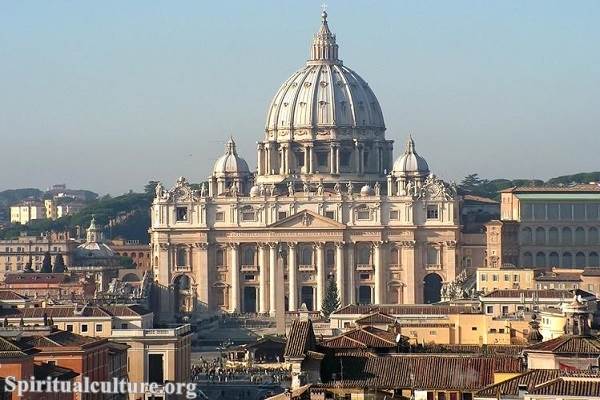
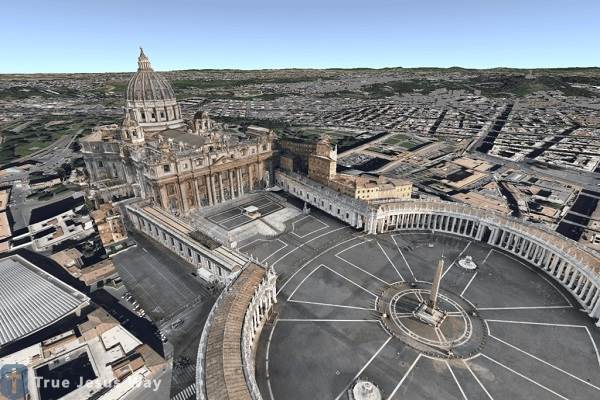
St. Peter’s Basilica occupies a central place in Catholic history, papal ceremony, Renaissance art, and global pilgrimage. Its official website describes it as the largest Christian basilica in the world and records approximately 22,000 square metres of flooring. The building is about 187 metres long and reaches approximately 136 metres to the top of its dome.
The present basilica was constructed between the early sixteenth and early seventeenth centuries, replacing an earlier church associated with Emperor Constantine. According to Catholic tradition, the site is connected with the burial of the apostle Peter, whom Catholics regard as the first bishop of Rome. Archaeological remains and a Roman necropolis survive beneath the present church, although questions concerning the precise identification and interpretation of individual remains belong to historical and archaeological study rather than doctrine alone.
Several of the most influential architects of Renaissance and Baroque Italy participated in its design. Donato Bramante developed an ambitious centralized plan. Raphael and other architects subsequently revised the project. Michelangelo simplified and strengthened the design and shaped the conception of the dome, while Giacomo della Porta and Domenico Fontana continued its construction after his death. Carlo Maderno extended the nave and created the façade, and Gian Lorenzo Bernini later designed the monumental square and colonnades.
The dome remains one of the basilica’s defining achievements. The Vatican records an internal height of about 117.57 metres from the pavement to the vault of the lantern and an external height of about 133.3 metres from street level to the summit of the cross. Its richly decorated interior surface covers approximately 3,000 square metres.
St. Peter’s is also an extraordinary museum of Catholic art, though it remains first and foremost an active place of worship. Michelangelo’s Pietà, Bernini’s bronze baldachin, papal monuments, mosaics, altars, chapels, and inscriptions form an artistic environment intended to communicate theological themes through space and image.
Major papal liturgies take place in the basilica or in St. Peter’s Square. The church also receives ordinary pilgrims, parish groups, clergy, scholars, tourists, and visitors of many religious backgrounds. Its scale therefore serves several purposes: ceremonial visibility, the movement of pilgrims, the celebration of large liturgies, and the presentation of Rome as a center of the Catholic Church.
Conservation is continuous. Marble, mosaics, metalwork, underground structures, roof systems, and the dome all require specialist monitoring. Recent digital documentation projects have treated the basilica as a complex historical structure whose architecture, foundations, subsoil, and decoration must be understood together.
2. Basilica of the National Shrine of Our Lady of Aparecida, Brazil
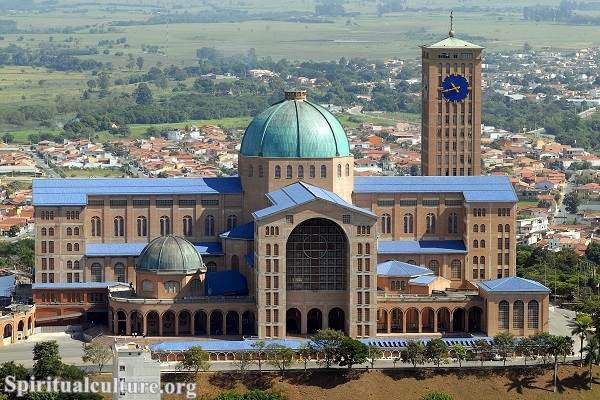
The Basilica of the National Shrine of Our Lady of Aparecida stands in the municipality of Aparecida in São Paulo State. It is the largest Marian shrine in the world and one of the most important pilgrimage centers in Latin America. The church is also the cathedral of the Archdiocese of Aparecida.
Its immense scale reflects the growth of devotion to Our Lady of Aparecida, the Catholic title under which the Virgin Mary is honored as the principal patroness of Brazil. According to the traditional Catholic account, fishermen recovered a small image from the Paraíba do Sul River in 1717. Devotion developed gradually around the image, leading first to local chapels and an older basilica and later to the construction of the present national shrine.
The modern basilica was designed by Benedito Calixto de Jesus Neto, commonly known as Benedito Calixto Filho. Construction began in the twentieth century as the earlier church could no longer accommodate the growing number of pilgrims. Pope John Paul II consecrated the basilica during his visit to Brazil in 1980. The official sanctuary identifies it as the world’s largest shrine dedicated to Mary.
The building follows a monumental cross-shaped plan organized around a central altar. Its red-brick surfaces, broad arches, dome, towers, and large interior distinguish it from the pale marble Gothic and Baroque churches of Europe. The architectural language draws partly on Romanesque traditions while adapting them to a modern structural system and the needs of mass pilgrimage.
Official sanctuary information describes the main ground-floor level as covering about 25,000 square metres. Eucharistic celebrations in this space can gather approximately 30,000 worshippers around the central altar, while exterior areas can receive far larger crowds during important events. These figures include a broader ground-floor arrangement than some rankings use when measuring the inner floor of other churches, which is why direct comparisons should be made cautiously.
The basilica’s central altar makes large communal liturgies possible. Because worshippers gather around rather than only in front of the sanctuary, the plan reflects twentieth-century Catholic approaches to visibility and congregational participation. Numerous chapels, devotional areas, confession facilities, circulation routes, and pilgrim services support the religious life of the larger complex.
Aparecida also preserves a major tradition of ex-votos: objects, photographs, letters, and other offerings given by people in gratitude or as expressions of prayer. The sanctuary’s Room of Promises contains large collections of such objects. These should be understood as evidence of personal and communal devotion, not as scientific proof of supernatural events.
The shrine continues to evolve artistically. Large exterior mosaics form part of an ongoing biblical program that uses sacred art to present scriptural narratives to arriving pilgrims. Aparecida is therefore not a completed monument frozen in the past. It is a living religious campus whose architecture, art, pastoral work, broadcasting, pilgrimage management, and cultural memory continue to develop.
3. Milan Cathedral, Italy
Milan Cathedral, commonly called the Duomo di Milano, is one of the largest Catholic churches in Europe and one of the most recognizable achievements of Gothic architecture. It is dedicated to the Nativity of the Blessed Virgin Mary and is the cathedral of the Archdiocese of Milan.
Construction probably began in 1386 on the site of earlier Christian buildings. In 1387, the Veneranda Fabbrica del Duomo was established to manage the enormous undertaking. The decision to use marble from the Candoglia quarries rather than the brick more customary in Lombardy shaped both the cathedral’s appearance and the specialized network of quarrying, transportation, carving, and maintenance required to sustain it.
The Duomo was not built according to a single unchanging medieval design. Architects, engineers, sculptors, clergy, patrons, and civic authorities repeatedly reconsidered parts of the building. Gothic forms were combined with later Renaissance, Baroque, Neoclassical, and nineteenth-century interventions. Work on the façade, spires, doors, sculpture, and decoration continued for centuries, with the final façade doors completed between 1909 and 1965.
Its exterior is distinguished by a dense forest of pinnacles, flying buttresses, statues, carved figures, and decorative details. The official cathedral institution notes that more than 3,000 statues populate the complex. Above them rises the principal spire and the gilded figure of the Madonnina, the Virgin Mary who became both a religious image and a civic emblem of Milan.
The cathedral reaches approximately 108.5 metres at the Madonnina. The statue itself is about 4.16 metres high and was placed on the main spire in 1774. The image has long held a special place in the civic imagination of Milan, connecting the cathedral’s devotional identity with the city’s public life.
Inside, immense piers divide the five-aisled space. Stained glass, carved capitals, tombs, altars, liturgical furnishings, and pavement designs reflect several periods of Catholic art. The cathedral also belongs to the Ambrosian tradition, the distinctive liturgical heritage of the Church of Milan associated with St. Ambrose.
Milan Cathedral remains a working episcopal church rather than only a tourist landmark. Daily worship, diocesan celebrations, musical traditions, conservation work, and the responsibilities of the cathedral chapter continue alongside cultural visitation.
The Veneranda Fabbrica still maintains specialized construction and restoration activity at the site. Marble exposed to urban pollution, weather, moisture, and temperature changes must be inspected and repaired. In this sense, the Duomo remains what it has been for more than six centuries: a continuing workshop as well as a completed sacred monument.
4. Seville Cathedral, Spain
The Cathedral of Saint Mary of the See in Seville is the largest Gothic cathedral in the world. UNESCO describes it as the largest Gothic building in Europe, while the cathedral’s official institution similarly presents it as the world’s largest Gothic cathedral.
Its scale is inseparable from Seville’s complex history. The cathedral stands on the site of the city’s former Almohad congregational mosque. After the Christian conquest of Seville in 1248, the mosque was adapted for Christian use. Construction of the great Gothic cathedral began in the early fifteenth century.
Important elements of the Islamic complex were preserved and transformed. The former minaret became the Giralda bell tower, while the courtyard survives as the Patio de los Naranjos, or Orange Tree Courtyard. The Giralda’s lower sections belong to Almohad architectural history; later Christian additions changed its function and silhouette. UNESCO regards this combination as an important example of cultural and architectural continuity across political and religious change.
The cathedral has five naves and an extraordinary collection of chapels, tombs, stained glass, paintings, sculpture, metalwork, and liturgical furnishings. Its principal altarpiece is among the largest and most elaborate carved Christian altarpieces. Created over several generations, it presents an extensive visual cycle of Christ, Mary, saints, and biblical narratives.
Published measurements require interpretation. The cathedral’s official material gives a total occupied building area of about 23,500 square metres, while describing the Gothic section as approximately 126 metres long and 83 metres wide. The total figure is not equivalent to unobstructed interior worship space because it includes the broader building footprint and associated areas.
Seville Cathedral also reflects the historical wealth and global connections of early modern Seville. Its artworks and memorials emerged within the social and political context of a city deeply connected with Spain’s Atlantic empire. Interpretation of this heritage must therefore consider both artistic achievement and the unequal colonial systems through which wealth, objects, and cultural influences circulated.
The building remains the cathedral of the Archdiocese of Seville. Liturgies, sacramental celebrations, Holy Week observances, musical programs, archival research, tourism, and conservation all form part of its present life.
Conservation must address the legacy of several architectural traditions at once. Gothic stone vaults, Islamic and Mudéjar fabric, Renaissance additions, Baroque furnishings, stained glass, the Giralda, and the extensive art collection each require different forms of care.
5. Basilica of Our Lady of Licheń, Poland
The Basilica of Our Lady of Licheń stands at Licheń Stary in west-central Poland. Although located in a village rather than a major capital, it is the largest church in Poland and one of Europe’s most monumental modern Catholic sanctuaries.
The basilica forms part of the Shrine of Our Lady of Sorrows, Queen of Poland. The shrine’s identity is connected with local Catholic traditions concerning Tomasz Kłossowski, a soldier who was said to have experienced a Marian vision in the early nineteenth century, and later accounts involving Mikołaj Sikatka. These narratives belong to the devotional history of the shrine and should be distinguished from independently verified historical evidence.
Construction of the present church began in 1994 and was completed in 2004. Barbara Bielecka designed the monumental building, which combines a large classical composition with modern construction, a central dome, extensive colonnades, towers, and a broad ceremonial approach.
Polish tourism information describes the building as approximately 139 metres long. Its enormous interior and surrounding square were designed to receive major pilgrimages, while the separate tower rises to about 141.5 metres. The official shrine provides access to observation levels in the tower at approximately 98 and 114 metres.
The basilica’s scale is strongly symbolic. Numbers and architectural elements refer to biblical themes, Catholic history, and Polish identity. The church houses the venerated image of Our Lady of Licheń, and its decoration brings together Marian themes, national memory, biblical references, and contemporary sacred art.
Licheń illustrates an important point about living heritage: monumental Catholic architecture is not only a product of medieval or Renaissance Europe. Large shrines continued to be built in the late twentieth and early twenty-first centuries, often through pilgrim donations and the organization of religious communities.
The basilica’s artistic reception has not been universally positive. Some observers admire its grandeur and symbolic program, while others consider its eclectic forms excessive. Such disagreement is part of the building’s cultural history. Architectural importance does not require unanimous aesthetic approval.
6. Basilica of the Most Holy Trinity at Fátima, Portugal
The Basilica of the Most Holy Trinity stands within the Sanctuary of Fátima in central Portugal. It was created to supplement the older Basilica of Our Lady of the Rosary and accommodate the enormous congregations that gather at the shrine.
Fátima developed around the accounts of three shepherd children—Lúcia dos Santos and her cousins Francisco and Jacinta Marto—who reported Marian apparitions in 1917. Within Catholic tradition, these events are associated with prayer, penance, conversion, and devotion to the Immaculate Heart of Mary. Historians can document the children, the growth of pilgrimage, Church investigations, public responses, and the sanctuary’s institutional development; the supernatural meaning of the apparitions remains a matter of faith.
The new church was designed by the Greek architect Alexandros Tombazis. It was completed and dedicated in 2007. Its restrained modern form differs sharply from the vertical tower and historical language of the older basilica across the prayer area.
The Basilica of the Most Holy Trinity is circular, approximately 125 metres in diameter, and contains no intermediate columns blocking the congregation’s view. The official sanctuary records 8,633 seats, including designated spaces for people with disabilities. A movable wall allows the large assembly space to be divided into smaller sectors.
Its interior emphasizes visibility, accessibility, and congregational unity. The floor slopes gently toward the sanctuary so that worshippers can see the altar. The presbytery can accommodate a large number of concelebrating clergy, reflecting the international character of Fátima’s major liturgies.
The church also contains modern sacred artworks from several countries. These works demonstrate how contemporary Catholic art can operate internationally, bringing different artistic traditions into a shared liturgical environment.
Unlike many historic cathedrals whose enormous dimensions emerged through gradual expansion, the Fátima basilica was planned specifically for modern pilgrimage. Crowd movement, acoustics, accessibility, unobstructed sightlines, confession, Eucharistic celebration, and the management of international groups shaped its design from the beginning.
7. Basilica of Saint Paul Outside the Walls, Rome
The Papal Basilica of Saint Paul Outside the Walls is one of Rome’s four major basilicas and one of the largest historic Catholic churches in the city. It stands outside the ancient Aurelian Walls near the place traditionally associated with the burial of the apostle Paul.
An early basilica was established during the Constantinian period and later enlarged. The historic church developed into an enormous five-aisled basilica whose longitudinal form influenced Christian architecture for centuries. Vatican material records the enlarged early structure as approximately 131.66 metres long, 65 metres wide, and 30 metres high.
A disastrous fire in 1823 destroyed much of the ancient and medieval fabric. The basilica was reconstructed during the nineteenth century, with efforts made to restore the monumental spatial character of the earlier church. Some original elements survived, while others were reconstructed, replaced, or newly created.
The result is an immense interior of granite columns, marble surfaces, gilded decoration, mosaics, coffered ceilings, papal portraits, and broad processional space. The surviving medieval cloister is especially valued for its twisted columns, colored stone inlays, and quiet relationship between architecture and monastic life.
The basilica is not only a reconstruction of the past. It remains an active place of worship entrusted to a Benedictine community. It has particular importance during the Week of Prayer for Christian Unity, reflecting the apostle Paul’s significance across many Christian traditions.
Its conservation raises questions familiar to many restored monuments. What should be preserved as ancient fabric? How should nineteenth-century reconstruction be valued? Can a rebuilt church possess historical authenticity? Saint Paul Outside the Walls shows that heritage may reside not only in untouched material but also in continuity of worship, memory, location, artistic tradition, and community stewardship.
8. Basilica of Our Lady of Guadalupe, Mexico City
The Basilica of Our Lady of Guadalupe stands at the foot of Tepeyac Hill in northern Mexico City. It is one of the largest Catholic pilgrimage churches and one of the most culturally influential Marian sanctuaries in the world.
Catholic tradition holds that the Virgin Mary appeared to the Indigenous Christian Juan Diego in 1531 and that her image appeared on his cloak, or tilma. The cloth displayed in the basilica is venerated by believers as the image connected with these events. Historical scholarship examines the documentary development of the apparition account, colonial religious culture, artistic materials, Indigenous and Spanish influences, and the emergence of Guadalupe as a symbol extending beyond institutional Catholicism.
An older basilica constructed during the colonial period remains within the Tepeyac complex. Because unstable ground caused serious structural problems, a new basilica was built between 1974 and 1976.
The modern sanctuary was principally associated with architect Pedro Ramírez Vázquez and a wider design team. Its circular plan allows worshippers to see the altar and the Guadalupan image from many points in the building. The broad roof and unobstructed interior represent a functional response to mass pilgrimage rather than an imitation of a traditional European cathedral.
The basilica accommodates approximately 10,000 seated worshippers. Seven main entrances and the expansive plan assist the circulation of large crowds. A moving walkway beneath the image allows pilgrims to view it while reducing congestion immediately in front of the sanctuary.
Guadalupe is both a Catholic devotion and a powerful element of Mexican cultural identity. Her image has appeared in churches, homes, processions, political movements, art, popular music, murals, clothing, and public demonstrations. The symbol has been interpreted in many ways by Indigenous communities, clergy, nationalists, artists, migrants, activists, and ordinary families.
This range of meanings should not be reduced to a simple claim that Guadalupe represents all Mexicans in the same way. Mexico is religiously diverse, and individual relationships with the image differ. Nevertheless, the basilica remains a major place where religious faith, family memory, national history, and Indigenous-colonial cultural encounter are negotiated in public.
9. Cathedral of Santa Maria del Fiore, Florence
Florence Cathedral, officially the Cathedral of Santa Maria del Fiore, is among the largest churches of medieval and Renaissance Europe. It stands within Florence’s cathedral complex beside Giotto’s bell tower and the Baptistery of St. John.
Construction of the cathedral began in 1296 under Arnolfo di Cambio. Later architects expanded and modified the project, producing a vast Gothic church whose exterior is now associated with patterned marble cladding in green, white, and pink tones.
The building’s defining feature is the dome designed by Filippo Brunelleschi. When work began on the dome in the fifteenth century, builders faced the challenge of covering an immense octagonal opening without the traditional wooden centering used for many masonry vaults.
Brunelleschi’s solution combined an inner and outer shell, ribs, carefully arranged masonry, specialized lifting devices, and construction methods that remain central to the history of architecture and engineering. The dome became a symbol of Florentine ingenuity and an important model for later European architecture.
UNESCO identifies Santa Maria del Fiore as one of the principal monuments expressing Florence’s centuries of artistic achievement. The cathedral is part of the Historic Centre of Florence World Heritage property rather than a separately inscribed World Heritage Site.
Inside, the contrast between the monumental architecture and relatively restrained wall surfaces directs attention toward the scale of the nave and the dome. Giorgio Vasari and Federico Zuccari created the vast painted program of the Last Judgment inside the cupola.
Florence Cathedral remains the episcopal church of the Archdiocese of Florence. Its liturgical calendar, civic ceremonies, sacred music, visitor management, and conservation are closely connected with the historic center surrounding it.
The cathedral also demonstrates that the “size” of a church can be experienced vertically. Its floor area is enormous, but the emotional effect of the building depends especially on the upward expansion of the crossing and the visual power of the dome over the city.
10. Basilica of the Sacred Heart at Koekelberg, Belgium
The National Basilica of the Sacred Heart stands on Koekelberg Hill in Brussels. It is one of the largest Catholic churches of the twentieth century and one of the most significant monumental Art Deco religious buildings in Europe.
The project originated under King Leopold II, but construction extended through changing architectural ideas, two world wars, financial difficulties, and national debates. Albert Van Huffel’s Art Deco design ultimately shaped the building’s distinctive form.
The basilica combines an immense central dome, twin towers, broad transepts, brick and terracotta-colored surfaces, reinforced concrete, and simplified geometric ornament. Rather than reproducing medieval Gothic architecture, it demonstrates how twentieth-century designers sought a monumental Catholic style suited to modern materials.
The institution responsible for the basilica describes it as the fifth-largest church in the world according to the ranking it follows. Such claims depend on the measurement method and include non-Catholic churches in the comparison, so the exact numerical position should not be treated as universally accepted. The description nevertheless reflects the building’s extraordinary dimensions and international architectural importance.
The external gallery beneath the dome is situated at a height of about 52.8 metres and provides broad views across Brussels and Brabant.
The basilica functions as a parish church, a place for national Catholic celebrations, a venue for prayer for peace, and a cultural institution. Museums, exhibitions, concerts, and educational programs coexist with worship.
Koekelberg’s heritage value lies partly in this mixture. It is not only a large container for crowds but also an example of how Catholic sacred architecture responded to industrial materials, modern urban planning, national symbolism, and the Art Deco movement.
11. Basilica of Our Lady of Peace, Yamoussoukro, Côte d’Ivoire
The Basilica of Our Lady of Peace in Yamoussoukro is among the most visually astonishing Catholic churches ever constructed. Its great dome, encircling colonnades, marble surfaces, extensive plazas, and monumental approach were inspired in part by St. Peter’s Basilica, though the two buildings differ in plan, proportions, internal arrangement, and cultural context.
The basilica was commissioned during the presidency of Félix Houphouët-Boigny and built during the 1980s. Pierre Fakhoury was its principal architect. Pope John Paul II consecrated the church in September 1990.
It is frequently described as the world’s largest church by exterior area. The often-quoted total of approximately 30,000 square metres includes elements of the broader complex, however, and does not mean that its unobstructed interior floor is larger than that of St. Peter’s. This explains why St. Peter’s can be called the largest Christian basilica by its own official institution while Yamoussoukro appears as the largest church in rankings based on the wider external complex.
The dome rises to approximately 158 metres when the cross is included. The church contains around 7,000 permanent seats, with additional standing space that can raise the interior congregation to approximately 18,000. Vast stained-glass surfaces fill the building with colored light.
Its construction generated controversy because of its great cost and scale in relation to the country’s economic conditions. Any responsible cultural account should acknowledge this debate rather than presenting the basilica only as an architectural spectacle. Monumental religious buildings can embody devotion and artistic ambition while also raising questions about political power, public resources, social priorities, and national image.
The basilica’s dedication to Our Lady of Peace has acquired additional meaning amid periods of political tension and conflict in Côte d’Ivoire. Worshippers and clergy have used its liturgical life to express hopes for peace, unity, and reconciliation. During times of unrest, the building has also functioned as a place of refuge and communal gathering.
Although inspired by a European Catholic monument, the basilica is now part of African Catholic history. Its living meaning depends not only on the intentions of its political patron or architect but also on the clergy, worshippers, workers, visitors, and local communities who continue to use and interpret it.
12. Cologne Cathedral, Germany
Cologne Cathedral, or Kölner Dom, is one of the greatest High Gothic churches in Europe. Its twin towers dominate the skyline of Cologne and rise to approximately 157.22 and 157.18 metres. The cathedral is about 144.58 metres long and 86.25 metres wide across the transept.
Construction began in 1248. The cathedral was planned in part to provide a suitably monumental setting for the Shrine of the Three Kings, a reliquary associated in Catholic tradition with the Magi who visited the infant Jesus.
Work progressed during the Middle Ages but eventually stopped, leaving the building incomplete for centuries. Construction resumed in the nineteenth century using surviving medieval plans together with contemporary scholarship and engineering. The cathedral was finally completed in 1880.
This long building history complicates simple distinctions between “medieval” and “modern.” The plan and architectural language are Gothic, yet much of the visible structure was completed during the nineteenth century. UNESCO considers the continuity between the medieval conception and later completion to be part of the cathedral’s exceptional significance.
The interior is remarkable for its height, narrow vertical proportions, stained glass, choir, chapels, sculpture, tombs, and liturgical objects. UNESCO records the central nave at approximately 43.58 metres high.
Cologne Cathedral suffered damage during the Second World War but survived the destruction of much of the surrounding city. Its silhouette subsequently became associated with endurance, reconstruction, and Cologne’s postwar identity.
The cathedral is now both an active Catholic church and one of Germany’s most visited cultural monuments. Managing this dual role requires the coordination of worship, pilgrimage, tourism, security, research, restoration, and the ordinary life of the cathedral community.
Conservation is permanent. Wind, rain, pollution, biological growth, vibration, and the aging of stone affect its enormous surface. The cathedral workshop continues the tradition of specialized masonry, sculpture, glazing, documentation, and repair that has accompanied the building for centuries.
Which Catholic Church Is Really the Largest?
St. Peter’s Basilica provides the clearest answer when the question concerns the largest Catholic church by internal flooring and overall liturgical scale. Its official institution reports approximately 22,000 square metres of flooring and identifies it as the largest Christian basilica.
The answer changes when other measurements are used:
Largest Catholic basilica by interior flooring
St. Peter’s Basilica is the most widely accepted answer. Its enormous nave, transepts, chapels, crossing, and surrounding spaces create the largest continuous Catholic basilica interior.
Largest Marian shrine
The Basilica of the National Shrine of Our Lady of Aparecida holds this distinction. It was created specifically to receive the large pilgrimages associated with Brazil’s national Marian devotion.
Largest Gothic cathedral
Seville Cathedral is recognized by its official institution and UNESCO as the largest Gothic cathedral or Gothic building of its kind.
Largest church by exterior complex area
The Basilica of Our Lady of Peace in Yamoussoukro is frequently given this title. The claim uses a wider exterior measurement that includes more than the internal worship floor.
Largest Catholic church in Poland
The Basilica of Our Lady of Licheń is Poland’s largest church and one of the most ambitious modern pilgrimage churches in Europe.
Largest modern Catholic pilgrimage interiors
The basilicas at Aparecida, Fátima, and Guadalupe stand out because their plans were deliberately designed for large twentieth-century pilgrim congregations. Their open interiors provide greater visibility and easier crowd movement than many medieval churches.
Why Did Catholic Communities Build Such Enormous Churches?
Large Catholic churches emerged from different historical conditions. They should not be explained by a single motive.
To accommodate pilgrimage
Aparecida, Fátima, Guadalupe, and Licheń expanded because existing buildings could not contain growing numbers of pilgrims. Their size is connected with devotion, transportation networks, national religious movements, mass media, and the organization of modern pilgrimage.
To express episcopal and civic importance
Medieval cathedrals such as Milan, Seville, Florence, and Cologne were closely tied to urban identity. Bishops, cathedral chapters, rulers, guilds, merchants, and civic authorities contributed to construction. The cathedral became a public representation of the city as well as a place of worship.
To preserve sacred memory
St. Peter’s Basilica and Saint Paul Outside the Walls developed around places traditionally associated with the apostles Peter and Paul. Their architecture helped give permanent material form to Christian memory, pilgrimage, liturgy, and Roman ecclesiastical authority.
To make theology visible
Church architecture communicates through space. A long nave can represent pilgrimage and procession. A dome may suggest the heavens. Light can symbolize divine presence. An altar placed at the center of a large assembly can emphasize participation in the Eucharistic liturgy.
These meanings are theological and symbolic interpretations within Christian tradition. They should not be confused with measurable scientific properties of the buildings.
To express national identity
Aparecida, Guadalupe, Licheń, Koekelberg, and Yamoussoukro all have national dimensions. Their sacred images, dedications, ceremonies, and public histories connect Catholic practice with broader debates about identity and memory.
National significance, however, does not mean that every citizen shares the same beliefs. These churches exist within religiously diverse societies and may be interpreted differently by believers, nonbelievers, minority communities, historians, and visitors.
Architecture and the Experience of Sacred Scale
Numbers alone cannot explain why these churches feel immense. Two buildings with similar floor areas may produce very different experiences.
Gothic cathedrals use pointed arches, ribbed vaults, clustered piers, stained glass, vertical lines, and complex processional routes. Their scale is often experienced through height, repetition, shadow, and the gradual revelation of chapels and altars.
Renaissance churches generally emphasize proportion, geometry, classical orders, domes, and centralized spatial relationships. St. Peter’s Basilica combines these Renaissance foundations with Baroque art and movement.
Modern pilgrimage churches often use reinforced concrete, steel, wide roof spans, circular plans, flexible partitions, ramps, modern acoustics, and carefully planned circulation. Their scale is experienced through the shared presence of thousands of worshippers rather than through a forest of medieval columns.
Art Deco buildings such as Koekelberg use simplified geometry and modern materials while retaining a monumental sacred character. Yamoussoukro adapts monumental classical and Baroque references within the political and religious context of late twentieth-century Côte d’Ivoire.
The biggest Catholic churches therefore form no single architectural category. They show how different societies have imagined sacred space across centuries.
The Biggest Churches as Living Heritage
Calling a church “heritage” should not imply that it belongs only to the past. Every church discussed here remains connected with living communities.
Clergy and laypeople celebrate Mass, baptisms, marriages, funerals, ordinations, feast days, processions, devotional prayers, concerts, and charitable activities within these buildings. Pilgrims may travel great distances, while local worshippers may use the same monumental church for ordinary weekly services.
Craft traditions also remain alive. Stonecutters, mosaicists, stained-glass specialists, organ builders, metalworkers, conservators, architects, archivists, musicians, sacristans, and cleaners all help transmit the material and ritual life of a church.
Tourism can support conservation and wider cultural understanding, but it may also place pressure on worship, fragile artworks, floors, air quality, crowd management, and local communities. Successful preservation therefore requires balance. A cathedral cannot be treated entirely as a museum, yet unrestricted use without conservation planning can damage the heritage entrusted to future generations.
Climate change introduces further challenges. Intense heat, changing rainfall, flooding, storms, humidity, and biological growth may affect historic masonry, roofs, stained glass, foundations, and surrounding landscapes. Modern churches also face the aging of reinforced concrete, electrical systems, air conditioning, waterproofing, and large roof structures.
Community-led preservation is essential. Decisions should involve the religious communities that maintain worship, as well as conservation specialists, public authorities, researchers, local residents, and accessibility advocates.
Visiting a Major Catholic Church Respectfully
The largest Catholic churches welcome people for many reasons. Some arrive to pray, attend Mass, make a pilgrimage, study architecture, hear sacred music, or view historic art. Others visit from curiosity without sharing Catholic beliefs.
Visitors should remember that these are active religious places. Appropriate behavior normally includes modest clothing, quiet movement, respect for restricted areas, and avoiding disruption during worship. Photography rules vary, especially during liturgies or near sensitive artworks.
A visitor should also avoid interpreting every object only as decoration. An altar is used for the Eucharistic liturgy. A tabernacle has a specific devotional and sacramental role. A baptismal font is connected with Christian initiation. A reliquary, Marian image, or saint’s tomb may be approached with deep reverence by pilgrims.
Respect does not require accepting Catholic teachings. It means recognizing that a living sacred place carries meanings that differ from those of an ordinary tourist attraction.
Practical conditions such as opening hours, tickets, security procedures, pilgrimage schedules, restoration closures, and dress requirements can change. Travelers should consult the official institution responsible for each church before visiting.
The biggest Catholic churches in the world reveal many different forms of sacred monumentality. St. Peter’s Basilica represents the vast ceremonial and artistic traditions of papal Rome. Aparecida, Fátima, Guadalupe, and Licheń demonstrate the continuing power of pilgrimage. Milan, Seville, Florence, and Cologne preserve the ambitions of medieval and Renaissance cities. Koekelberg and Yamoussoukro show how modern societies reinterpreted monumental Catholic architecture.
No single ranking can capture all these buildings fairly. St. Peter’s is the strongest answer when interior flooring is the standard. Yamoussoukro is often presented as the largest by exterior complex area. Seville is the largest Gothic cathedral, and Aparecida is the largest Marian shrine.
More important than any numerical record is the relationship between architecture and community. These churches remain places of prayer, ritual, memory, artistic creation, public debate, and cultural encounter. Their preservation depends not only on repairing stone, glass, concrete, and metal, but also on sustaining the knowledge, worship, craftsmanship, and communal responsibility that give sacred buildings their living meaning.