Have you ever stood in a place so old and silent that you could almost hear the whispers of the past? South America is a continent where the earth itself seems to speak. From the mist-covered peaks of the Andes to the rhythmic, beating heart of the Amazon rainforest, the cultural tapestry here is not just colorful; it is alive. It is a blend of ancient wisdom that predicted the stars and resilient traditions that survived centuries of change.
At Spiritual Culture, we believe that understanding these cultures isn’t about memorizing dates or looking at museum artifacts behind glass. It is about understanding the human spirit. It is about seeing how different people have answered the eternal questions: Who are we? Why are we here? And how do we live in harmony with the land that sustains us?
The cultures listed below vary wildly—some built empires of stone that touch the clouds, while others tread so lightly on the forest floor they leave no trace. Yet, they all share a profound spiritual connection to their environment. Whether they are ancient civilizations that left us mysterious riddles or living communities fighting to preserve their way of life, these are the top 10 cultures that define the spiritual landscape of South America.
Table of the Top 10 Most Influential Cultures in South America
| Rank | Culture / Civilization | Primary Region | Key Spiritual Focus |
|---|---|---|---|
| 10 | The Nazca | Peru (Southern Coast) | Cosmic Connection & Sacred Geometry |
| 9 | The Yanomami | Brazil & Venezuela (Amazon) | Shamanism & The Living Forest |
| 8 | The Tiwanaku | Bolivia (Lake Titicaca) | Stone Architecture as Worship |
| 7 | The Wayuu | Colombia & Venezuela | Dreams & Matriarchal Wisdom |
| 6 | The Mapuche | Chile & Argentina | Balance (Newen) & Ancestral Power |
| 5 | Afro-Brazilian Culture | Brazil (Bahia/Northeast) | Syncretism & Joyful Resilience |
| 4 | The Guaraní | Paraguay, Brazil, Argentina | The Land Without Evil & Word-Soul |
| 3 | The Aymara | Bolivia, Peru, Chile | Pachamama (Mother Earth) & Reciprocity |
| 2 | The Quechua | Andean Region | Community (Ayllu) & Cosmic Order |
| 1 | The Inca Civilization | Western South America | Sun Worship & Imperial Harmony |
Top 10. The Nazca
Imagine flying over a scorched, reddish desert where rain almost never falls. Suddenly, beneath you, gigantic lines stretch for miles, forming perfect geometric shapes, monkeys, spiders, and hummingbirds. This is the legacy of the Nazca people. Flourishing in the arid valleys of southern Peru long before the Inca, they turned the earth itself into a canvas. These weren’t just drawings; they were massive prayer pathways walked by priests during ritual processions, visible fully only to the gods in the sky.
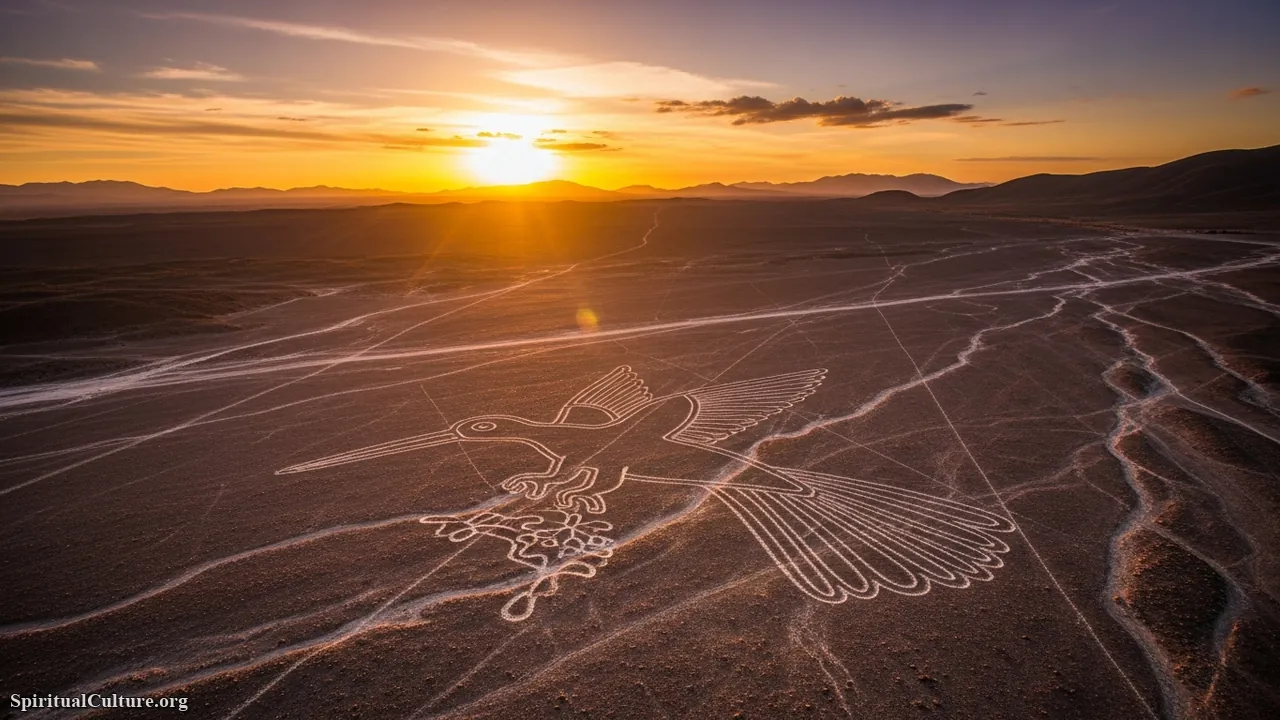
The spiritual essence of the Nazca is rooted in a desperate, beautiful plea for water and fertility. In a landscape that offered little, they developed a complex relationship with nature’s forces. Their spirituality wasn’t hidden in temples; it was etched into the planet’s crust. They believed that by creating these massive geoglyphs, they could communicate directly with the celestial bodies and mountain gods to bring the life-giving rain they so critically needed.
Standing on the edge of the Nazca lines, we are reminded of the lengths humanity will go to connect with the divine. It teaches us about faith in the face of scarcity. Even when the land was dry and unforgiving, the Nazca didn’t give up; they created art on a scale that defies logic, proving that spiritual hope can drive immense human achievement.
Cultural Highlights
- The Nazca Lines: Over 1,000 geoglyphs spanning nearly 200 square miles.
- Puquios: An advanced system of underground aqueducts that still function today.
- Ceramics: Famous for their polychrome pottery featuring mythical creatures.
Top 9. The Yanomami
Deep within the dense canopy of the Amazon rainforest, straddling the border of Brazil and Venezuela, live the Yanomami. They live in large, communal circular structures called shabonos, which open to the sky. For the Yanomami, there is no separation between the ‘natural’ world and the ‘spiritual’ world. The forest is not a resource; it is a crowded house of spirits. Every tree, stone, and river has a voice, and the health of the community is tied directly to the health of the jungle.
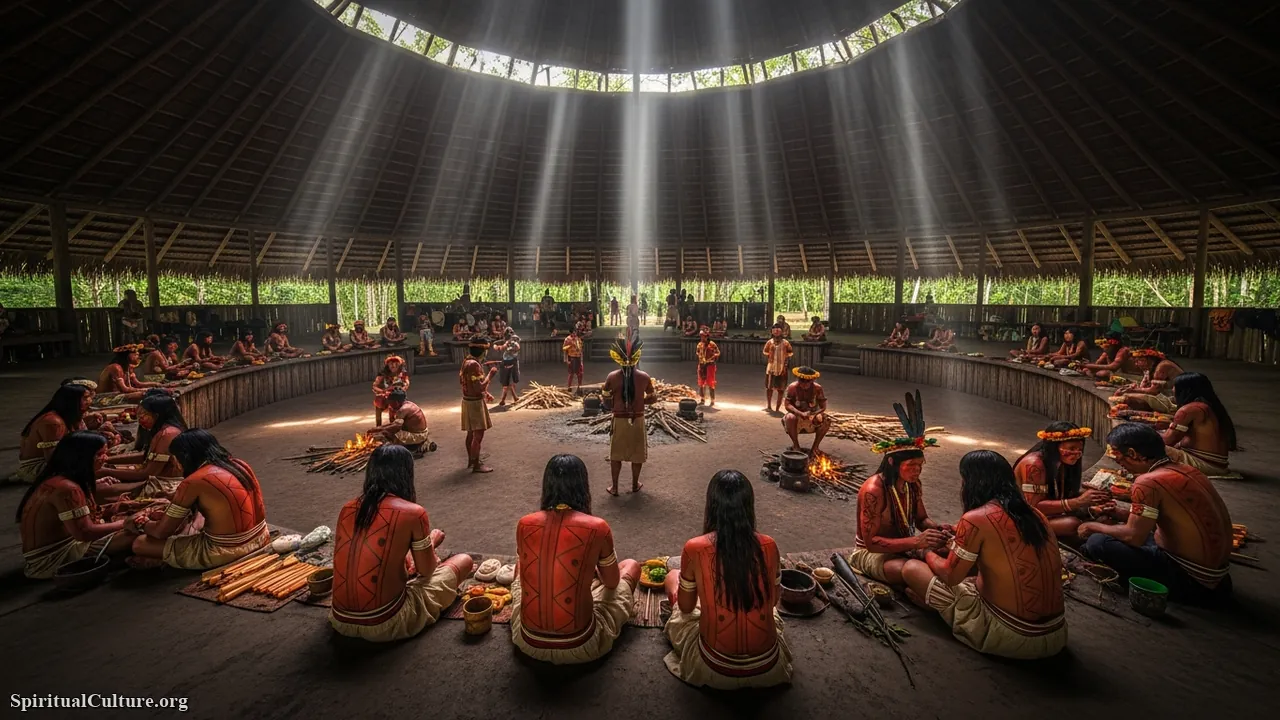
Their spiritual life revolves around the shaman, who inhales a snuff called yakoana to commune with the xapiri—tiny, dancing spirits of light. The Yanomami teach us that spirituality is not about escaping the world, but seeing the dazzling vibrancy within it. They believe that the shaman holds up the sky and that if the forest dies, the spirits will flee, and the sky will fall, ending humanity. It is a worldview of total interdependence.
In our modern world of concrete and glass, the Yanomami offer a critical warning and a lesson. They remind us that we are the guardians of the earth, not its owners. Their fight to protect their territory from illegal mining isn’t just a political struggle; it is a spiritual battle to keep the cosmos in balance.
Cultural Highlights
- Shamanism: A central pillar of life, used for healing and guidance.
- Communal Living: The entire village lives under one roof, sharing all resources.
- Isolation: One of the largest relatively isolated tribes remaining in South America.
Top 8. The Tiwanaku
Long before the Inca built their empire, the Tiwanaku civilization thrived on the freezing, high-altitude plains of Bolivia near Lake Titicaca. Walking through their ruins feels like stepping onto another planet. Massive stone monoliths, cut with laser-like precision, stand silent against the stark blue sky. The “Gate of the Sun,” carved from a single block of stone, features the Staff God, a deity holding lightning bolts, weeping rain from his eyes.
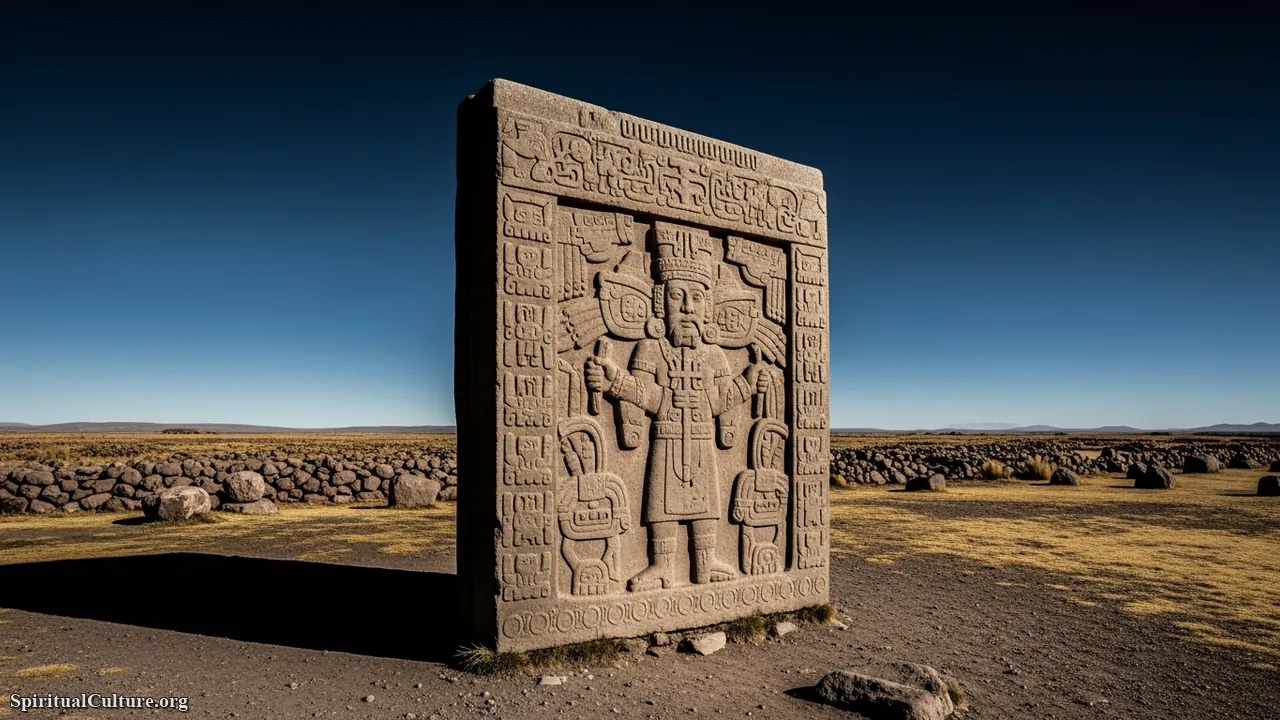
The soul of Tiwanaku was centered on cosmology and pilgrimage. They were the spiritual ancestors of the Andes, creating a religious state that influenced the entire region for centuries. Their spirituality was deeply astronomical; their temples were aligned to the rising sun and the changing seasons. They understood that to survive at 13,000 feet, one had to be perfectly in sync with the cycles of the heavens.
Tiwanaku represents the foundations of Andean belief. It shows us how ancient people used architecture to create a sense of awe and order. When we look at their precise stonemasonry, we see a culture that valued permanence and perfection as a way to honor the gods.
Cultural Highlights
- Gate of the Sun: A monolithic stone archway with intricate calendar carvings.
- Pumapunku: Famous for its bafflingly precise interlocking stone blocks.
- Influence: Considered the “mother culture” for many later Andean civilizations, including the Inca.
Top 7. The Wayuu
On the northernmost tip of South America, in the desert peninsula of La Guajira, live the Wayuu people. This is a land of harsh sun and wind, yet the Wayuu brighten the landscape with vibrant colors. Known as the “people of the sun, sand, and wind,” they are famous for their mochilas—intricately crocheted bags that are works of art. But these bags are more than fashion; they are a manifestation of Wayuu thoughts and creativity.
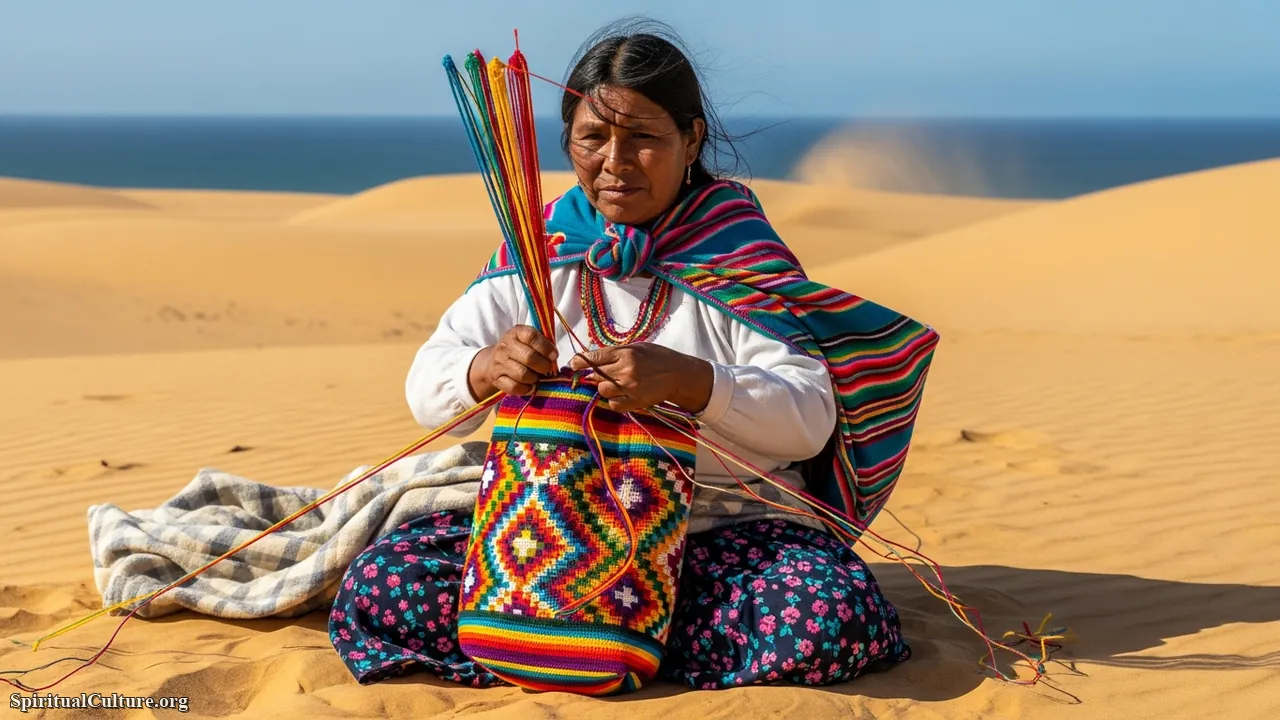
What makes the Wayuu soul unique is the supreme importance of dreams. To the Wayuu, the dream world is as real as the waking world. Dreams are messages from ancestors, warnings of the future, or guidance for the present. Furthermore, this is a matrilineal society. Women are the pillars of the family and the keepers of tradition, passing down the clan name and the secrets of weaving from generation to generation.
The Wayuu teach us to listen to our intuition. In a world that prizes logic above all else, the Wayuu remind us that our subconscious mind has value. Their resilience is also legendary; they were never fully conquered by the Spanish, maintaining their laws and customs through sheer strength of spirit.
Cultural Highlights
- Weaving: A spiritual practice taught by the mythical spider, Wale’ Kerü.
- Matrilineal Clans: Lineage and property are passed down through the mother.
- Dream Interpretation: A vital daily practice for decision-making.
Top 6. The Mapuche
Down in the southern forests and lakes of Chile and Argentina, the “People of the Earth” (Mapuche) have held their ground for centuries. They are perhaps best known for their fierce resistance—first against the Inca, then the Spanish, and finally modern states. But behind this warrior reputation lies a deeply spiritual culture centered on balance. Their traditional ceremonies are held in the open air, often around a sacred Canelo tree, to the sound of the kultrún (drum).
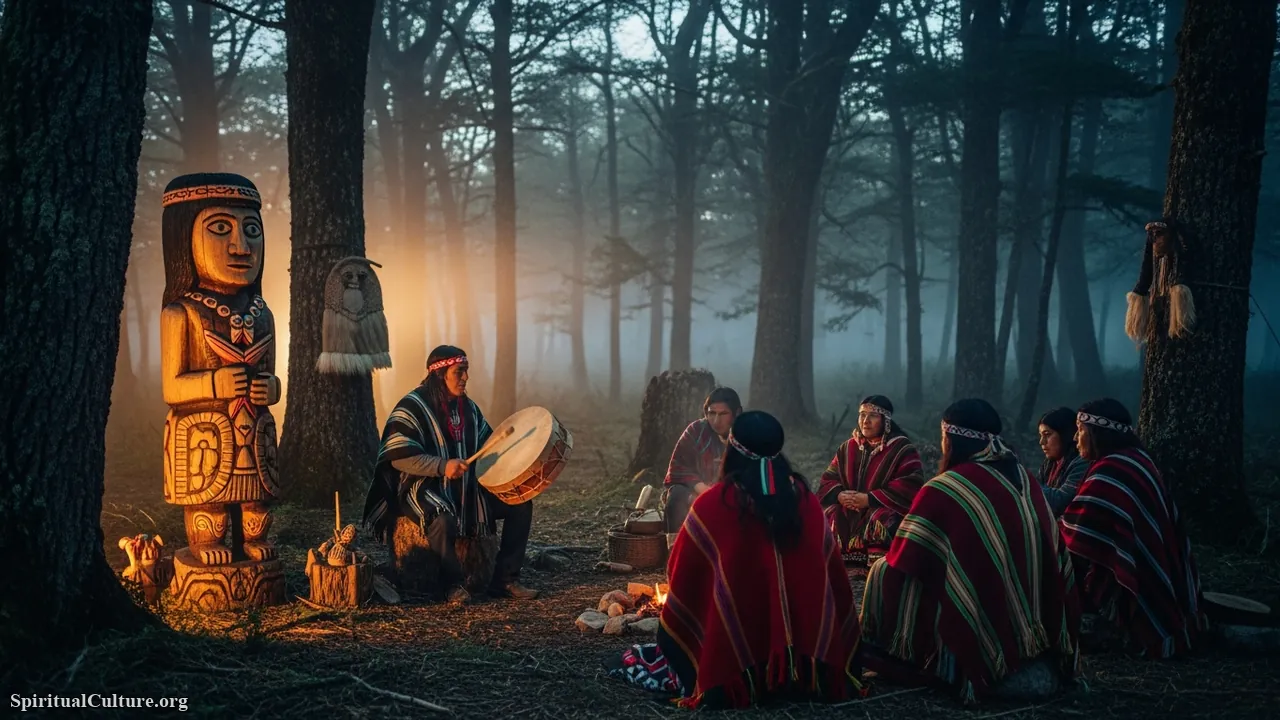
The core of Mapuche spirituality is Newen—energy or force that exists in all living things. The goal of life is not dominance, but maintaining a balance between these energies. Illness or bad luck is often seen as a disruption of this spiritual equilibrium. They revere the wisdom of the Machi (shaman), usually a woman, who acts as the bridge between the human world and the spiritual dimension.
The Mapuche connection is one of resilience and identity. They show us that protecting one’s culture is a sacred duty. Their worldview challenges us to look at the energy we bring into the world: are we creating balance, or are we causing disruption?
Cultural Highlights
- The Machi: The spiritual healer and religious leader of the community.
- Chemamull: Large wooden statues placed over graves to help the soul transition.
- Resistance: The only indigenous group in the Americas the Spanish Crown signed a treaty with, recognizing their sovereignty.
Top 5. Afro-Brazilian Culture
Step into the streets of Salvador de Bahia, and you will feel a pulse that is distinctly African, yet entirely Brazilian. This culture was born from the pain of the Atlantic slave trade, but it blossomed into a celebration of life, rhythm, and spirit. It is visible in the acrobatic martial art of Capoeira and audible in the thunderous drums of Samba-Reggae. But its heart lies in the spiritual practice of Candomblé.

In Candomblé, the forces of nature are personified as Orixás (deities). There is Yemanjá, the queen of the sea; Ogum, the warrior of iron; and Oxum, the goddess of fresh water and love. Devotees dress in white and dance to induce a trance, allowing the deity to inhabit them. It is a religion of joy, food, dance, and community. It is syncretic, meaning it often blended with Catholicism to survive, creating a unique, dual-faith identity.
This culture teaches us about the alchemy of the human spirit—the ability to turn suffering into gold. It reminds us that spirituality doesn’t have to be somber; it can be loud, colorful, and communal. It is a celebration of survival and the enduring power of ancestry.
Cultural Highlights
- Candomblé: A religion based on the worship of Orixás through dance and drumming.
- Capoeira: A martial art disguised as a dance, created by enslaved people for self-defense.
- Yemanjá Festival: A massive celebration where gifts are offered to the ocean goddess.
Top 4. The Guaraní
Spanning the borders of Paraguay, Brazil, and Argentina, the Guaraní people possess a culture so influential that their language is still an official language of Paraguay today—spoken by millions of non-indigenous people. The Guaraní see themselves as travelers on this earth. Historically, they were constantly on the move, searching for the “Land Without Evil,” a mythical place of immortality and peace on earth.

For the Guaraní, the spoken word is sacred. They believe that the soul and the word are one and the same. To speak is to manifest one’s spirit. Their spirituality is gentle and profound, focused on teko porã—the “good way of being,” which involves living in harmony with the community and nature. They also gave the world Yerba Mate, a drink that is now a symbol of friendship and gathering across the Southern Cone.
The Guaraní legacy is a testament to the power of language. It reminds us that our words have weight and spirit. By preserving their language, they preserved their soul, influencing the identity of entire nations. They teach us that paradise isn’t necessarily a place we go to after death, but a state of harmony we can seek right here.
Cultural Highlights
- Guaraní Language: The only indigenous language in the Americas widely spoken by a non-indigenous population.
- Land Without Evil: A central mythological search for an earthly paradise.
- Yerba Mate: A culturally significant plant and ritual drink originating from their traditions.
Top 3. The Aymara
On the Altiplano, the high plateau of the Andes, the air is thin, and life is hard. Here, the Aymara people have thrived for millennia. You might recognize the women by their distinctive bowler hats and colorful shawls, but their culture goes far deeper than clothing. The Aymara worldview is centered on the concept of Ayni—reciprocity. Today for you, tomorrow for me. Nothing is taken without giving something back.
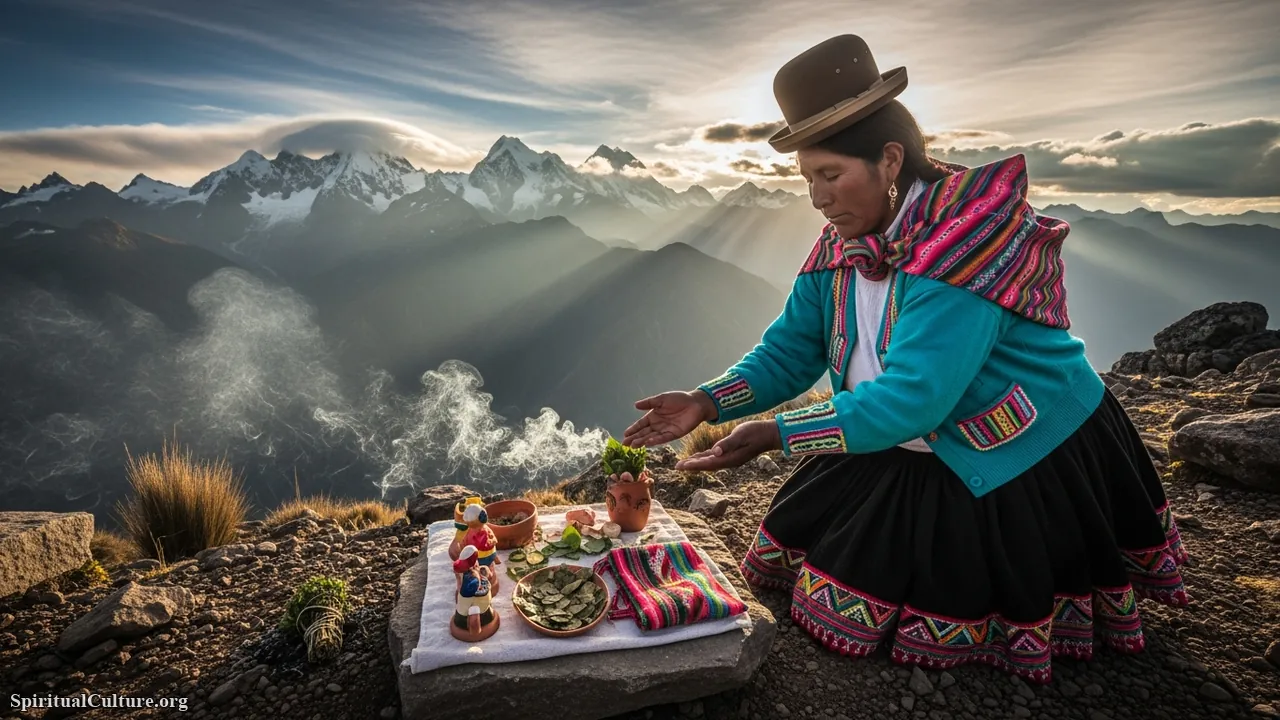
The Aymara are the great guardians of Pachamama (Mother Earth). This isn’t just a metaphor; Pachamama is a living being who provides food and life. Before drinking, an Aymara person will often spill a few drops on the ground as an offering to her. Their spirituality is practical and daily. It is about maintaining a relationship with the mountains (Apus) and the earth to ensure the crops grow and the llamas are healthy.
In a consumerist world, the Aymara philosophy of reciprocity is a radical lesson. It suggests that we cannot just take from the planet or from each other indefinitely. Life is a cycle of giving and receiving. To break that cycle is to invite disaster.
Cultural Highlights
- Wiphala: The checkerboard rainbow flag representing unity and indigenous rights.
- Coca Leaf: A sacred plant used in rituals and offering to the earth, not a drug in this context.
- Alasitas Festival: A festival of miniatures where people buy tiny versions of things they want the gods to grant them.
Top 2. The Quechua
The Quechua are the direct linguistic and cultural descendants of the Inca nobility and the commoners who built the greatest empire in the Americas. Today, millions of Quechua people span the Andes from Ecuador to Bolivia. They are the living memory of the mountains. Their culture is a stunning blend of pre-Columbian beliefs and Spanish Catholicism, creating a vibrant, unique form of worship.
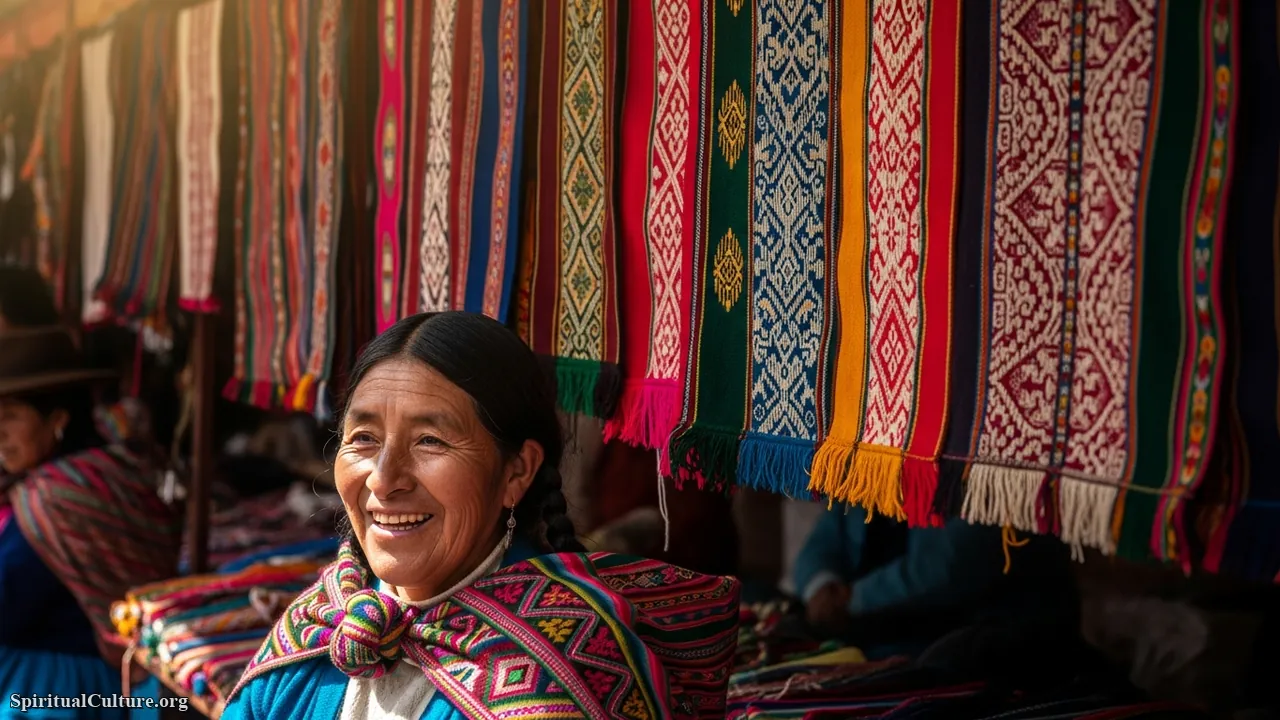
Central to Quechua life is the concept of Sumak Kawsay, or “Good Living.” This is not about accumulating wealth, but about living in harmony with one’s community and the cosmos. The Quechua see the world as pairs: sun and moon, male and female, earth and sky. Their textiles are legendary—complex codes of color and knotting that tell stories of their ancestors and their gods. Every weaving is a prayer.
The Quechua connect us to the ancient past in a tangible way. When you see a Quechua community working together to harvest potatoes or build a roof, you are watching a system of cooperation that has worked for thousands of years. They teach us that community is the ultimate survival tool.
Cultural Highlights
- Inti Raymi: The Festival of the Sun, a massive reenactment of Inca ceremonies held in Cusco.
- Runasimi: The Quechua name for their language, meaning “People’s Mouth.”
- Weaving: A highly developed art form used to record history and cultural identity.
Top 1. The Inca Civilization
It is impossible to talk about South American culture without bowing to the Inca. In less than a century, they built the largest empire in the pre-Columbian Americas, stretching along the spine of the Andes. But they were more than conquerors; they were master organizers and spiritual architects. They built Machu Picchu, a sanctuary in the clouds that still leaves modern engineers baffled, and the Qhapaq Ñan, a road system that united the continent.

The Inca believed their ruler, the Sapa Inca, was the son of Inti, the Sun God. Their society was a theocracy where labor was a form of tax and worship. They didn’t use money; they used labor and goods. They mummified their ancestors and brought them out during festivals to consult on state affairs. It was a civilization where the government, religion, and daily life were fused into one singular purpose: maintaining order in the universe.
The Inca take the top spot because their influence is foundational. They organized the spiritual geography of South America. They showed that a society could be built on the principle of collective well-being rather than individual gain. Even today, the stones they laid remain the literal and spiritual foundation of Andean culture. They remind us that we are capable of building things that last forever if we build them with purpose.
Cultural Highlights
- Machu Picchu: The iconic citadel that serves as a testament to Inca spirituality and engineering.
- Qhapaq Ñan: The 25,000-mile road network connecting the empire.
- Coricancha: The Temple of the Sun in Cusco, once covered in sheets of gold.
Conclusion
South America is often portrayed through the lens of its breathtaking landscapes, but as we have seen, the true magic lies in the people who inhabit them. From the geometric prayers of the Nazca to the vibrant resistance of the Mapuche and the imperial grandeur of the Inca, these cultures offer us a different way of seeing the world.
They teach us that we are not separate from nature, but part of it. They show us that the past is not dead; it lives on in language, in weaving, and in the spirit of the people. At Spiritual Culture, we hope this journey has inspired you to look beyond the surface. Maybe the next time you see a photo of Machu Picchu or hear the beat of a Brazilian drum, you’ll feel that deep, human connection that spans across centuries.