Bhutan’s spiritual culture is deeply shaped by Vajrayana Buddhism, especially the Drukpa Kagyu tradition, alongside Nyingma lineages and older local religious practices. Understanding Bhutan through religion and sacred heritage gives a clearer picture than treating culture only as food, tourism, or national symbols.
Religious traditions and everyday practice
Monasteries, temples, dzongs, monastic education, prayer flags, stupas, and household rituals are visible across the country. Guru Rinpoche, or Padmasambhava, is especially important in Bhutanese religious history and sacred geography.
Sacred places and religious heritage
Sites such as Paro Taktsang, Punakha Dzong, Trongsa Dzong, and numerous mountain temples connect religious practice with dramatic landscapes. Sacred valleys, cliffs, lakes, and pilgrimage routes are often linked to Buddhist masters and local protective deities.
Festivals, rituals, and community life
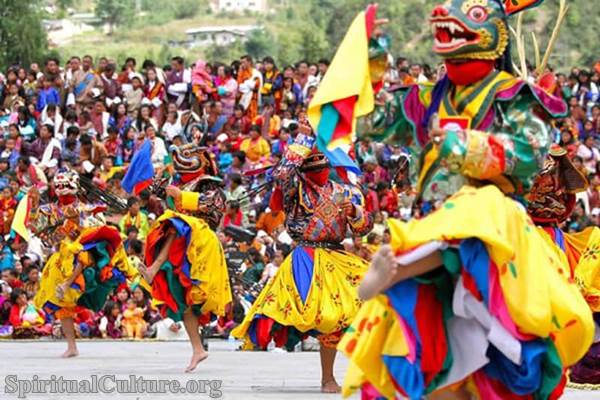
Tsechu festivals feature masked dances, ritual performances, blessings, and community gatherings. Buddhist calendar observances, household offerings, pilgrimage, and monastic ceremonies shape everyday and annual life.
Living spiritual culture
Bhutan’s spiritual culture blends institutional Buddhism with local sacred geography and community customs. It should not be reduced to tourism slogans about happiness; it is a living religious system with disciplined monastic, ritual, and household forms.
Religious diversity in context
Bhutan’s public religious culture is strongly shaped by Vajrayana Buddhism, especially the Drukpa Kagyu tradition, while Nyingma lineages and local protective-deity traditions are also important. Monasteries and monastic institutions remain highly visible, but lay households participate through offerings, pilgrimage, prayer, ritual sponsorship, and festival life. Hindu communities, especially in the south, form another significant part of Bhutan’s religious landscape.
Local traditions differ by valley, language group, and community. Mountain deities, protective rituals, ancestral customs, and Buddhist practice can overlap, so the country should not be portrayed as religiously uniform.
Festivals, pilgrimage, and sacred memory
Regional tsechu festivals feature masked dances, teachings, blessings, and large community gatherings. Monasteries, dzongs, hermitages, sacred caves, mountains, and pilgrimage sites connect Buddhist history with landscape and national memory.
Some sites are important because of their association with teachers such as Padmasambhava or later Bhutanese religious figures. Their meaning is devotional as well as historical, and respectful interpretation should recognize that they remain places of practice.
Historical change and regional variation
Bhutan’s religious culture has been shaped by Vajrayana Buddhist institutions, the Drukpa Kagyu and Nyingma traditions, monastic networks, local protective deities, and sacred geography. Modern state development and tourism have changed access and presentation, but monasteries, dzongs, pilgrimage, household ritual, and festival life remain central.
Reading Bhutan’s spiritual culture carefully
Bhutan should not be reduced to a romantic image of a uniformly Buddhist kingdom. Monastic and lay practice differ, local traditions vary by valley and community, and the country also includes Hindu and other religious populations whose experiences form part of the contemporary landscape.