Taiwan has a highly diverse spiritual culture in which Buddhist, Daoist, Chinese popular-religion, Confucian, Christian, and Indigenous traditions often exist side by side. Understanding Taiwan through religion and sacred heritage gives a clearer picture than treating culture only as food, tourism, or national symbols.
Religious traditions and everyday practice
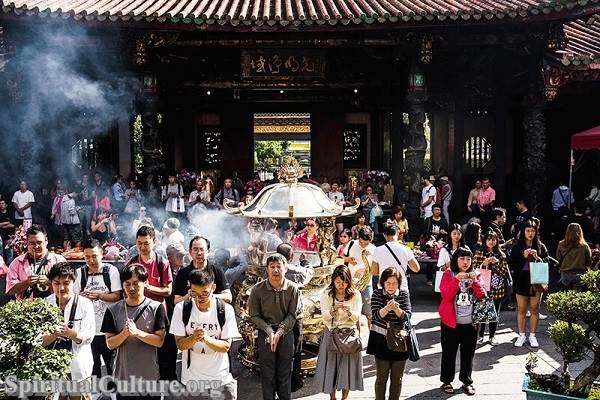
Many Taiwanese temples do not fit neatly into a single label: Buddhist, Daoist, and popular deities may be honored through overlapping ritual traditions. Mazu devotion is especially prominent, while Guanyin, local gods, ancestors, and protective deities are important in many communities.
Sacred places and religious heritage
Temples are central to Taiwan’s sacred geography. Major pilgrimage networks connect Mazu temples, Buddhist monasteries, Daoist sanctuaries, Confucian temples, and local community shrines. Indigenous Austronesian peoples maintain distinct ancestral and ceremonial traditions that should not be treated as extensions of Han Chinese religion.
Festivals, rituals, and community life
Temple processions, Mazu pilgrimages, Ghost Festival observances, Lunar New Year rites, ancestor remembrance, and Buddhist festivals all shape the ritual year. Christian churches also maintain active communities and distinctive Indigenous Christian traditions.
Living spiritual culture
Taiwan’s religious life is notable for fluid boundaries between traditions. Rather than asking which single religion defines the island, it is more accurate to study networks of temples, families, pilgrimage, ancestral memory, and modern religious organizations.
Religious diversity in context
Taiwanese religious life is notable for the interaction of Chinese popular religion, Daoist ritual, Buddhism, ancestor veneration, Confucian traditions, and local deity cults. Mazu, Wang Ye, Guanyin, and many other figures are honored through temples and pilgrimage networks, while large Buddhist organizations have developed modern educational, charitable, and global institutions. Christianity and Indigenous Austronesian religions add distinct histories and communities.
Labels such as “Buddhist,” “Daoist,” and “folk religion” do not always map neatly onto temple practice. A single temple may contain deities and rituals associated with several traditions, and households may move between specialists and institutions for different life events.
Festivals, pilgrimage, and sacred memory
Mazu pilgrimages, temple birthdays, the Ghost Festival, Lunar New Year observances, ancestor rites, Buddhist festivals, and Indigenous ceremonies create different sacred calendars. Large processions can link many towns and temples, turning pilgrimage into both religious practice and regional identity.
Taiwan’s sacred geography ranges from urban temples and mountain monasteries to Indigenous landscapes and Christian churches. Modernization has changed their settings, but ritual networks remain highly active.
Historical change and regional variation
Taiwan’s religious landscape developed through Chinese popular religion, Daoist ritual, Buddhist institutions, Confucian traditions, Indigenous Austronesian religions, Christianity, Japanese colonial influence, and modern religious organizations. Urbanization has changed temple neighborhoods, yet pilgrimage networks and local festivals remain highly active.
Reading Taiwan’s spiritual culture carefully
Temple life often crosses labels that look separate in textbooks. Mazu devotion, Guanyin worship, Daoist ritual specialists, Buddhist organizations, ancestors, and local gods may all appear within one community, while Indigenous and Christian traditions have their own distinct histories and should not be folded into Han Chinese religion.