Azerbaijan’s religious landscape combines a Muslim cultural majority with a strongly secular public sphere and long-standing Jewish, Christian, and other communities. Shia and Sunni traditions are both present, while shrines, mosques, churches, synagogues, pilgrimage customs, and local sacred heritage reflect the country’s layered history.
Azerbaijan’s spiritual heritage is shaped primarily by Islam, especially Shia and Sunni traditions, alongside a strongly secular public culture and older Jewish, Christian, and fire-temple traditions. Understanding Azerbaijan through religion and sacred heritage gives a clearer picture than treating culture only as food, tourism, or national symbols.
Religious traditions and everyday practice
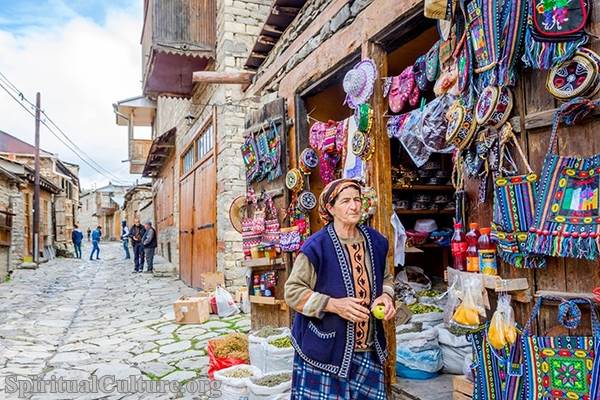
Most religiously observant Azerbaijanis identify with Islam, but everyday practice ranges widely. Shia commemorations, Sunni mosque life, Sufi memory, family customs, and pilgrimage to local sacred places all form part of the religious landscape.
Sacred places and religious heritage
Important sites include historic mosques in Baku and regional towns, the Bibi-Heybat Mosque, the Ateshgah fire-temple complex near Baku, Orthodox and Armenian Christian monuments, and the heritage of Mountain Jewish communities in the north.
Festivals, rituals, and community life
Ramadan and the Eids are part of Muslim life, while Novruz carries pre-Islamic seasonal symbolism and has become a major national tradition. Jewish and Christian communities maintain their own liturgical calendars.
Living spiritual culture
Azerbaijan’s spiritual culture reflects centuries of Persian, Turkic, Caucasian, Russian, Islamic, Christian, and Jewish interaction. Describing that diversity is more accurate than presenting the country as religiously uniform.
Religious diversity in context
Azerbaijan has a Muslim majority with both Shia and Sunni traditions, but levels of formal observance vary widely after a long history of Russian imperial and Soviet secularization. Sufi heritage, mosque life, pilgrimage, and family religious customs coexist with a strongly secular national public culture. Jewish communities, Russian Orthodox Christians, Georgian Orthodox Christians, Catholics, and other groups add further historical depth.
The country’s location between the Caucasus, Iran, Anatolia, and the Caspian world has produced layered religious influences. Pre-Islamic fire symbolism and Zoroastrian-associated heritage are culturally significant, but modern Azerbaijan should not be described as a surviving Zoroastrian society.
Festivals, pilgrimage, and sacred memory
Ramadan and Eid are observed by practicing Muslims, while Ashura has particular importance in Shia communities. Novruz is a major spring celebration with roots broader than Islam and is shared across several cultures of the region. Mosques, synagogues, churches, pilgrimage shrines, and the Ateshgah complex illustrate different layers of sacred and historical memory.
Azerbaijani spiritual culture is therefore best approached through the interaction of religion, secularism, regional identity, and heritage rather than through affiliation alone.
Historical change and regional variation
Azerbaijan’s religious culture reflects Shia and Sunni Islam, Persian and Turkic influences, Jewish and Christian communities, Russian and Soviet secularization, and post-Soviet religious revival. Historic mosques, churches, synagogues, pilgrimage places, and the Ateshgah complex preserve different layers of this history.
Reading Azerbaijan’s spiritual culture carefully
Religious identity is often cultural as well as devotional. Levels of observance vary widely, and Islamic affiliation does not erase Jewish, Christian, Sufi, or pre-Islamic heritage. Novruz, family custom, and local pilgrimage also show how national and religious traditions can overlap without being identical.